How Are AI Models Advancing Toward Superintelligence?
TL;DR
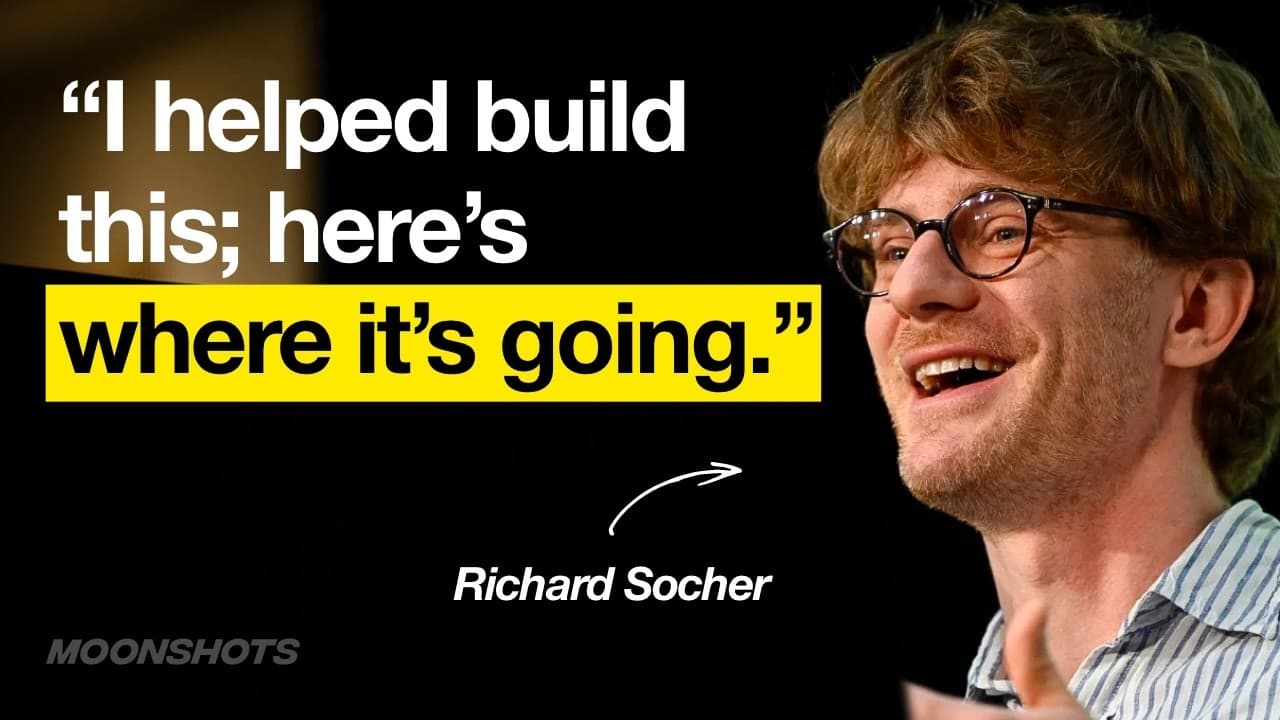
AI progress is shifting from everyday information tasks toward harder work in programming, science, research, and agentic systems. Richard Socher argues that model intelligence cannot be reduced to one benchmark or IQ score because accuracy also depends on task type, user intent, speed, and the amount of computation allowed while generating an answer.
Transcript
if you were given a couple of billion dollars you'd be able to build a digital super intelligence how quickly I think probably like year and a half to two years Richard soer Richard soer Richard soer often called the father of prompt engineering he is one of the top five most cited researchers in AI former Chief scientist at Salesforce co-founder o... Read More
Key Insights
- Grok 3 was developed after xAI raised $6 billion and built a large GPT cluster in 122 days. Richard Socher views that pace as surprising but plausible when an organization applies substantial resources to an exponential technology and executes effectively across infrastructure and model development.
- Large AI clusters depend on both hardware and software capabilities. Socher connects xAI's rapid progress to experience associated with Tesla and SpaceX, while noting that infrastructure companies such as Anyscale can simplify scaling from five GPUs to 5,000 GPUs through a few lines of code.
- Everyday information needs may already be served adequately by current models. Socher argues that most people do not routinely ask PhD-level questions, so the leading frontier is moving toward unusually difficult tasks in programming, scientific work, and research rather than ordinary knowledge retrieval.
- AI intelligence cannot be represented reliably by a single IQ score. Intelligence contains multiple dimensions, and Socher says existing measurements can break down when an AI reveals itself by answering far better or faster than a human rather than by failing to imitate one.
- The traditional Turing test is weakened by superior machine performance. Socher gives the example of requesting an application in 30 seconds: completing it identifies the system as AI, while being unable to complete it makes the respondent appear more human.
- You.com provides access to more than 40 AI models and also uses its own models fine-tuned from open-source systems. The platform classifies user intent, such as programming, history, or medical requests, then routes the query toward models receiving stronger positive feedback for that intent.
- Model popularity and performance change frequently across tasks. Socher identifies OpenAI's o1 and o3 as popular, Anthropic's Sonnet 3.5 as especially strong and popular for programming, and DeepSeek as a model that gained substantial attention quickly without a large marketing budget.
- Test-time computation can improve the accuracy of the same underlying model. Research discussed by Socher indicates that telling a model to wait and think before answering can produce better results, making response speed and available computation important dimensions of measured intelligence.
Install to Summarize YouTube Videos and Get Transcripts
Explore YouTube Video Summarizer or Get YouTube Transcript Extractor
Questions & Answers
Q: How did xAI build its large AI cluster so quickly?
Richard Socher attributes the rapid buildout to a combination of substantial funding, hardware capability, software engineering, and strong execution. The discussion says xAI raised $6 billion and created a large coherent GPT cluster in 122 days. Socher also notes that modern infrastructure tools raise the level of abstraction, making it easier to scale workloads across thousands of GPUs.
Q: Why is programming considered a major frontier for AI models?
Programming remains a demanding area where model improvements can create meaningful differences, even after everyday informational needs have become well served. Socher says most people do not have PhD-level questions in daily life, so progress is increasingly concentrated on harder tasks. He identifies programming, science, and research as major frontiers for leading AI systems.
Q: Why are AI benchmarks insufficient for comparing models?
Benchmarks capture selected capabilities, but they do not reduce intelligence to one universally meaningful score. Socher argues that intelligence has several dimensions and that most users do not ask the highly technical mathematics, science, or coding questions emphasized by frontier tests. Results also depend on response speed and how much computation a model receives before answering.
Q: How does test-time compute affect an AI model's answers?
Test-time compute gives a model more opportunity to reason before producing its response. Socher cites research showing that the same model can provide more accurate answers when instructed to wait and think first. This means a model does not have one fixed level of observable intelligence, because its performance can vary with available computation and required response speed.
Q: How does You.com choose which AI model answers a query?
You.com classifies the user's intent and routes the request according to model performance and positive feedback for that category. Socher gives programming, history, and medical requests as examples of distinct intents. The platform combines its own fine-tuned open-source models with federated access to external models, and routing preferences can change as performance and user feedback evolve.
Q: Which AI models were described as popular on You.com?
Socher says OpenAI remains difficult to ignore and identifies o1 and o3 as popular choices. Anthropic's Sonnet 3.5 is also described as highly popular and among the strongest options for programming. Grok 2 is available and popular, while DeepSeek gained considerable mind share in a short period despite having little marketing budget.
Q: Why does Richard Socher think the Turing test is broken?
The Turing test becomes less useful when an AI distinguishes itself by performing far better than a person. Socher illustrates this with a request to build an application in 30 seconds. A system that succeeds is clearly identified as AI, while failure appears human, so superior capability can cause the machine to fail an imitation-based test.
Q: Why might open-source AI still require substantial computing resources?
Socher suggests that the smartest answers may require considerable computation during inference, not only during model training. Because giving a model more time and test-time compute can improve accuracy, possessing open model weights may not be enough to obtain the best possible performance cheaply. Significant computing capacity could therefore remain necessary even when the underlying model is openly available.
Summary & Key Takeaways
-
Grok 3 illustrates how quickly a well-funded team can build and coordinate a very large AI computing cluster. Richard Socher attributes the achievement to combining hardware expertise, software systems, substantial resources, and increasingly accessible infrastructure that lets developers scale workloads from a few GPUs to thousands with less operational complexity.
-
Model comparisons are difficult because users have different needs and models excel at different tasks. You.com provides access to more than 40 models, classifies requests by intent, and routes them accordingly. OpenAI models, Anthropic's Sonnet 3.5, and DeepSeek are discussed as popular choices, especially for reasoning and programming.
-
AI evaluation is becoming multidimensional. Traditional IQ scores, the Turing test, and static benchmarks cannot fully represent model capability because performance varies with task, response time, and test-time computation. Asking a model to wait and think can improve accuracy, suggesting intelligence should be assessed across several dimensions instead of one number.
Read in Other Languages (beta)
Share This Summary 📚
Summarize YouTube Videos and Get Video Transcripts with 1-Click
Try YouTube Summary with ChatGPT & Claude or YouTube Transcript Generator
Explore More Summaries from Peter H. Diamandis 📚






Summarize YouTube Videos and Get Video Transcripts with 1-Click
Try YouTube Summary with ChatGPT & Claude or YouTube Transcript Generator