What Did Obama Say About the Israel-Hamas War and Its “Moral Reckoning”? | Full Speech
TL;DR
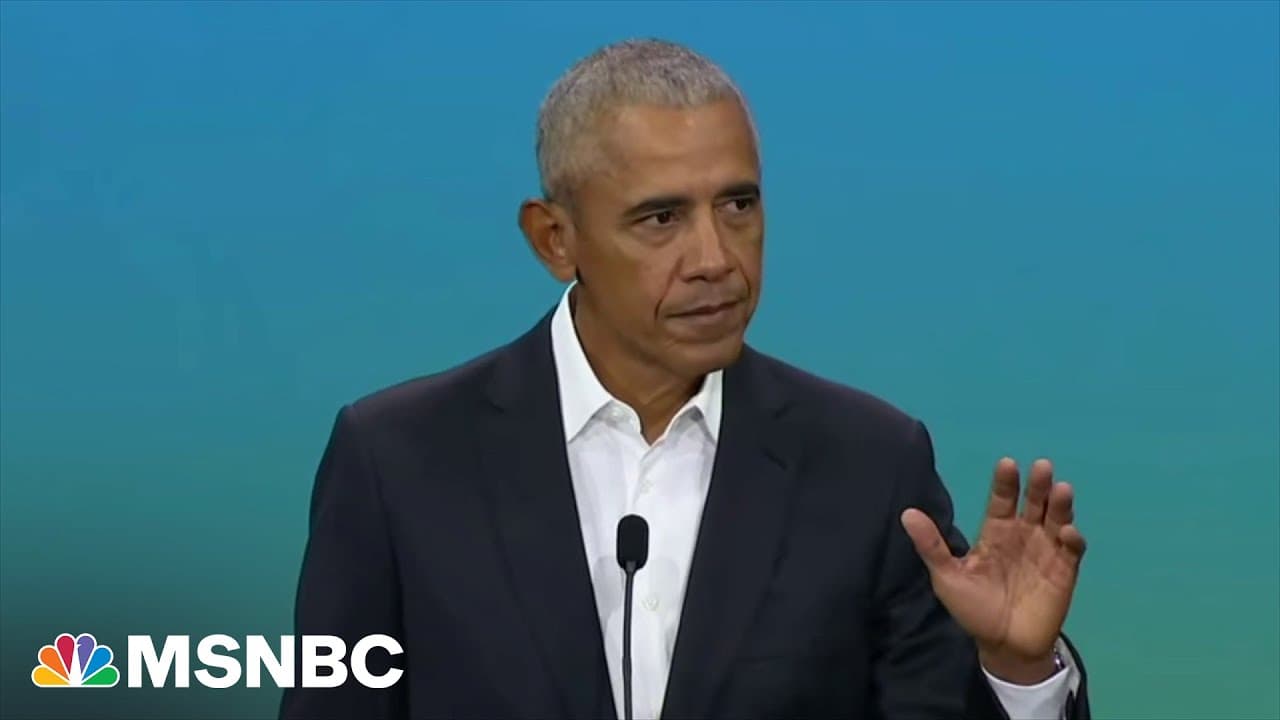
Barack Obama says the Israel-Hamas war forces a moral reckoning because Israeli and Palestinian families are enduring devastating violence while decades of peace efforts have failed. He calls for an end to the killing and peaceful coexistence between two sovereign, free peoples, grounded in Israeli security and Palestinian self-determination. Read on for his account of the crisis, its wider social impact, and the democratic values he believes can guide a response.
Transcript
hello everybody have a seat have a seat hello Chicago thank you Alina for that outstanding introduction uh I I will say that Michelle would be jealous to see that she has a six-month-old at home and she doesn't look tired uh and more importantly thank you for everything that you're doing to connect people with jobs and reduce inequality in the city... Read More
Key Insights
- 🌍 The world feels more unstable and dangerous than ever, with issues such as Russia's invasion of Ukraine, record-breaking temperatures, political polarization, and the Israeli-Palestinian conflict. The world needs a new generation of leaders to drive change.
- 🔑 Despite the challenges, it is within the power of young leaders to make the world a better place by bridging differences, maintaining democratic values, and working towards common goals.
- 📈 Capitalism has been a significant driver of wealth and innovation, but it has also led to inequality, exploitation, and environmental degradation. In order to create a more just and sustainable economy, a shift in mindset and economic frameworks is required.
- 💼 Workers' rights and the labor movement are essential for achieving higher wages, better working conditions, and a more equitable society. Reversing the decline in unionization and adapting to new workforce needs are crucial steps.
- 🌐 Global cooperation is necessary to enforce tax and regulatory standards across borders. A race to the bottom in terms of business-friendly environments and the shifting of operations can harm workers and communities.
- 🌱 The social safety net needs to be adapted to new economic realities, including portable benefits and innovative solutions like shorter workweeks or universal basic income. Financial stability and support can lead to improved well-being and productivity.
- 🌐 International trade policies should be reimagined to prioritize the needs of the poorest countries, while encouraging sustainable practices and balancing economic growth with social goals.
- 💼 Corporations should consider their impact beyond shareholder value and work towards the common good. New corporate structures, such as worker-owned companies and purpose-driven public benefit corporations, can facilitate this shift.
- 🗝 Achieving these changes requires not only innovative policymaking and political strategies but also a broader shift in values. The material measures of progress should not overshadow the importance of holistic well-being and human flourishing.
Install to Summarize YouTube Videos and Get Transcripts
Explore YouTube Video Summarizer or Get YouTube Transcript Extractor
Questions & Answers
Q: What did Obama say about the Israel-Hamas war and its “moral reckoning”?
Obama said the images of mourning families and bodies being pulled from rubble make it impossible to remain dispassionate and force a moral reckoning on everyone. He described the news as heartbreaking but maintained that people can bridge differences, listen to one another, and make better choices.
Q: What outcome did Obama advocate for Israelis and Palestinians?
Obama advocated for an end to the killing and peaceful coexistence between two sovereign and free peoples. He said a durable peace must include genuine security for Israel, recognition of its right to exist, an end to the occupation, and a viable state and self-determination for Palestinians.
Q: What figures did Obama cite about the Israel-Hamas war?
Obama said the conflict was triggered by Hamas’s murder of more than 1,400 mostly civilian Israelis and the abduction of over 200 hostages. He also said Israel’s response had displaced well over a million people and killed at least 9,000 Palestinian civilians, including thousands of children.
Q: What humanitarian concerns did Obama raise about Gaza?
Obama warned that water, food, and electricity had been cut off from a captive population. He said these conditions risked creating an even greater humanitarian crisis.
Q: How did Obama describe the war’s effect on public debate and communities?
Obama said the debate had roiled college campuses, divided friends and allies, and exposed generational divides. He also pointed to a surge in anti-Semitism and anti-Muslim sentiment and acknowledged disagreements within the Obama Foundation family.
Q: Where did Obama say disagreements about the conflict remained?
Obama said the disagreement was not primarily about the desired outcome, which he described as ending the killing and achieving peaceful coexistence. Instead, people differed over the path to that outcome and the roles each person should play in maximizing its chances.
Q: What role did Obama assign to democracy in confronting global crises?
Obama argued that renewed commitment to democracy is a key ingredient in solving major challenges. He described democratic systems as ones where dignity, the rule of law, human rights, public voice, and a shared stake in social order are respected.
Q: What other global challenges did Obama discuss in the speech?
Obama cited Russia’s invasion of Ukraine, record-breaking temperatures, drought, flooding, wildfires, attacks on democratic norms, political polarization, and misinformation on social media. He said war, religious conflict, poverty, hunger, racial division, and catastrophic climate change are not inevitable.
Summary & Key Takeaways
-
Former President Barack Obama emphasizes the need for a renewed commitment to democracy in order to address the world's pressing challenges, such as climate change, economic inequality, and social divisions.
-
He discusses the importance of supporting workers' rights and unionization to ensure fair wages and working conditions for all.
-
Obama highlights the need to adapt the social safety net to new economic realities, such as automation and changing job markets, and proposes exploring concepts like shorter work weeks and universal basic income.
-
He calls for international cooperation to enforce tax and regulatory standards across borders and to address issues like trade imbalances and climate change.
-
Obama advocates for reimagining corporate governance to prioritize the common good alongside profit, including the consideration of impact investing and purpose-driven business models.
Read in Other Languages (beta)
Share This Summary 📚
Summarize YouTube Videos and Get Video Transcripts with 1-Click
Try YouTube Summary with ChatGPT & Claude or YouTube Transcript Generator
Explore More Summaries from MSNBC 📚
Summarize YouTube Videos and Get Video Transcripts with 1-Click
Try YouTube Summary with ChatGPT & Claude or YouTube Transcript Generator