How to Train GPT-3 with Legal Data for Analysis
TL;DR
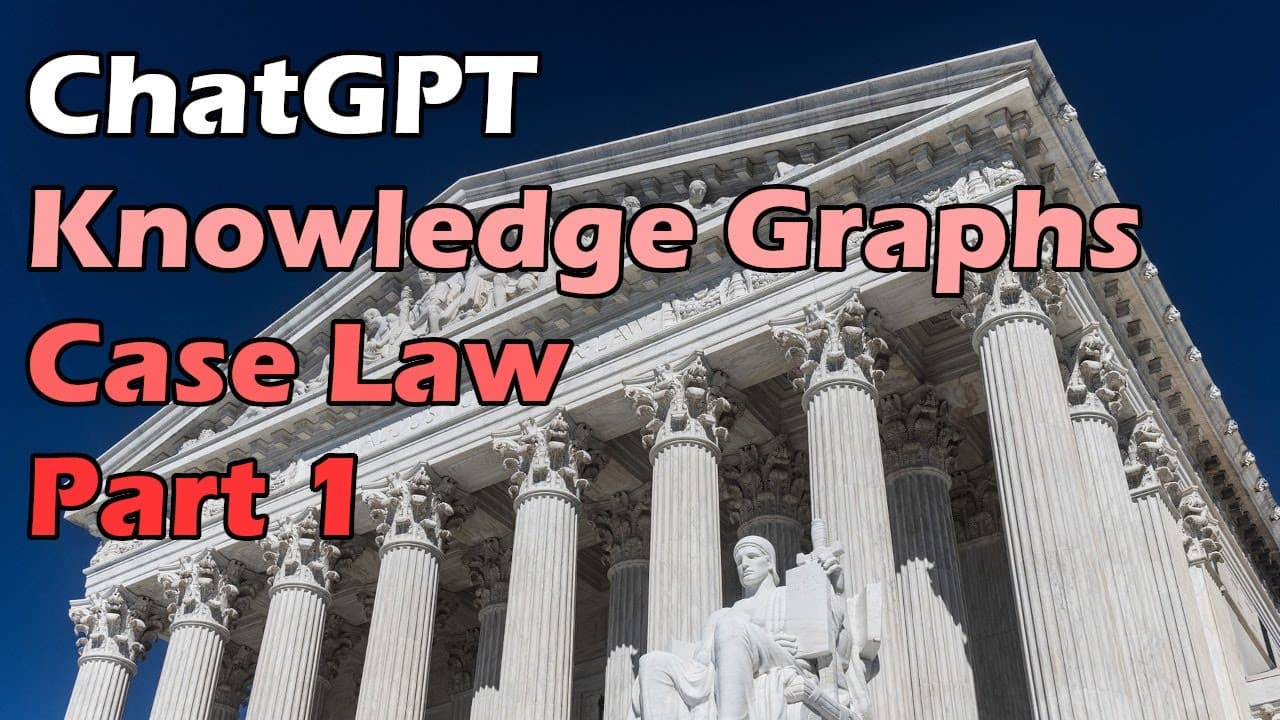
To train GPT-3 for legal data analysis, create a Knowledge Graph using JSON-LD to contextualize Supreme Court opinions. This enables efficient analysis of case law, particularly for antitrust matters, by structuring legal concepts and their interrelations. Fine-tuning alone isn't sufficient, as external databases enhance the model's understanding and capabilities.
Transcript
hey everybody David Shapiro here uh back after a Hiatus um I've got a lot going on you'll be excited for some news coming up um first I want to address um a big elephant in the room I just put most of my videos back online um this comes after of course making a recent video explaining why I took them down um I did leave some of my videos down some ... Read More
Key Insights
- ⁉️ Fine-tuning AI models like GPT-3 for question answering has limitations, and utilizing external databases or knowledge bases is essential to enhance their capabilities.
- 💁 Converting Supreme Court opinions into a machine-readable format, such as text or JSON-LD, enables efficient analysis and retrieval of legal information.
- ❓ Knowledge Graphs offer a powerful approach for representing and organizing interconnected legal concepts and relationships.
- 👻 JSON-LD is a suitable format for building a Knowledge Graph as it allows for easy querying, visualization, and editing of the graph structure.
- 🍉 Large amounts of legal text data pose challenges in terms of data preparation, storage, and computational limitations.
- 💁 The token limit of language models like GPT-3 restricts the amount of information that can be processed, necessitating techniques such as summarization and chunking.
- 🏛️ Building a comprehensive Knowledge Graph for legal precedent analysis requires expertise in data preparation, graph representation, and visualization.
Install to Summarize YouTube Videos and Get Transcripts
Explore YouTube Video Summarizer or Get YouTube Transcript Extractor
Questions & Answers
Q: How does fine-tuning work for training question answering bots?
Fine-tuning does not involve teaching the model new knowledge but rather focuses on teaching it patterns. For example, in the case of a chatbot, the pattern is asking a question and receiving a response. Fine-tuning helps the model learn the structure and context of the conversation.
Q: Why is connecting GPT-3 to external data sources challenging?
GPT-3 operates as a "mind in a bottle" and lacks direct contact with external data sources. Connecting the model to external databases or vast amounts of text data is complex due to technical limitations, cost, and accessibility constraints.
Q: What is the significance of case law in the American legal system?
Case law, specifically Supreme Court decisions, plays a crucial role in establishing legal precedent in the American common law system. Understanding case law is essential to comprehending the American legal system and its application in various legal fields.
Q: How can a Knowledge Graph aid trial lawyers in legal precedent analysis?
A Knowledge Graph can serve as a research tool for trial lawyers by providing a searchable database of legal precedents. By representing interconnected legal concepts and relationships, the Knowledge Graph enables lawyers to navigate and analyze relevant case law effectively.
Summary & Key Takeaways
-
The video discusses the process of building a Knowledge Graph for analyzing legal precedents, specifically focusing on antitrust law in the American legal system.
-
It highlights the limitations of fine-tuning AI models like GPT-3 for question answering and proposes using external databases or knowledge bases.
-
The content explores converting Supreme Court opinions into a machine-readable format and the challenges of working with large amounts of text data.
-
The video introduces the concept of a Knowledge Graph and suggests using JSON-LD as a format for representing interconnected legal concepts and relationships.
Read in Other Languages (beta)
Share This Summary 📚
Summarize YouTube Videos and Get Video Transcripts with 1-Click
Try YouTube Summary with ChatGPT & Claude or YouTube Transcript Generator
Explore More Summaries from David Shapiro 📚
![Claude 3 Review - LLMs are finally good at fiction and prose! [Cyberpunk Fanfic] thumbnail](/_next/image?url=https%3A%2F%2Fi.ytimg.com%2Fvi%2F3anercD5sLA%2Fhqdefault.jpg&w=750&q=75)


Summarize YouTube Videos and Get Video Transcripts with 1-Click
Try YouTube Summary with ChatGPT & Claude or YouTube Transcript Generator