How to Build AI Skills Employees Keep Using
TL;DR
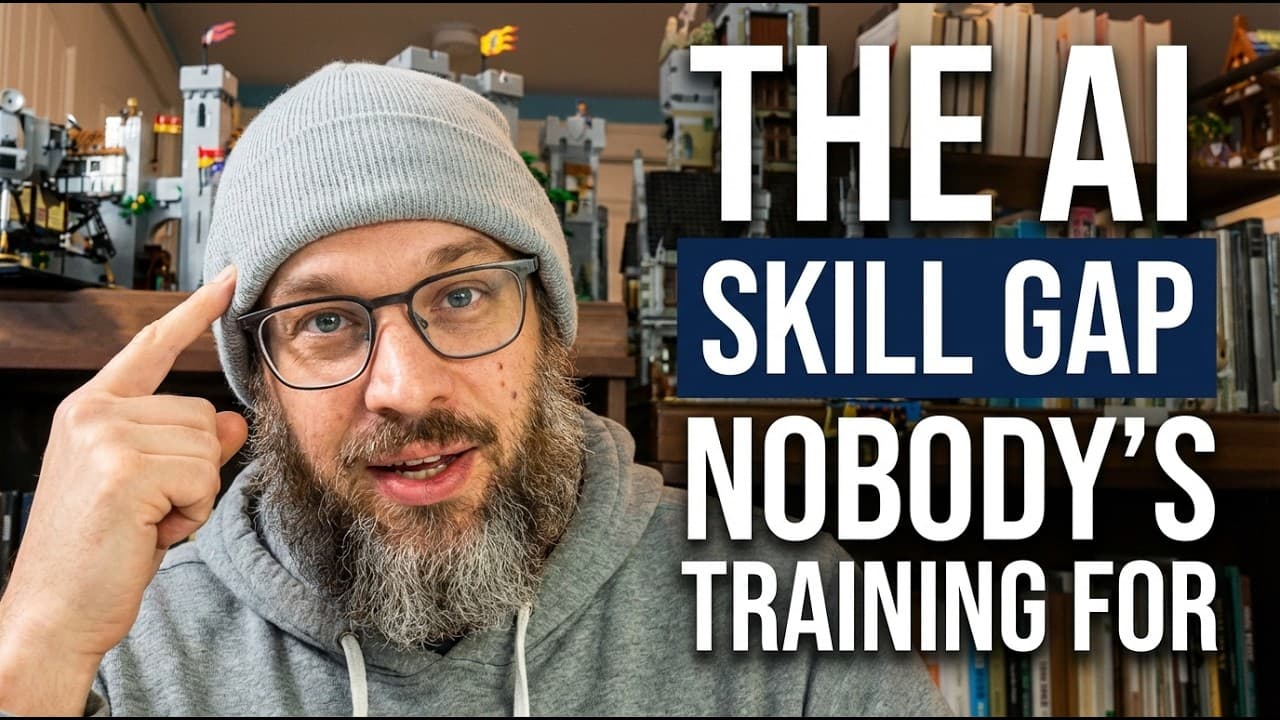
Treat AI as a capable but inexperienced collaborator that requires clear context, task division, review, and feedback. Basic prompting lessons often fail because sustained adoption depends on management skills, domain judgment, and verification. Organizations should let experts map AI’s uneven capability boundaries, then create guardrails and repeatable workflows that help other employees use it safely.
Transcript
Toward the very end of 2025, a study happened that we didn't pay attention to. Microsoft tracked 300,000 employees using AI C-Pilot. Excitement peaked for the first three weeks. Then there was a crater of disappointment. For those of you in the audience, that wasn't just because of Copilot, and we'll get into that. And then most people just quietly... Read More
Key Insights
- AI adoption is an organizational capability problem because access and introductory training do not teach employees how to integrate AI into real workflows, judge its output, or decide when verification is necessary. Sustainable use requires a judgment layer between basic prompting and technical implementation.
- The missing middle is applied AI judgment, where employees determine which parts of a task AI should perform, which parts require human ownership, and how the combined output should be evaluated. This level contains much of the practical productivity opportunity for ordinary knowledge workers.
- Effective AI use is a management skill because users must decompose work, communicate expectations, provide context, review results, and offer corrective feedback. Treating AI like a capable but inexperienced collaborator creates a more realistic operating model than expecting a single request to produce finished work.
- AI’s capability frontier is jagged because strong performance on one task does not guarantee strong performance on another seemingly similar task. In the cited BCG and Harvard study, consultants working outside that frontier were 19 percentage points less likely to reach correct answers than people working without AI.
- Experts are frontier mappers who can identify where AI performs reliably within their domains, define guardrails, and create verification protocols. Their organizational value extends beyond personal productivity because they can establish safe conditions that enable less experienced users to gain benefits without repeating avoidable failures.
- Centaur workflows are divided arrangements in which humans and AI have distinct responsibilities, such as a human framing strategy while AI generates options. This pattern is suited to high-stakes work requiring clear accountability, explicit review checkpoints, and substantial human judgment.
- Cyborg workflows are deeply integrated arrangements in which people interact continuously with AI and refine work through repeated exchanges. This fluid pattern is suited to creative, iterative, and building-oriented tasks where ongoing adjustment can improve the resulting output.
- Context assembly is the skill of selecting the right background, sources, constraints, and examples for an AI task. Providing almost no context or indiscriminately supplying entire documents can produce mediocre results because output quality depends heavily on the relevance and quality of the information supplied.
Install to Summarize YouTube Videos and Get Transcripts
Explore YouTube Video Summarizer or Get YouTube Transcript Extractor
Questions & Answers
Q: Why do employees stop using AI after initial training?
Employees often stop because introductory training shows tool features and prompting basics without teaching workflow integration or quality judgment. They ask AI for broad help, receive generic or confidently incorrect material, try several times, and decide manual work is faster. The underlying problem is not simply access or motivation. Employees lack a practical framework for supplying context, dividing tasks, evaluating results, and verifying claims.
Q: What skills make employees effective AI users?
Effective AI users apply skills associated with good managers and teachers. They break complex assignments into manageable pieces, explain the objective, provide relevant background and constraints, define what good output looks like, review the work, and give corrective feedback. They also know which task types AI handles well, when human judgment must remain primary, and how much verification each result requires before it can be used.
Q: What is the missing middle in enterprise AI training?
The missing middle is the applied judgment layer between introductory tool instruction and advanced technical implementation. Introductory programs cover features, prompts, and generic use cases, while advanced programs cover APIs, retrieval architectures, fine-tuning, and other builder concerns. Most employees instead need guidance on where AI fits within their workflows, how to divide responsibilities, how to assess output quality, and when results are trustworthy enough to use.
Q: Why is AI adoption considered a management problem?
AI adoption is a management problem because useful results require more than issuing a prompt. A user must assign work thoughtfully, provide sufficient context, specify expectations, monitor quality, and request revisions. These activities resemble managing a capable but inexperienced colleague. Organizations that categorize AI solely as a technology tool can overlook the leadership, teaching, task decomposition, and review abilities that support reliable use over time.
Q: What is AI’s jagged capability frontier?
AI’s jagged capability frontier is the uneven boundary between tasks it handles well and tasks where it can reduce accuracy. A person may see strong performance on one report or analysis and incorrectly assume similar tasks are equally suitable. The cited BCG and Harvard research found gains inside the frontier, but consultants outside it were 19 percentage points less likely to reach correct answers than people completing the work without AI.
Q: How should experts support broader AI adoption?
Experts should map where AI succeeds and fails within their own domains, then convert that knowledge into guardrails, verification protocols, and repeatable workflows. Their role is not limited to pursuing more advanced personal use. By documenting task boundaries, review requirements, and safe operating practices, they can help non-experts work productively within the capability frontier while reducing the risk of unnoticed errors and declining work quality.
Q: When should teams use a centaur AI workflow?
Teams should use a centaur workflow when human and AI responsibilities need to remain clearly separated. The human might frame the strategy, retain accountability, and verify key decisions, while AI generates options or drafts defined components. This arrangement works well for high-stakes contexts such as legal or medical work because it creates explicit ownership and review checkpoints instead of allowing responsibility to become unclear during continuous interaction.
Q: When should teams use a cyborg AI workflow?
Teams should use a cyborg workflow for creative, iterative, or building-oriented work where continuous interaction and refinement improve the result. Human and AI contributions remain fluid rather than being divided into fixed stages. The important skill is not choosing cyborg mode for every assignment, but recognizing when fluid collaboration fits the task and switching to a more clearly divided centaur pattern when accountability or verification demands increase.
Summary & Key Takeaways
-
Enterprise AI adoption often falls after initial enthusiasm because employees receive generic or incorrect results and conclude that doing the work themselves is faster. Basic tool tours and advanced technical training leave a missing middle: employees need applied judgment about workflow fit, task allocation, context, output quality, and verification.
-
Effective AI users manage the system like a capable but inexperienced collaborator. They break assignments into parts, define what good work looks like, supply relevant background and constraints, review results, and provide feedback. These abilities resemble established management and teaching skills more than isolated prompting techniques or technical implementation knowledge.
-
Organizations should ask domain experts and advanced adopters to map AI’s jagged capability frontier, establish guardrails, and design verification protocols. Employees can then choose between centaur workflows with distinct human and AI responsibilities, or cyborg workflows with continuous interaction, based on accountability, risk, creativity, and iteration needs.
Read in Other Languages (beta)
Share This Summary 📚
Summarize YouTube Videos and Get Video Transcripts with 1-Click
Try YouTube Summary with ChatGPT & Claude or YouTube Transcript Generator
Explore More Summaries from AI News & Strategy Daily | Nate B Jones 📚






Summarize YouTube Videos and Get Video Transcripts with 1-Click
Try YouTube Summary with ChatGPT & Claude or YouTube Transcript Generator