This AI Creates Beautiful Time Lapse Videos ☀️
TL;DR
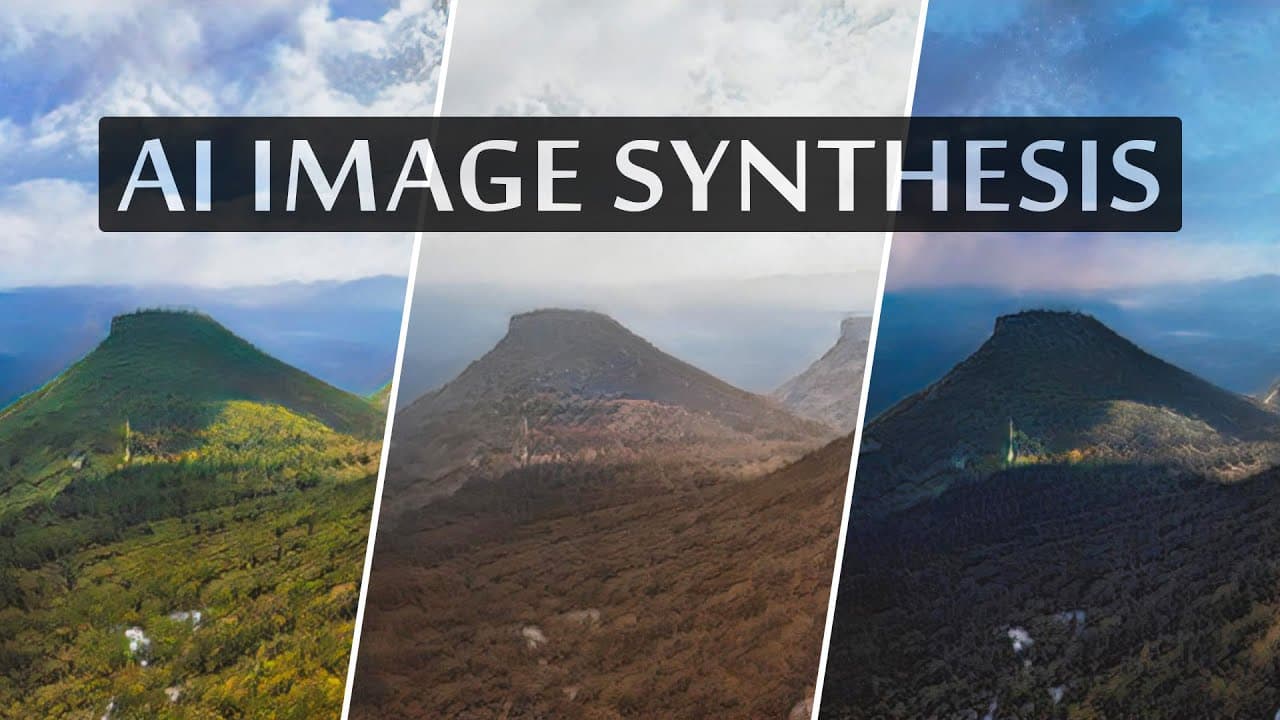
This AI creates beautiful time-lapse videos by translating landscape photos into different times of day and generating smooth transitions between them. Trained without labels on 20 thousand landscape images, the method uses a novel upsampling scheme to preserve detail and can also perform style transfer. Read on to see how it improves upon CycleGAN and learns without manually categorized images.
Transcript
Dear Fellow Scholars, this is Two Minute Papers with Dr. Károly Zsolnai-Fehér. A few years ago, we have mainly seen neural network-based techniques being used for image classification. This means that they were able to recognize objects, for instance, animals and traffic signs in images. But today, with the incredible pace of machine learning resea... Read More
Key Insights
- ❓ Neural networks have transitioned from image classification to image synthesis and translation.
- 🌸 The CycleGAN technique introduced the concept of cycle consistency loss for better image translation.
- ❓ The advanced image translation technique focuses on daytime reimagining of landscape images.
- 🎚️ The technique employs a novel upsampling scheme to enhance the level of detail in the translated images.
- 🥳 It can create smooth timelapse videos with seamless transitions between different times of the day.
- 🎭 The neural network learns to perform the translation task without explicitly labeled data.
- 👻 The technique's generality allows for other related tasks, such as style transfer.
Install to Summarize YouTube Videos and Get Transcripts
Explore YouTube Video Summarizer or Get YouTube Transcript Extractor
Questions & Answers
Q: How does this AI create beautiful time-lapse videos?
The AI reimagines landscape photos as though they were taken at different times of day. Rather than producing only separate images a few hours apart, it creates smooth transitions between them to form time-lapse videos.
Q: What is new about this daytime image translation technique?
The method proposes a novel upsampling scheme that helps generate highly detailed output images. It can also create smooth time-lapse transitions and learn the translation task from landscape images without labels.
Q: How is the AI trained without labeled images?
Training involves feeding 20 thousand landscape images into the neural network without marking which ones depict daytime or other conditions. The algorithm learns the translation task on its own, eliminating the need to search for and manually categorize the images.
Q: How does CycleGAN improve image translation?
CycleGAN introduced a cycle consistency loss function. If it converts a summer image into a winter image and then back into summer, the final result should be the same as, or very similar to, the original input, which significantly improves translation quality.
Q: What changes can the AI make to landscape photos?
The AI can reimagine an input landscape photo at different times of day. Its synthesized results include effects such as clouds forming and moving over time and a night sky containing stars.
Q: Can this image translation method perform style transfer?
Yes. Beyond changing the apparent time of day, the method can reimagine pictures in the style of famous artists, demonstrating that it can be reused for related image translation tasks.
Q: Why is label-free training useful for this technique?
Label-free training removes the need to identify daytime images and explicitly tell the learner which images belong to that category. It also makes the system easier to use because substantially more training data can be supplied without correctly labeling every image.
Q: What objectives does the image translation paper minimize?
The paper tries to minimize 7 things at the same time. The transcript presents this multi-objective setup as part of a capable technique that can compete with other work in the field while learning without labels.
Summary & Key Takeaways
-
Neural network-based techniques have evolved from image classification to image synthesis and translation.
-
The CycleGAN technique, introduced with a cycle consistency loss function, allows for image translation between different categories, such as transforming apples into oranges.
-
This paper presents a more advanced image translation technique that focuses on reimagining landscape images to appear as if they were taken at different times of the day, with a focus on achieving high levels of detail.
Read in Other Languages (beta)
Share This Summary 📚
Summarize YouTube Videos and Get Video Transcripts with 1-Click
Try YouTube Summary with ChatGPT & Claude or YouTube Transcript Generator
Explore More Summaries from Two Minute Papers 📚


Summarize YouTube Videos and Get Video Transcripts with 1-Click
Try YouTube Summary with ChatGPT & Claude or YouTube Transcript Generator