Products
Features
YouTube Video Summarizer
Summarize YouTube videos
Web & PDF Highlighter
Highlight web pages & PDFs
Chat with PDF
Ask any PDF questions with AI
Ask AI Clone
Chat with your highlights & memories
Audio Transcriber
Transcribe audio files to text
Glasp Reader
Read and highlight articles
Kindle Highlight Export
Export your Kindle highlights
Idea Hatch
Hatch ideas from your highlights
Integrations
Obsidian Plugin
Notion Integration
Pocket Integration
Instapaper Integration
Medium Integration
Readwise Integration
Snipd Integration
Hypothesis Integration
Apps & Extensions
Chrome Extension
Safari Extension
Edge Add-ons
Firefox Add-ons
iOS App
Android App
Discover
Discover
Ideas
Discover new ideas and insights
Articles
Curated articles and insights
Books
Book recommendations by great minds
Posts
Essays and notes from readers
Quotes
Inspiring quotes collection
Videos
Curated videos and summaries
Explore Glasp
Glasp Newsletter
Weekly insights and updates
Glasp Talk
Interview series with great minds
Glasp Blog
Latest news and articles
Glasp Use Cases
Learn how others use Glasp
Build & Support
Glasp API
Access Glasp's API for developers
MCP Connector
Connect Glasp to Claude & ChatGPT
Community
Glasp Reddit Community
Students
Student discount and benefits
FAQs
Frequently Asked Questions
AboutPricing
DashboardLog inSign up

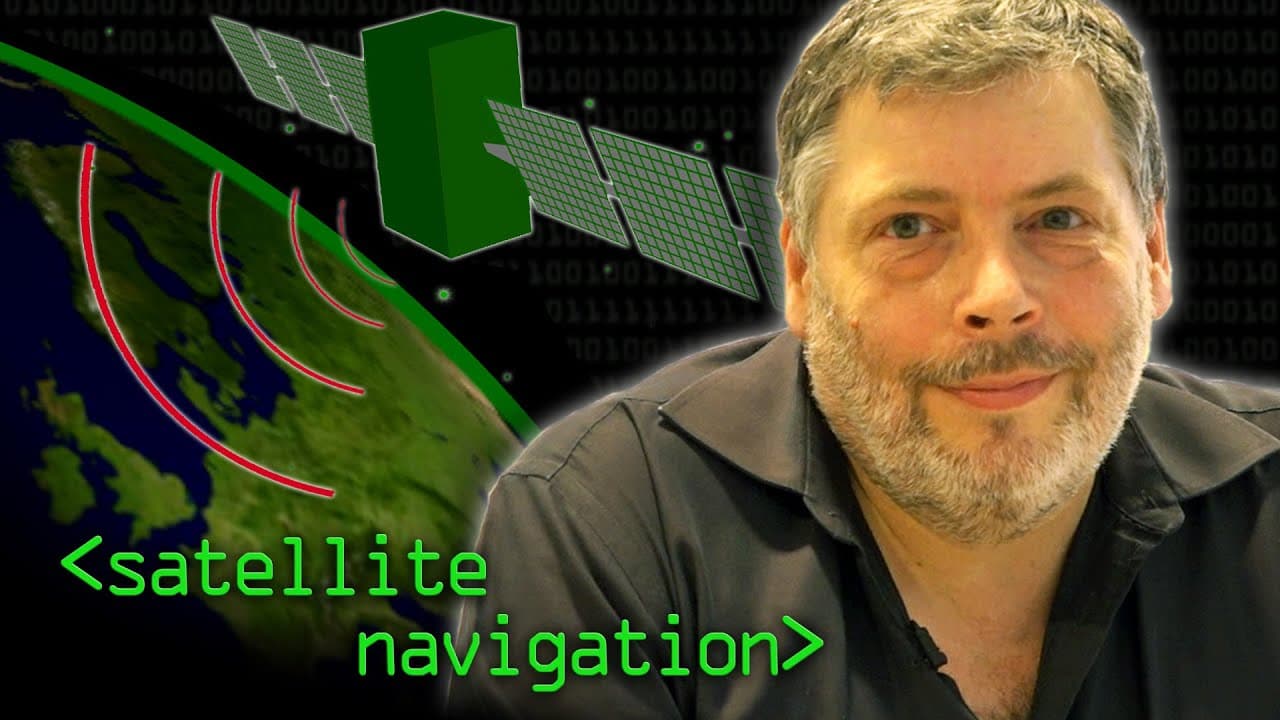
Satellite Navigation - Computerphile

September 21, 2016
by
Computerphile
YouTube video player
Satellite Navigation - Computerphile

TL;DR

Satellite navigation uses signals from satellites to determine an accurate position and time on Earth.

Transcript

Steve: Phones are the the main way that people access satellite navigation data nowadays. We have all sorts of other receivers but this is what we'll tend to have and so that's the illustration I'm going to be using today. Brady: There are satellites up there your phone works out where's one and it goes "how far am I from it." Is it something like ... Read More

Key Insights

  • 🛰️ Phones are commonly used to access satellite navigation data.
  • 🛰️ Satellites broadcast time signals and information about their health and orbit.
  • 📞 Receivers calculate their precise position by receiving signals from multiple satellites.
  • 📡 The timing accuracy of satellite signals can be enhanced by syncing them with atomic clocks.
  • 🛰️ Satellite navigation provides nanosecond precision timing to receivers.
  • 🛰️ Space is not completely empty and external influences can affect satellite orbits.
  • 🐎 Satellites travel at a speed of about seven kilometers per second.

Install to Summarize YouTube Videos and Get Transcripts

Explore YouTube Video Summarizer or Get YouTube Transcript Extractor

Questions & Answers

Q: How does satellite navigation work?

Satellite navigation works by picking up signals from multiple satellites and using the time information to calculate the receiver's precise position on Earth.

Q: What information do satellites broadcast?

Satellites primarily broadcast time signals and also provide information about their health, orbit, and other satellites in the constellation.

Q: How is the timing accuracy of satellite signals improved?

The timing accuracy of satellite signals is improved by comparing the satellite clock with a more accurate atomic clock on the ground and relaying the information to the receiver.

Q: Can satellite navigation keep up with fast-moving objects?

Yes, satellite navigation refreshes its information several times per second, even for fast-moving objects like jet fighters or vehicles on a motorway.

Summary & Key Takeaways

  • Satellite navigation relies on a network of satellites that broadcast time signals and other information to receivers on Earth.

  • By receiving signals from multiple satellites, receivers can calculate their precise position on Earth.

  • The timing accuracy of satellite signals can be enhanced by syncing them with atomic clocks.


Read in Other Languages (beta)

English

Share This Summary 📚

Summarize YouTube Videos and Get Video Transcripts with 1-Click

Download browser extensions on:

Try YouTube Summary with ChatGPT & Claude or YouTube Transcript Generator

Explore More Summaries from Computerphile 📚

Error Detection and Flipping the Bits - Computerphile thumbnail
Error Detection and Flipping the Bits - Computerphile
Computerphile
Stable Diffusion in Code (AI Image Generation) - Computerphile thumbnail
Stable Diffusion in Code (AI Image Generation) - Computerphile
Computerphile
The Problem with Time & Timezones - Computerphile thumbnail
The Problem with Time & Timezones - Computerphile
Computerphile
SLAM Robot Mapping - Computerphile thumbnail
SLAM Robot Mapping - Computerphile
Computerphile
Man in the Middle Attacks & Superfish - Computerphile thumbnail
Man in the Middle Attacks & Superfish - Computerphile
Computerphile
Bit Blit Algorithm (Amiga Blitter Chip) - Computerphile thumbnail
Bit Blit Algorithm (Amiga Blitter Chip) - Computerphile
Computerphile

Summarize YouTube Videos and Get Video Transcripts with 1-Click

Download browser extensions on:

Try YouTube Summary with ChatGPT & Claude or YouTube Transcript Generator

Apps & Extensions

  • Chrome Extension
  • Safari Extension
  • Edge Add-ons
  • Firefox Add-ons
  • iOS App
  • Android App

Key Features

  • YouTube Video Summarizer
  • Web & PDF Summarizer
  • Web & PDF Highlighter
  • Chat with PDF
  • Ask AI Clone
  • Audio Transcriber
  • Glasp Reader
  • Kindle Highlight Export
  • Idea Hatch

Integrations

  • Obsidian Plugin
  • Notion Integration
  • Pocket Integration
  • Instapaper Integration
  • Medium Integration
  • Readwise Integration
  • Snipd Integration
  • Hypothesis Integration

More Features

  • APIs
  • MCP Connector
  • Blog & Post
  • Embed Links
  • Image Highlight
  • Personality Test
  • Quote Shots

Company

  • About us
  • Blog
  • Community
  • FAQs
  • Job Board
  • Newsletter
  • Pricing
Terms

•

Privacy

•

Guidelines

© 2026 Glasp Inc. All rights reserved.