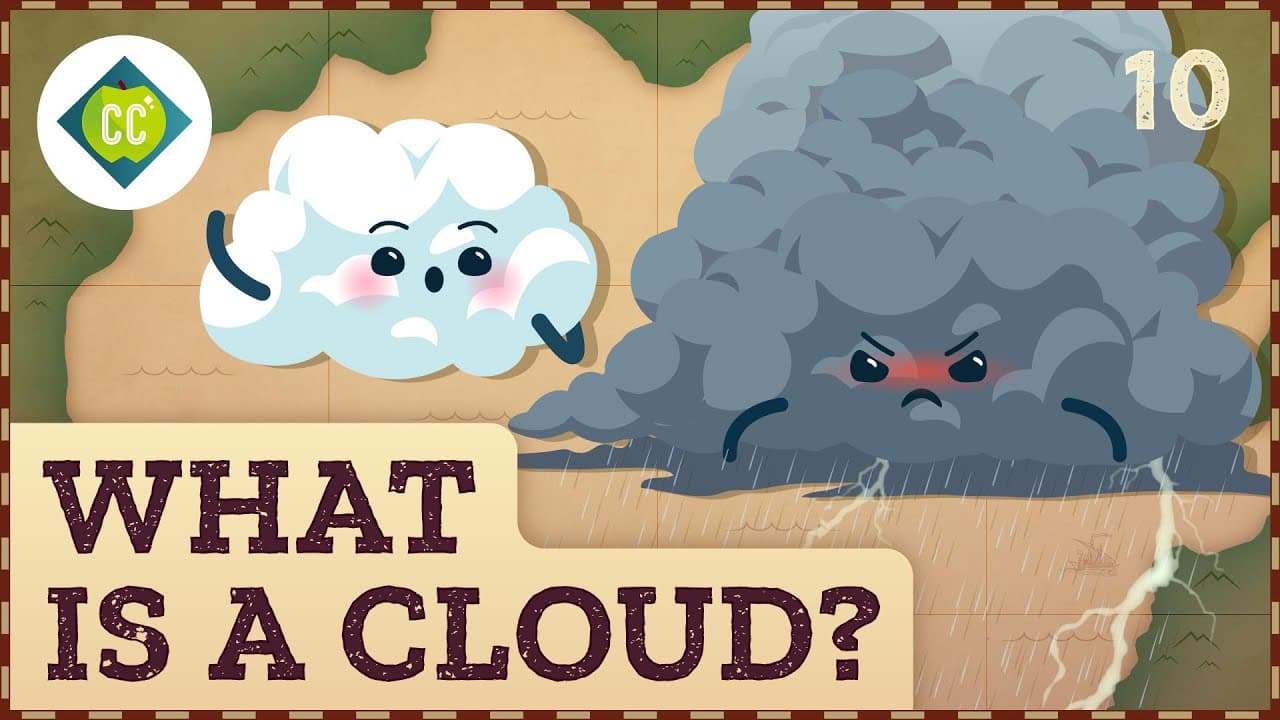
☁️ What is a Cloud? Crash Course Geography #10
TL;DR
A cloud is a collection of billions of tiny water droplets and ice crystals suspended in the atmosphere because they are too small to form raindrops. Clouds reveal atmospheric temperature and moisture, help forecast weather, and affect Earth’s energy flows. Cirrus, stratus, and cumulus clouds each interact differently with incoming and outgoing radiation, so read on to see how cloud type, height, and thickness shape weather and climate.
Transcript
Before there were weather satellites and sophisticated forecasting technology, clouds were the best way to predict what weather was coming. Clouds high up in the sky or no clouds at all meant fine weather. But clouds moving low in the sky or dark clouds meant rain was on its way. Common sayings even sprung up from our cloud observations, like "red... Read More
Key Insights
- ☀️ Clouds have been utilized by different cultures throughout history to predict weather conditions.
- 😶🌫️ Smog clouds indicate high levels of pollution and contribute to global warming.
- 😶🌫️ Different types of clouds have varying effects on the Earth's energy balance.
Install to Summarize YouTube Videos and Get Transcripts
Explore YouTube Video Summarizer or Get YouTube Transcript Extractor
Questions & Answers
Q: What is a cloud?
A cloud is essentially a large collection of water suspended in the atmosphere. It consists of billions of tiny water droplets and ice crystals that are too small to form raindrops, allowing them to remain airborne.
Q: How do clouds help forecast the weather?
Clouds provide information about the temperature and amount of moisture in the atmosphere. High clouds or clear skies traditionally indicated fine weather, while low-moving or dark clouds suggested that rain was approaching.
Q: What are the three main types of clouds?
The vast majority of clouds are classified by appearance as cirrus, stratus, or cumulus. Cirrus clouds are wispy, stratus clouds form flat horizontal layers, and cumulus clouds look bright and lumpy.
Q: How do cirrus clouds affect Earth’s temperature?
Cirrus clouds are made of ice crystals and occur above 6,000 meters. They reflect about 50% of incoming solar radiation, but they trap longwave radiation even more effectively, helping warm the atmosphere through the natural greenhouse effect.
Q: How do stratus clouds affect Earth’s energy balance?
Stratus clouds form dull, gray, horizontal layers and can occur below 2,000 meters. They reflect and scatter about 90% of incoming solar radiation, cooling Earth by preventing much of that energy from reaching the ground.
Q: Do cumulus clouds warm or cool the atmosphere?
Cumulus clouds can be thick and extend far upward through the atmosphere. They generally reflect about as much energy away from Earth as they absorb, making their overall effect on atmospheric warming approximately neutral.
Q: What do cloud names such as altocumulus and cirrostratus mean?
Cloud names describe both form and altitude. “Cirro” indicates a high-level cloud, “alto” identifies the middle level above 2,000 meters but below 6,000 meters, and “nimbus” may be added when a cloud produces rain.
Q: How do clouds form through evaporation?
Cloud formation begins when liquid water molecules absorb enough heat to escape the surface as water vapor. Turning one gram of liquid water into vapor absorbs 585 calories, which the vapor stores as latent heat of evaporation.
Summary & Key Takeaways
-
Clouds have been used throughout history as a way to predict weather. Today, geographers and meteorologists still rely on clouds for weather forecasting.
-
Clouds can indicate the presence of smog, which is harmful to human health and contributes to global warming.
-
Clouds come in different types and have varying effects on the Earth's energy balance. Cirrus clouds trap longwave radiation, while stratus clouds reflect and scatter incoming solar radiation. Cumulus clouds can both reflect and absorb energy.
Read in Other Languages (beta)
Share This Summary 📚
Summarize YouTube Videos and Get Video Transcripts with 1-Click
Try YouTube Summary with ChatGPT & Claude or YouTube Transcript Generator
Explore More Summaries from CrashCourse 📚



Summarize YouTube Videos and Get Video Transcripts with 1-Click
Try YouTube Summary with ChatGPT & Claude or YouTube Transcript Generator