How to Build Cash Flow Without Relying on a Job
TL;DR
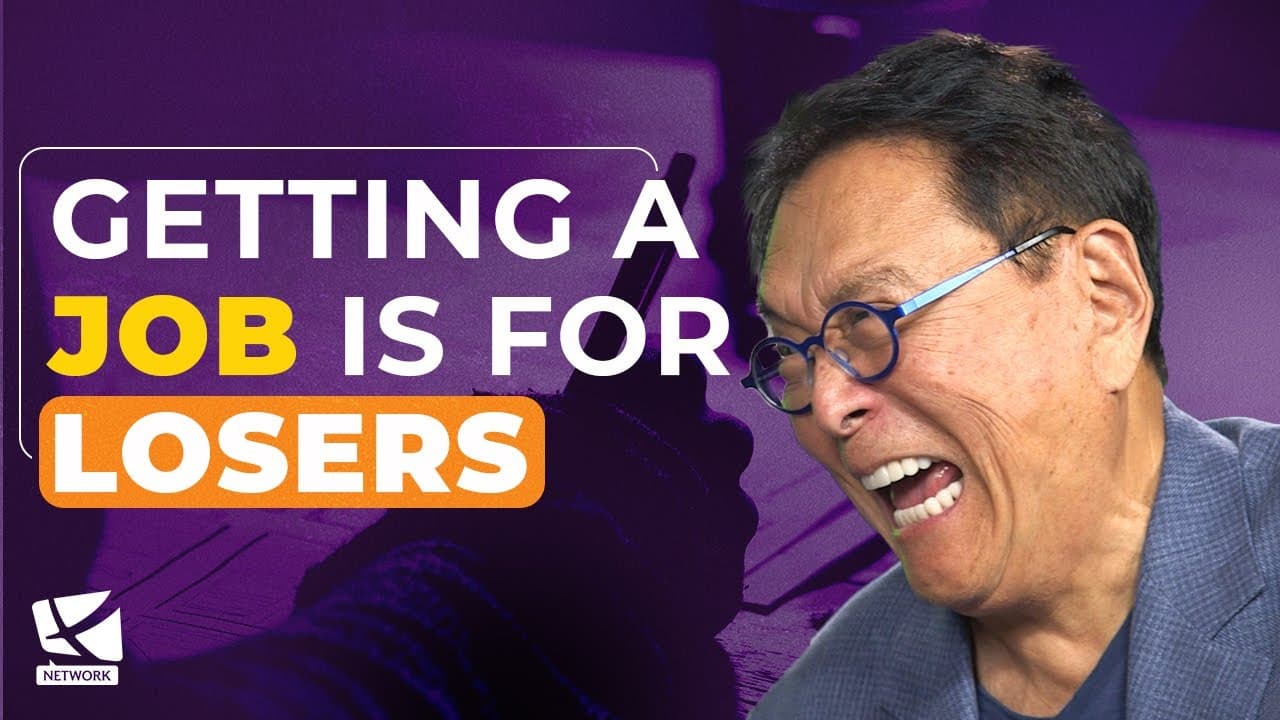
Financial independence means building cash flow from businesses, real estate, commodities, or other assets instead of remaining dependent on an employer or government paycheck. Robert Kiyosaki argues that financial education should teach people to read financial statements, distinguish assets from liabilities, understand debt and taxes, and pursue income-producing ownership.
Transcript
- Hello this is Robert Kiyosaki and we're here for another exciting and important and financial education. Money for Millennials, or Millennials and Their Money. Cause as you and I know, our school teaches us this about money. - Yes. - And it really kinda screws people up, because they go out of school and they start doing the thing we talked about... Read More
Key Insights
- Kiyosaki’s central principle is that financial independence comes from eliminating dependence on paychecks, including payments from employers and government programs. He describes freedom as having asset-generated cash flow rather than needing wages, a pension, Social Security, or Medicare to support daily life.
- Financial education is presented as knowledge that extends beyond securing employment. Kiyosaki says people should understand financial statements, cash flow, debt, taxes, assets, and liabilities so they can evaluate where money comes from, where it goes, and whether ownership produces income or continuing expenses.
- The rich-dad lesson is that wealthy people work to acquire assets rather than merely working for money. Kiyosaki identifies businesses, real estate, paper assets, and commodities as major asset classes, although he personally emphasizes businesses, property, gold, oil, land, water, and food.
- A paycheck-to-paycheck cycle is created when wages are consumed by bills and personal expenses without producing income-generating ownership. Alexandra describes experiencing this pattern while working at a bank, where her income covered obligations but did not provide enough freedom to pursue the activities she wanted.
- An asset is evaluated through the direction of its cash flow in Kiyosaki’s framework. He argues that a personally occupied house can function as a liability when it continually costs its owner money, while an investment is valuable when it produces recurring cash flow.
- Real estate is attractive to Kiyosaki because he says debt can be used to acquire it and tax benefits can accompany ownership. He makes a similar distinction between owning shares connected to oil and directly owning oil wells, claiming that direct ownership provides larger tax advantages.
- Entrepreneurship involves significant risk as well as the possibility of cash flow. Kiyosaki recounts launching a nylon-and-Velcro surfer-wallet company worldwide, watching it rise and fall, and relying on his commodity and real-estate holdings to remain financially stable after the business declined.
- Young adults can become financially constrained by combining student loans, housing expenses, car costs, and credit card debt. Kiyosaki argues that these obligations may prevent them from acquiring income-producing assets, especially when their education and financial planning remain centered on getting and keeping a job.
- Related book: Rich Dad Poor Dad
- Export your Kindle highlights to Glasp: How to Download Highlights and Notes from Kindle
Install to Summarize YouTube Videos and Get Transcripts
Explore YouTube Video Summarizer or Get YouTube Transcript Extractor
Questions & Answers
Q: How can someone stop depending on a paycheck?
Kiyosaki’s proposed approach is to acquire assets that generate cash flow, particularly businesses, real estate, and commodities, instead of relying entirely on wages. He says the goal should be reaching a point where payments from an employer or government are unnecessary. Achieving that objective requires financial education about income, expenses, assets, liabilities, debt, taxes, and financial statements.
Q: What does the rich do not work for money principle mean?
The principle means that wealthy people focus their efforts on building or acquiring income-producing assets rather than remaining dependent on wages. Kiyosaki does not claim that they perform no work. He distinguishes working for a paycheck from working to create businesses, acquire real estate, own commodities, and establish cash flow that can continue without constant personal labor.
Q: Why does Kiyosaki criticize conventional financial education?
Kiyosaki criticizes conventional education because he says schools encourage students to earn credentials, find jobs, and pay bills without teaching them how money works. He believes students should learn to read financial statements and understand cash flow, taxes, debt, assets, and liabilities. Without that knowledge, graduates may earn wages yet remain financially vulnerable and dependent on employment.
Q: What asset classes does Kiyosaki discuss?
Kiyosaki discusses four broad asset classes: businesses, real estate, paper assets, and commodities. He describes paper assets as savings, stocks, bonds, mutual funds, ETFs, 401(k) plans, and IRAs. His commodity examples include gold, silver, oil, land, water, and food. He personally emphasizes businesses, property, commodities, and direct ownership that can produce cash flow.
Q: How does Kiyosaki distinguish an asset from a liability?
Kiyosaki distinguishes assets and liabilities by examining the direction of cash flow. In his framework, an asset should produce income, while a liability continually takes money away through expenses. He therefore argues that a personal home can operate as a liability when it costs money every month, even if its owner commonly describes it as an asset.
Q: Why does Kiyosaki prefer cash flow to wages?
Kiyosaki prefers cash flow because he associates it with ownership and independence, while wages require continued reliance on an employer. He seeks income from businesses, real estate, and other holdings rather than a paycheck. He also claims that certain forms of ownership provide tax advantages and allow debt to be used in ways unavailable to ordinary wage earners.
Q: How can debt support Kiyosaki’s real-estate strategy?
Kiyosaki says he uses substantial debt to purchase real estate rather than treating all borrowing as harmful. In his account, property ownership connects debt, cash flow, and tax advantages. He contrasts this approach with student loans and consumer obligations, which burden borrowers without producing income. His distinction depends on whether borrowed money acquires cash-flow-producing property or finances continuing expenses.
Q: Why can young workers become trapped financially?
Young workers can become trapped when student loans, housing costs, car expenses, credit card debt, taxes, and ordinary bills consume their paychecks. Kiyosaki argues that this pattern leaves little money or opportunity for acquiring income-producing assets. If employment disappears, the worker may also lose the security expected from the job because no independent cash-flow source has been established.
Summary & Key Takeaways
-
Robert Kiyosaki contrasts his academically successful father with his best friend’s entrepreneurial father, who began teaching him about money at age nine. He says conventional schooling prepares students to seek jobs but rarely provides the financial education required to understand cash flow, taxes, debt, assets, liabilities, or business ownership.
-
Kiyosaki defines freedom as reaching the point where an employer or government paycheck is unnecessary. He distinguishes wages from cash flow and says he works to acquire businesses, real estate, commodities, and other income-producing assets. His stated objective is ownership that generates income while reducing dependence on personal labor.
-
The discussion follows a financial-statement framework connecting income, expenses, assets, and liabilities. Kiyosaki argues that student loans, housing costs, cars, and credit card debt can trap young workers in paycheck dependence. He presents entrepreneurship and asset acquisition as alternatives, while acknowledging that his first major business rose and later collapsed.
Read in Other Languages (beta)
Share This Summary 📚
Summarize YouTube Videos and Get Video Transcripts with 1-Click
Try YouTube Summary with ChatGPT & Claude or YouTube Transcript Generator
Explore More Summaries from The Rich Dad Channel 📚
Summarize YouTube Videos and Get Video Transcripts with 1-Click
Try YouTube Summary with ChatGPT & Claude or YouTube Transcript Generator