How to Apply What You Read
TL;DR
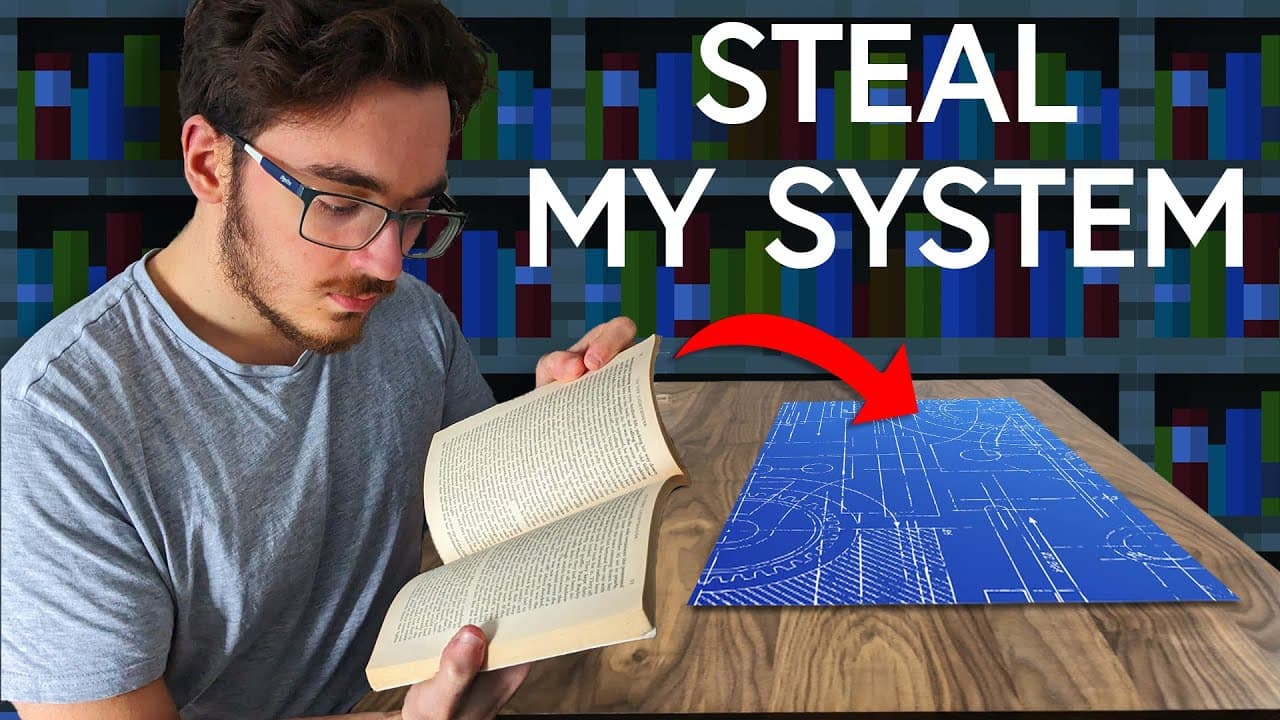
You can apply what you read or watch by consuming with intent, recording what matters, extracting practical actions, and moving those actions into one central system. The speaker uses a Notion to-do list for one-off actions and an implementation hub for daily, weekly, monthly, or yearly habits. Read on for the complete three-step framework and its rules for turning passive consumption into real-world action.
Transcript
I guarantee you that this is a problem you faced and it's something that annoys you it's the idea that we consume content we consume YouTube videos uh books podcasts everything but we fail to actually take what we learn and apply it to the real world this is something that has affected me for years and something that really annoys me to this day bu... Read More
Key Insights
- Consumption can imitate progress: Watching self-improvement material feels like doing something beneficial, even when nothing changes in reality. The speaker identifies this feeling as part of the problem, since consuming large amounts of useful content can create satisfaction without application. Progress depends on transferring at least some of what was consumed into concrete behavior.
- Intent begins before playback: The framework does not wait until a video ends to ask whether it contained anything actionable. It establishes the purpose before consumption starts. Being willing to take notes creates a deliberate condition for watching, listening, or reading, helping the speaker approach the material with the precise intent to carry something useful away.
- Saving content protects its value: When a potentially valuable video appears at an unsuitable moment, the recommended response is to save it rather than watch passively. The speaker has about 2,000 videos in a watch later playlist accumulated over years. That backlog is preferable to consuming those videos while unwilling to focus and record useful ideas.
- The rule is deliberately strict: Refusing to watch unless notes are possible may sound severe, but the restriction is meant to force alertness. The speaker applies it even when relaxing and looking for something to watch. The rule interrupts the tendency to use educational or self-improvement videos as entertainment that merely creates the feeling of productive activity.
- Personal relevance guides notes: Notes are not presented as a complete record of everything a source contains. The speaker writes down what was important personally, what resonated, and what could transfer into their own world. This focus makes the captured material relevant to the consumer's circumstances and prepares it for the later process of extracting practical points.
- Practical points connect worlds: A practical point is the part of an idea that can be carried directly into reality. Identifying it answers the question of what the consumer will do after encountering the theory. Within a life-improvement context, the value of the notes depends on locating these implementable elements rather than stopping after understanding an explanation.
- Distillation reduces repeated searching: Practical items are moved away from the complete notes and collected together. The purpose is not to discard the theory, but to avoid repeatedly exploring a broad field of notes to locate the next action. Centralization makes the applicable material visible at a glance and gives the user a clearer direction forward.
- Only basic tools are required: The speaker uses Notion, but the framework is not dependent on that particular app. Any method that lets someone write things down and keep everything learned in one place can support it. Its simplicity comes from limiting the workflow to note capture, practical-point identification, and centralized organization before implementation begins.
- One-off actions need closure: A task that only needs to happen once belongs on the to-do list. The example is finding a free course mentioned in a YouTube video and adding an instruction to check it out. Because the event does not need repetition, placing it among recurring habits would add unnecessary structure instead of clarifying its completion.
- Recurring actions need visibility: Lessons that describe repeatable behavior are treated differently from tasks that can be finished once. The speaker places habits in an implementation hub so they remain available for repeated execution. A lesson about regularly entering nature, for example, cannot be completed permanently after one visit and therefore needs an ongoing place in the system.
- Frequency provides the categories: The implementation hub groups recurring events as daily, weekly, monthly, and perhaps yearly items. This arrangement connects each practical lesson to the rhythm at which it should occur. A goal to get into nature every one or two weeks is placed in the weekly category, making its expected recurrence easier to see during a review.
- Three steps precede the work: The framework has three preparation stages: consume only when ready to take notes, record valuable and applicable material, then extract practical points into a central area. These steps do not replace implementation. They organize the transition from content to action so that the person can see one-off tasks and recurring habits without reopening every source.
Install to Summarize YouTube Videos and Get Transcripts
Explore YouTube Video Summarizer or Get YouTube Transcript Extractor
Questions & Answers
Q: How can you apply what you read or watch?
Consume the material only when you are prepared to take notes and give it focused attention. Record what matters, what resonates, and what could be carried into your own life. Review those notes, identify the practical points, and move them into one central area. Put one-off actions in a to-do list and recurring behaviors in an implementation hub organized by frequency.
Q: Why should you only consume content when you can take notes?
The rule forces you to approach the material with a precise intent instead of consuming it passively. Without that condition, self-improvement videos can become entertainment that only feels productive. Taking notes keeps you alert and increases the chance that you will identify something usable. If you are unwilling to sit up and engage, the speaker recommends saving the content for later.
Q: What should you write in your notes?
Write down the points that seem important to you and the ideas that resonate with you. Give particular attention to anything that could be applied in your own world. Then identify the practical point, meaning the real-world thing you can implement. This keeps the notes connected to action rather than leaving them as a collection of theory.
Q: What are the three steps in the framework?
First, consume content only when you are in a position to take notes. Second, record the important, resonant, and applicable ideas while watching, listening, or reading. Third, extract the practical points from the full notes and move them into one central area. After those three steps, the remaining requirement is to put the identified actions into practice.
Q: How does a central area help with implementation?
A central area gathers practical points that would otherwise remain scattered through separate notes. This means you do not need to search through all the theory whenever you want to know what to do. You can glance at the collection and see the relevant actions together. The speaker uses Notion for this purpose, although any place for writing and storing the material can work.
Q: Why separate one-off tasks from recurring habits?
The two types of action require different forms of follow-through. A one-off item, such as checking out a free course, can be completed once and placed on a to-do list. A recurring behavior must remain visible because it needs to happen repeatedly. Separating them keeps temporary tasks distinct from habits that belong in an ongoing implementation system.
Q: How is the Notion implementation hub organized?
The hub contains categories for daily, weekly, monthly, and possibly yearly recurring events. Each extracted habit is placed according to how often it should happen. For example, getting into nature every one or two weeks goes in the weekly section. Reviewing the hub regularly lets the speaker see which repeated actions should be arranged or performed.
Q: Can this framework work without Notion?
Yes, because the system only requires a way to write things down and a place to keep what you learn. Notion is the speaker's chosen app, not a mandatory part of the framework. The important function is collecting practical points somewhere centralized and accessible. The method remains the same when another tool provides those basic capabilities.
Summary & Key Takeaways
-
Recognizing the application gap: People consume YouTube videos, books, podcasts, and other content but often fail to transfer what they learn into reality. Watching even 100 productivity videos or 100 videos about reading and learning can feel productive without producing meaningful change. After years of experiencing this problem, the speaker developed a simple framework for collecting useful ideas, placing them in one central location, and applying them without requiring a complex system.
-
Preparing to consume intentionally: The first and essential rule is to consume valuable content only when you are willing and able to take notes. If you find a promising video while lying in bed or relaxing on a couch, save it for later unless you will sit up and engage with it. This strict condition discourages using self-improvement content merely as entertainment and creates a precise intention to extract something useful from every item consumed.
-
Capturing useful material actively: Once ready to focus, watch the video, listen to the podcast, or read the book while taking notes online or in a notepad. Record what seems important, what resonates personally, and especially what could be applied in your own world. Theory may be worthwhile, but consuming material to improve your life requires identifying what you will actually do. The practical point is the part that can move directly from the source into reality.
-
Distilling notes into actions: The third and final step before doing the work is to review the notes and separate practical items from the surrounding theory. Move those action points into one central area instead of leaving them buried throughout the original notes. This distillation removes the need to explore all the material again whenever you want to act. A quick glance at the centralized collection should reveal what needs to be done and where to proceed next.
-
Organizing actions by repetition: The speaker keeps two Notion pages for practical points. One-off actions go into a basic to-do list, such as checking out a free course mentioned by a YouTuber. Recurring actions go into an implementation hub organized into daily, weekly, monthly, and possibly yearly categories. For example, a goal to get into nature every one or two weeks belongs in the weekly section, where it remains visible during regular reviews of the hub.
Read in Other Languages (beta)
Share This Summary 📚
Summarize YouTube Videos and Get Video Transcripts with 1-Click
Try YouTube Summary with ChatGPT & Claude or YouTube Transcript Generator
Explore More Summaries from Odysseas 📚



Summarize YouTube Videos and Get Video Transcripts with 1-Click
Try YouTube Summary with ChatGPT & Claude or YouTube Transcript Generator