Is GPT-5.1 Better for Everyday Chat Than Coding?
TL;DR
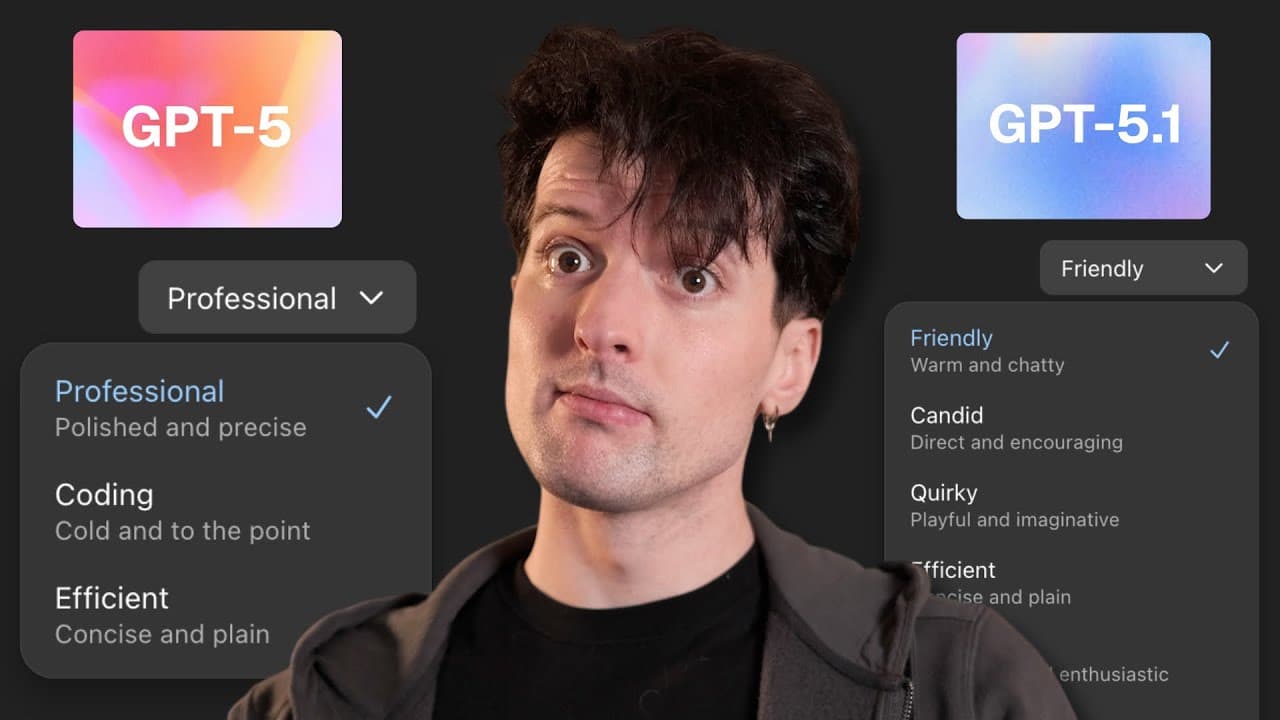
GPT-5.1 appears better suited to everyday ChatGPT users who value warmer conversation, clearer instruction following, faster simple answers, and adjustable tone. The reviewer found GPT-5.1 Instant interesting but still disliked its frequent bullet lists, headers, and stylized friendliness, while reserving judgment about developer workflows until API access became available.
Transcript
Oh boy, it's finally here. Gemini 3.0. Oh, GPT 5.1. At this point, I swear we're going to get GTA 6 before Gemini 3, but GBT 5.1 is still a very interesting release that I'm excited to go into with you guys. OpenAI was kind enough to give me early access, but that does not mean I'm going to be kind back necessarily. I've had an okay experience with... Read More
Key Insights
- GPT-5.1 is positioned as a smarter and more conversational refinement of GPT-5, with additional controls for shaping ChatGPT's tone. The release emphasizes both capability and communication style, reflecting the stated view that useful AI should also be enjoyable to talk with.
- GPT-5.1 Instant is designed to be warmer, more intelligent, and better at following instructions. The reviewer regarded its focus on non-reasoning interactions as valuable because reasoning can delay visible answers and consume more tokens when a straightforward response may be sufficient.
- GPT-5.1 Thinking is described as easier to understand, faster on simple tasks, and more persistent on complex ones. This design aims to vary effort according to difficulty instead of treating every request as though it requires the same amount of extended reasoning.
- GPT-5.1's tone customization is central to the release because conversational preferences differ across users and individual conversations. The reviewer recognized this goal but personally disliked the model's recurring use of emojis, segmented bullet lists, numerous headings, and overtly friendly phrasing.
- The relaxation test showed that GPT-5.1 could organize coping suggestions according to different kinds of stress. It recommended techniques such as box breathing, sensory grounding, listening to music, and stepping outside, producing a warmer response than the earlier GPT-5 example shown.
- Kimmy K2 produced the reviewer's preferred relaxation response because it combined immediate calming techniques with lifestyle adjustments and mentioned speaking with a therapist. He also found its tone and prose more natural, despite overlap in core suggestions such as breathing and sensory grounding.
- The Java defense test demonstrated that GPT-5.1 can avoid lists initially but may return to heavily structured formatting later. Its central argument was that Java prioritizes clarity and maintainability over cleverness, while modern Java should not be judged entirely by its older reputation.
- GPT-5.1's value for developers remained unresolved because API access was not yet available during the review. The reviewer planned a later comparison involving software writing inside tools such as Cursor or Codex, so his current judgment focused on ChatGPT behavior rather than coding performance.
Install to Summarize YouTube Videos and Get Transcripts
Explore YouTube Video Summarizer or Get YouTube Transcript Extractor
Questions & Answers
Q: What is GPT-5.1 designed to improve?
GPT-5.1 is designed to improve both intelligence and conversational quality while making ChatGPT easier to customize. GPT-5.1 Instant is described as warmer, more intelligent, and better at following instructions. GPT-5.1 Thinking is presented as easier to understand, faster for simple tasks, and more persistent when working through complex requests.
Q: Is GPT-5.1 better suited to everyday users or developers?
The reviewer's early impression was that GPT-5.1 was aimed more directly at ordinary ChatGPT users who care about friendliness, clarity, and adjustable conversational tone. He did not consider the review sufficient for developers because the API was expected later that week, preventing a proper evaluation inside coding environments such as Cursor or Codex.
Q: What is the difference between GPT-5.1 Instant and Thinking?
GPT-5.1 Instant focuses on common chat interactions, with a warmer default personality, stronger instruction following, and improved intelligence. GPT-5.1 Thinking is the advanced reasoning option, described as faster on simple tasks, easier to understand, and more persistent on complex work. The two variants therefore emphasize different levels of reasoning effort and response speed.
Q: Why does the reviewer value non-reasoning AI models?
The reviewer values capable non-reasoning models because extended reasoning can make users wait before seeing an answer and can consume substantially more tokens than a simple task requires. He believes strong models should remain available for quick, direct interactions, even though reasoning often improves benchmark performance and helps with more difficult problems.
Q: How did GPT-5.1 answer the relaxation request?
GPT-5.1 responded warmly and grouped relaxation suggestions according to the user's type of stress. Its recommendations included box breathing, the five-four-three-two-one sensory grounding technique, listening to music, and stepping outside. The reviewer considered the response clear and useful, but disliked its familiar bullet-heavy presentation and preferred Kimmy K2's broader suggestions and tone.
Q: Why did the reviewer prefer Kimmy K2 for conversation?
The reviewer preferred Kimmy K2 because he found its wording, organization, and conversational tone more natural. In the relaxation comparison, Kimmy offered immediate techniques, longer-term lifestyle adjustments, and a suggestion to speak with a therapist. In the Java test, he also preferred its headers, examples, and prose over GPT-5.1's more segmented structure.
Q: How did GPT-5.1 perform on the Java defense prompt?
GPT-5.1 produced a structured defense centered on Java's preference for clarity and maintainability over cleverness. It also argued that modern Java should not be treated as identical to older Java. The reviewer found parts of the response reasonable, but criticized its return to lists and its use of an awkward header labeled as a punchline.
Q: What remained untested in the GPT-5.1 review?
GPT-5.1's performance through the API and within software development tools remained untested. The reviewer wanted to evaluate how it writes software inside editors such as Cursor or Codex, but API availability was expected only later that week. He therefore reserved his developer-focused conclusions for a follow-up and evaluated mainly the ChatGPT experience.
Summary & Key Takeaways
-
GPT-5.1 was presented as a refinement of GPT-5 focused on intelligence, conversational quality, and easier tone customization. Its two main variants are Instant, designed as a warmer and more instruction-aware general model, and Thinking, intended to answer simple requests faster while remaining persistent when handling more complex problems.
-
The reviewer tested GPT-5.1 Instant with relaxation advice and a defense of Java. Although its responses were clear, structured, and practical, he disliked the repeated reliance on bullet lists, numerous headers, emojis, and forced conversational warmth. He personally preferred the writing style produced by Kimmy K2 in these comparisons.
-
The release seemed primarily aimed at ordinary ChatGPT users rather than developers working through APIs or coding editors. Because API access was expected later that week, the reviewer postponed conclusions about software development performance. His early assessment was mixed: GPT-5.1 offered useful improvements, but its default presentation did not match his preferences.
Read in Other Languages (beta)
Share This Summary 📚
Summarize YouTube Videos and Get Video Transcripts with 1-Click
Try YouTube Summary with ChatGPT & Claude or YouTube Transcript Generator
Explore More Summaries from Theo - t3․gg 📚






Summarize YouTube Videos and Get Video Transcripts with 1-Click
Try YouTube Summary with ChatGPT & Claude or YouTube Transcript Generator