How Should Investors Prepare for an AI Bubble?
TL;DR
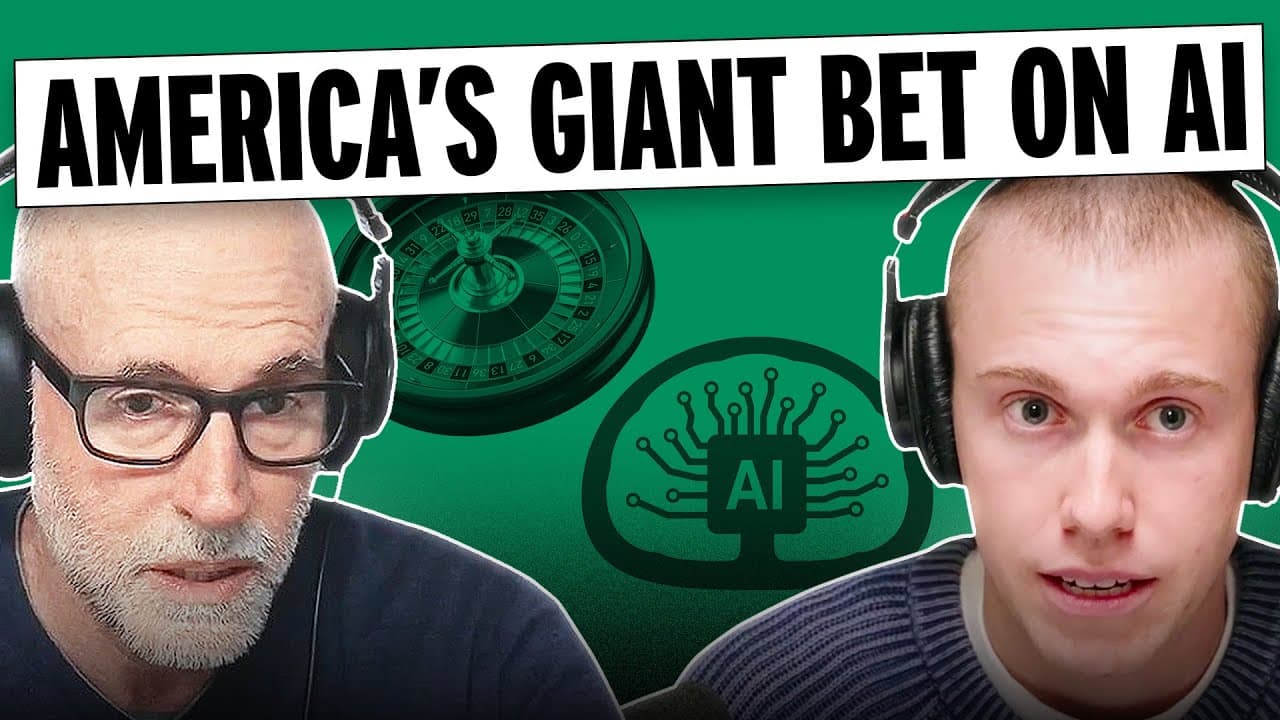
Treat the AI boom as a potential bubble, but do not assume that recognizing it reveals when it will burst. The discussion points to circular financing, extreme private-company valuations, market concentration, and major stock sales as warning signs, while emphasizing that earlier bubbles continued climbing after informed observers first identified them.
Transcript
Today's number 50. That's the percentage of teenagers who say they never read. Ed, what does a pregnant teenager and her unborn baby have in common? What's that? They're both saying, "Oh [ __ ] my mom's going to kill me." Is that the line? Is that the line, Ed? Totally inappropriate. What's going on, Ed? What's going on? Not too much, Scott. I'm go... Read More
Key Insights
- The AI market is described as a bubble supported partly by circular deals, including relationships involving AMD and OpenAI, and Nvidia and xAI. The concern is that investment capital can flow between interconnected companies and return as demand for the investor’s products.
- Calling a bubble does not identify its peak. Scott says the dot-com bubble was being recognized in 1997, yet the market climbed another 30 or 40 percent before 1999, illustrating how speculative markets can keep rising after credible warnings become widespread.
- A dangerous shift occurs when investors begin claiming that economic rules have fundamentally changed. Scott recalls that commentary near the dot-com peak moved from acknowledging a bubble to suggesting the internet had created a new economic age in which unusually high valuations were justified.
- Extreme valuations are presented as direct evidence of speculative excess. One cited assessment says a company with $50 million in annual recurring revenue cannot reasonably be valued at $10 billion, and argues that bubble conditions are visible in both public and private AI markets.
- Warren Buffett’s stock sales are interpreted by Scott as an implicit warning about market conditions. He says Buffett sold roughly $150 billion or $200 billion in stocks, treating that behavior as more meaningful than a verbal prediction about whether the market is overvalued.
- America is characterized as one large bet on AI because the stock market’s performance depends heavily on a small number of companies. Scott says roughly 10 companies are driving the market, creating broad exposure to one concentrated technology theme and its interconnected participants.
- Circular relationships extend beyond financing into corporate governance and partnerships. The hosts say directors at AI companies sit on one another’s boards and then form commercial alliances, creating a closely connected network that they had already discussed in April 2024.
- Market gains can provide political cloud cover because people commonly treat rising indexes as evidence that the country and its leadership are performing well. Scott argues that this fixation makes the stock market a misleading measure of the broader health of American institutions.
Install to Summarize YouTube Videos and Get Transcripts
Explore YouTube Video Summarizer or Get YouTube Transcript Extractor
Questions & Answers
Q: How should investors prepare for a possible AI bubble?
Investors should begin by recognizing that identifying bubble conditions is different from predicting when prices will fall. Scott says earlier speculative cycles continued rising substantially after knowledgeable observers sounded alarms. The practical conclusion from the discussion is to examine concentration, circular financing, interconnected partnerships, and valuations carefully rather than treating continued market gains as proof that the concerns are wrong.
Q: Why do circular AI deals raise bubble concerns?
Circular deals raise concerns because investment money can move from a major technology company into an AI partner and then return through purchases, partnerships, or demand for computing products. The hosts point to deals involving AMD and OpenAI, and Nvidia and xAI. Scott views a Bloomberg chart mapping these interconnected flows as especially strong evidence of possible market distortion.
Q: What does the dot-com bubble suggest about AI stocks?
The dot-com comparison suggests that a bubble can remain profitable and continue expanding after its risks are widely recognized. Scott recalls that people called the earlier market a bubble in 1997, but it rose another 30 or 40 percent before 1999. Therefore, accurate skepticism about AI valuations does not reveal the precise peak or guarantee an immediate decline.
Q: What signs suggest AI company valuations are excessive?
The discussion identifies unusually high valuations relative to business revenue as a major warning sign. A cited market assessment argues that a company producing $50 million in annual recurring revenue cannot reasonably be valued at $10 billion. The hosts also highlight all-time market highs, repeated circular deals, and close financial relationships among AI companies as supporting evidence.
Q: Why is America described as one big bet on AI?
America is described this way because the broader stock market is being driven by roughly 10 companies, while AI investment and partnerships connect many of those businesses. This concentration means market performance and perceptions of national economic health depend heavily on a narrow technology theme. If that theme weakens, the consequences could extend beyond individual AI companies.
Q: Can widespread bubble warnings cause the AI market to fall?
Widespread warnings do not necessarily trigger an immediate decline. Scott argues that bubbles often continue climbing while commentators openly describe them as bubbles. In his account, the more revealing late-stage moment arrives when people abandon their skepticism and embrace a new narrative claiming that old valuation rules no longer apply because the economy has fundamentally changed.
Q: What do Warren Buffett’s stock sales indicate about the market?
Scott interprets Warren Buffett’s behavior as a sign that an experienced investor sees serious market risk. He says Buffett sold approximately $150 billion or $200 billion in stocks. The discussion presents those sales as an implicit judgment rather than a formal forecast, using them as one piece of evidence alongside circular financing and elevated AI valuations.
Q: How can an AI-driven stock market affect politics?
Scott argues that rising stock prices provide political cloud cover because many people use the market as a simple test of whether the country and its leadership are doing well. He says the S&P was up about 20 or 23 percent that year and suggests that a 20 percent decline would significantly change the political environment and public tolerance.
Summary & Key Takeaways
-
Scott and Ed argue that the AI economy shows bubble-like characteristics, especially circular investments in which capital moves among chipmakers, AI companies, and commercial partners. They see these interconnected transactions as evidence that reported demand and rising valuations may be reinforcing one another rather than reflecting fully independent economic activity.
-
The discussion compares the current AI enthusiasm with the dot-com cycle. Scott recalls that observers identified that earlier bubble well before its peak, after which markets gained another 30 or 40 percent. His central warning is that correctly recognizing speculative excess does not provide a reliable timetable for the eventual decline.
-
America is described as a concentrated bet on AI because a small group of companies drives the broader market. The hosts argue that rising indexes shape perceptions of national health and political performance. The episode description also identifies Tesla’s reinvention, its valuation, and employment flexibility as additional topics examined later.
Read in Other Languages (beta)
Share This Summary 📚
Summarize YouTube Videos and Get Video Transcripts with 1-Click
Try YouTube Summary with ChatGPT & Claude or YouTube Transcript Generator
Explore More Summaries from The Prof G Pod – Scott Galloway 📚



Summarize YouTube Videos and Get Video Transcripts with 1-Click
Try YouTube Summary with ChatGPT & Claude or YouTube Transcript Generator