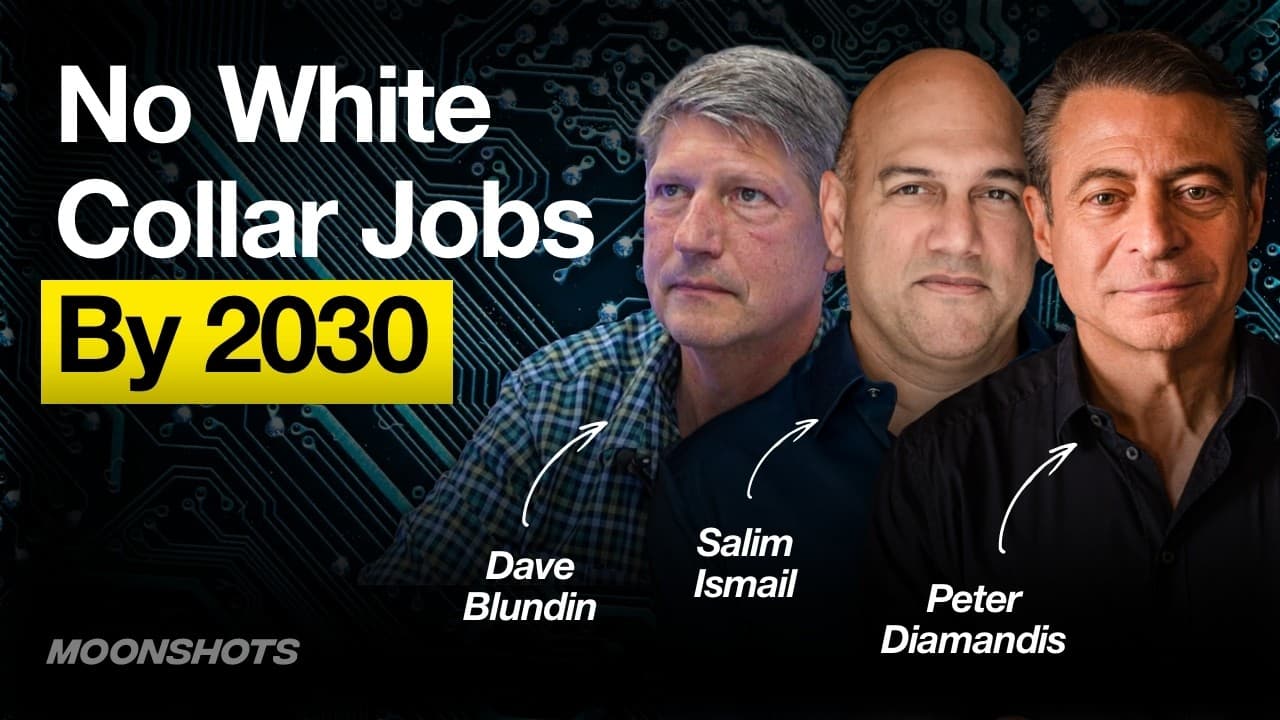
How Are Bitcoin and AI Shifting Global Power? Salim Ismail and Dave Blundin | Moonshots EP #172
TL;DR
Bitcoin and AI could shift global power by concentrating financial influence around scarce digital assets and technological influence around United States innovation backed by Middle Eastern capital. The discussion highlights Bitcoin’s fixed supply of 21 million coins, MicroStrategy’s proposed $84 billion purchasing plan, and Saudi Arabia’s acquisition of 18,000 Nvidia GB300 Blackwell chips. Read on to understand the investment, employment, and geopolitical changes the speakers anticipate before 2030.
Transcript
the experts, you speak to everybody on the street, they're expecting that we're about to see a bull run. We've been waiting for a long time for Bitcoin to peel off the tracking of the Dow and the financial markets. And I think this is finally the breaking point. Today, Amazon announced, "We are partnering with Humane, Saudi Arabia's newly created A... Read More
Key Insights
- Bitcoin is presented as increasingly legitimate because Coinbase joined the S&P 500 shortly after Bitcoin moved above $100,000. The speakers expect this institutional recognition to pressure wealth managers and financial organizations to reconsider policies that prevent advisers from recommending Bitcoin.
- MicroStrategy's proposed 42/42 plan involves $42 billion from stock sales and $42 billion from debt, potentially funding $84 billion in Bitcoin purchases. The speakers describe its newer financing structure as more scalable because it removes interest payments that previously depended on software-company cash flow.
- Bitcoin's fixed supply is 21 million coins, and the speakers emphasize that its available market float is relatively low. They argue that small treasury allocations by corporations or sovereign entities could absorb substantial supply and create a disproportionate effect on Bitcoin's market price.
- Bitcoin's gains are described as concentrated into a small number of trading days. One speaker says roughly 10 days can produce 70 percent of the year's upside, supporting a buy-and-hold approach instead of trying to predict short-term dips and repeatedly entering or leaving the market.
- The Middle East's AI advantage is described as a combination of abundant capital and rapid decision-making. Amazon's partnership with Saudi Arabia's newly created AI company, Humane, and Nvidia's sale of 18,000 GB300 Blackwell chips are cited as evidence of expanding regional AI infrastructure.
- United States innovation combined with Middle Eastern capital is presented as a potentially formidable global technology partnership. The speakers believe this pairing could shift AI influence by connecting technical capabilities and entrepreneurial ecosystems with investors able to fund ambitious projects quickly.
- White-collar employment is expected by the discussion to face major disruption by 2030. The chapter framing places this prediction alongside broader expectations about AI-driven abundance, suggesting that accelerating automation could alter professional work as well as the production and distribution of economic value.
- Human presence remains valuable despite the reach and efficiency of digital communication. The speakers observe that video conferencing did not eliminate conferences, and one recounts being flown to a studio to repeat a recorded talk because the organization specifically wanted a live appearance.
Install to Summarize YouTube Videos and Get Transcripts
Explore YouTube Video Summarizer or Get YouTube Transcript Extractor
Questions & Answers
Q: How are Bitcoin and AI shifting global power?
The speakers argue that Bitcoin could redistribute financial influence as corporations, sovereign entities, and retirement portfolios compete for its limited supply. They also describe a powerful technology bloc combining United States innovation with Middle Eastern capital and rapid decision-making. Together, these developments could reshape wealth, employment, AI infrastructure, and geopolitical influence before 2030.
Q: Why could Bitcoin’s limited supply increase its price?
Bitcoin has a fixed supply of 21 million coins, while the portion actively available for purchase is described as relatively small. The speakers argue that corporate buying programs, sovereign reserves, or even modest treasury allocations could absorb substantial supply and exert disproportionate upward pressure on the market price.
Q: How does MicroStrategy plan to finance additional Bitcoin purchases?
MicroStrategy’s proposed 42/42 plan combines $42 billion from stock sales with $42 billion from debt, potentially funding $84 billion in Bitcoin purchases. The speakers say its newer financing structure removes interest payments, making it more scalable than borrowing that depended on cash flow from the company’s software operations.
Q: Why do the speakers favor holding Bitcoin instead of timing dips?
One speaker says roughly 10 trading days can produce 70 percent of Bitcoin’s upside for the year. Because investors cannot reliably identify those days in advance, repeatedly entering and leaving the market could mean missing a substantial share of the gains.
Q: What does Coinbase joining the S&P 500 mean for Bitcoin and cryptocurrency?
The speakers treat Coinbase joining the S&P 500 shortly after Bitcoin moved above $100,000 as evidence of growing institutional legitimacy. They expect that recognition to pressure wealth managers and other financial organizations to reconsider policies preventing advisers from recommending Bitcoin.
Q: How is Saudi Arabia expanding its role in artificial intelligence?
The discussion cites Amazon’s partnership with Humane, described as Saudi Arabia’s newly created AI innovation company. It also says Nvidia is selling 18,000 GB300 Blackwell AI chips to Saudi Arabia, expanding the advanced computing infrastructure available for regional AI development.
Q: Why could the Middle East become a major center of AI power?
The speakers identify abundant capital and rapid decision-making as major Middle Eastern advantages. They argue that combining this funding capacity with innovation from the United States could create a formidable partnership capable of accelerating ambitious AI infrastructure projects.
Q: What technological and economic changes do the speakers expect before 2030?
The discussion anticipates major disruption to white-collar employment alongside AI-driven abundance, AGI safety challenges, humanoid robots, agent-to-agent payments, and broader Bitcoin adoption. The speakers describe the period through 2030 as an urgent race and advise people to move quickly toward their personal and organizational goals.
Summary & Key Takeaways
-
Bitcoin is presented as gaining institutional legitimacy through Coinbase joining the S&P 500, corporate acquisition strategies, and interest in sovereign reserves and retirement portfolios. The speakers argue that limited supply and relatively low available float could amplify price movements if corporations or governments allocate even small portions of their capital.
-
The discussion frames the Middle East as an emerging center of AI power because it combines vast capital with fast decision-making. Amazon's announced partnership with Saudi AI company Humane and Nvidia's planned sale of 18,000 GB300 Blackwell chips to Saudi Arabia illustrate how regional investment could complement United States innovation and accelerate infrastructure development.
-
The speakers describe technological change as an urgent race toward 2030, touching on AI abundance, white-collar automation, AGI safety, humanoid robots, and agent-to-agent payments. They also note a persistent human preference for physical presence, since conferences and requested live appearances remain valuable despite decades of increasingly capable video communication tools.
Read in Other Languages (beta)
Share This Summary 📚
Summarize YouTube Videos and Get Video Transcripts with 1-Click
Try YouTube Summary with ChatGPT & Claude or YouTube Transcript Generator
Explore More Summaries from Peter H. Diamandis 📚





Summarize YouTube Videos and Get Video Transcripts with 1-Click
Try YouTube Summary with ChatGPT & Claude or YouTube Transcript Generator