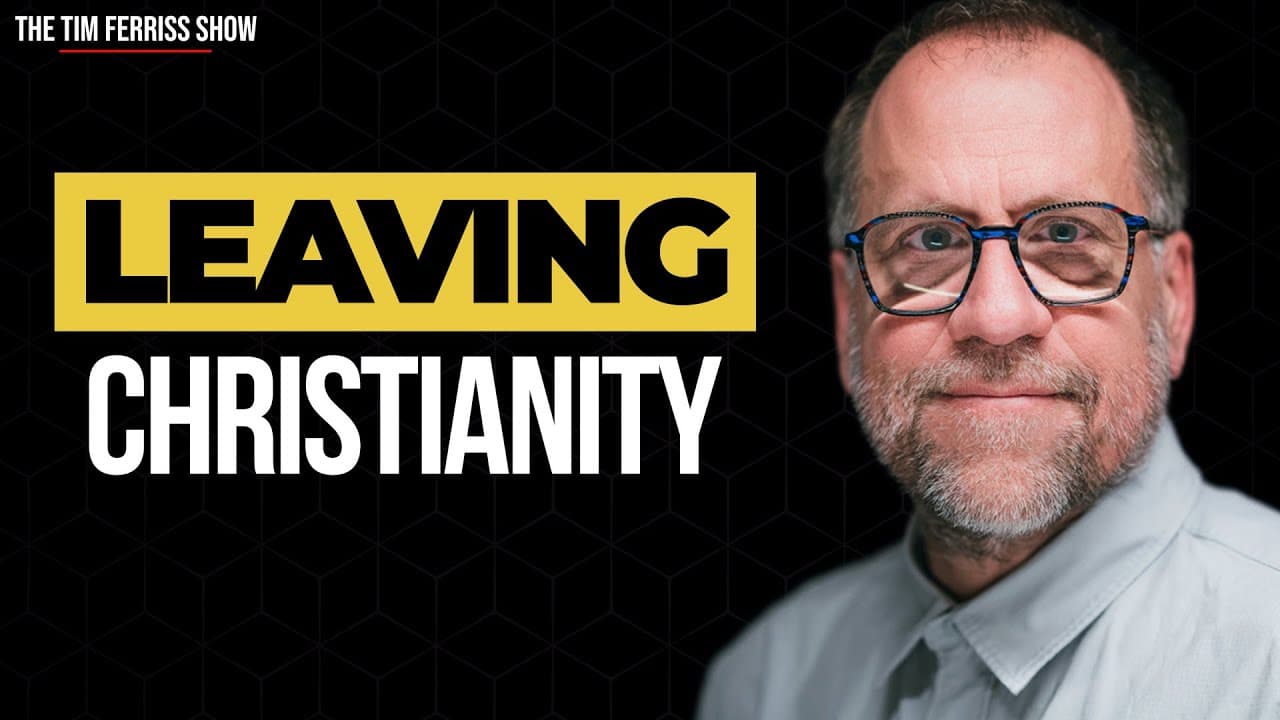
Why Did John Vervaeke Leave Christianity?
TL;DR
John Vervaeke left Christianity at 15 due to trauma from his fundamentalist upbringing, seeking wisdom outside traditional religion. He found solace in Eastern philosophies through meditation, Tai Chi, and contemplative practices, which helped him cultivate a deeper understanding of meaning and self-transcendence.
Transcript
foreign how did you find Tai Chi or how did Tai Chi find you oh and there hangs a tail so I was brought up in a fundamentalist Christian extended family not just the nuclear family the extended family and it's only sort of later that I've come to realize how traumatizing that was for me and so when I was 15 I read a couple of books Lord of Light an... Read More
Key Insights
- 🥺 Leaving a religious upbringing can be a challenging and traumatic experience, leading to a fragmented sense of self.
- 💨 Religion shapes a person in profound ways, even after leaving it behind.
- 🥺 Academic philosophy may lack a focus on wisdom and self-transcendence, leading individuals to explore alternative practices.
- 🧘 Combining meditation, contemplation, and Tai Chi Chuan can create an "Ecology of practices" that fosters the cultivation of wisdom.
- 🤯 Fragmentation can occur within individuals and between different disciplines studying the mind.
- 😨 The journey for wisdom involves addressing and integrating personal traumas and fears.
- 👨🔬 The speaker's experience resonates with others who have left religious homes and are searching for deep meaning and connectedness.
Install to Summarize YouTube Videos and Get Transcripts
Explore YouTube Video Summarizer or Get YouTube Transcript Extractor
Questions & Answers
Q: How did the speaker's upbringing in a fundamentalist Christian family impact their journey to find wisdom?
The speaker's Christian upbringing was traumatic and caused fragmentation in their life. Leaving Christianity at 15 was challenging, but it allowed them to explore alternative paths of wisdom.
Q: How did the speaker find solace and support during their transition period?
The speaker's friends in high school became supportive of their search for meaning. However, they also made impulsive decisions, like getting married young, to escape their family's fundamentalism.
Q: How did the speaker deal with the trauma and fears that stemmed from their religious upbringing?
The speaker sought therapy, practiced meditation, and engaged in contemplation and Tai Chi Chuan to address the fears and trauma caused by their religious upbringing. They also delved into education in the socratic platonic tradition.
Q: Why do other people who left religious homes resonate with the speaker's journey?
Many individuals who have left religious homes relate to the speaker's experience of longing for deep connectedness and meaning while not finding traditional religious spaces fulfilling. They are attracted to the speaker's work as it offers alternative paths to wisdom.
Summary & Key Takeaways
-
The speaker grew up in a fundamentalist Christian family but left Christianity at the age of 15 after reading books that opened their mind.
-
They found academic philosophy lacking in the subject of wisdom and self-transcendence but discovered a meditation and Tai Chi center nearby.
-
Through the practice of meditation, contemplation, and Tai Chi Chuan, they found an "Ecology of practices" that satisfied their hunger for wisdom.
Read in Other Languages (beta)
Share This Summary 📚
Summarize YouTube Videos and Get Video Transcripts with 1-Click
Try YouTube Summary with ChatGPT & Claude or YouTube Transcript Generator
Explore More Summaries from Tim Ferriss 📚




Summarize YouTube Videos and Get Video Transcripts with 1-Click
Try YouTube Summary with ChatGPT & Claude or YouTube Transcript Generator