What Are Webhooks and Why Are They Important in Development?
TL;DR
Webhooks are crucial for managing asynchronous processes in web development by allowing applications to be notified when a specific task is completed. They help avoid timeouts and resource waste by decoupling systems, enabling third-party services to communicate directly with your app without maintaining an active connection.
Transcript
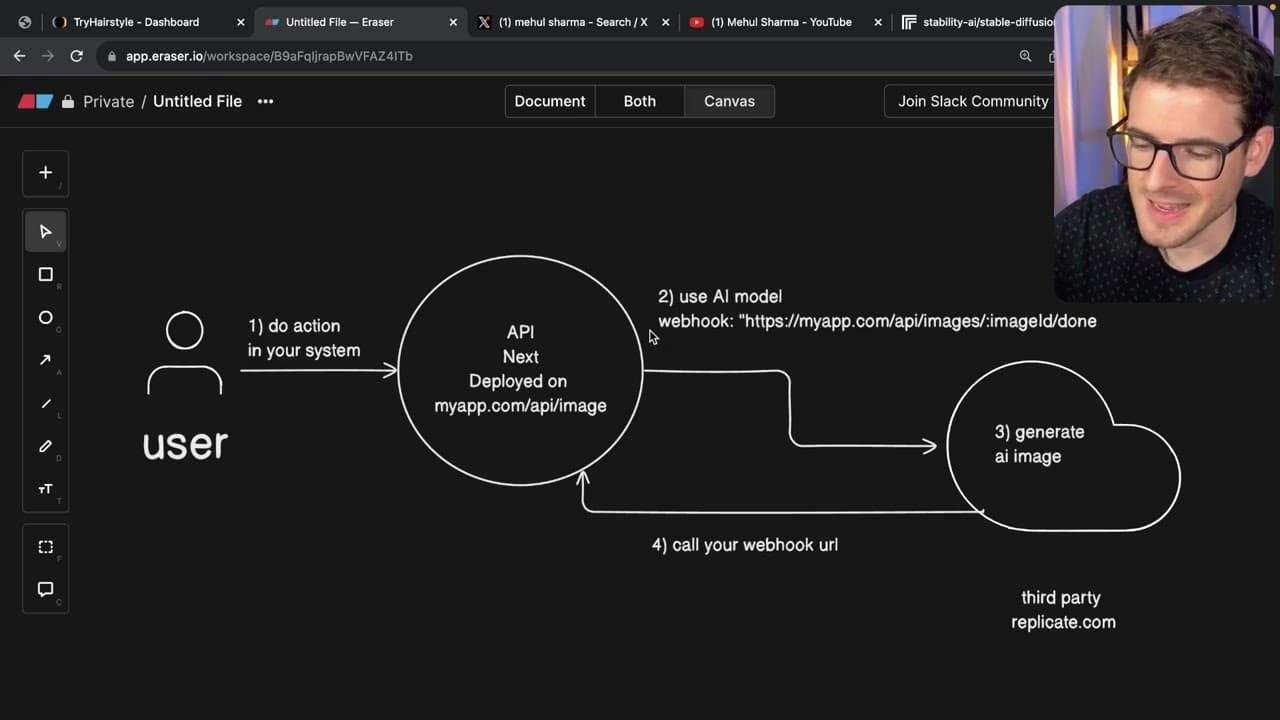
so one important concept that you'll need to understand if you're getting into web development is something called Web Hooks and the way web hooks kind of work is if you have a process that takes quite a long time for example I'm on this try hairstyle.com site which I'm kind of giving a little shout out to uh mul Sharma who is on Twitter here if yo... Read More
Key Insights
- 👻 Web hooks facilitate asynchronous interactions by allowing external services to inform applications upon task completion, alleviating potential timeout issues.
- 👤 Integration with web hooks enhances usability in scenarios where lengthy processing tasks would hinder user experience.
- 👤 Developers must be mindful of user notification methods when implementing web hooks, as polling can lead to inefficient resource use.
- 🚚 Using server-side events or websockets can improve real-time notifications but require careful management to ensure correct message delivery.
- 🐕🦺 The complexity of websockets necessitates leveraging services or message brokers for efficient connection handling in distributed environments.
- 👻 The concept of decoupling systems through web hooks allows for more modular architecture in application design.
- 🕸️ Understanding web hooks is crucial for successful integration with APIs, particularly in synchronous processing environments.
Install to Summarize YouTube Videos and Get Transcripts
Explore YouTube Video Summarizer or Get YouTube Transcript Extractor
Questions & Answers
Q: What is the primary purpose of using web hooks in web development?
The primary purpose of web hooks in web development is to efficiently handle notifications from third-party services regarding the completion of long-running processes. By using web hooks, developers can avoid user-facing delays caused by time-consuming tasks, as the application doesn’t need to hold open connections while waiting for responses. Instead, the third-party service sends a notification directly to the application when the task is completed, enhancing performance and user experience.
Q: How do web hooks improve the efficiency of web applications?
Web hooks improve the efficiency of web applications by allowing asynchronous processing of tasks. When an action is initiated, instead of keeping the user in a waiting state, the web application registers a web hook URL with the service performing the processing. Once the task is complete, the service sends a post request to the URL, which allows the application to update the user interface without constant polling or keeping resource-intensive connections open.
Q: What are the disadvantages of using polling to check the status of web hooks?
Polling can be inefficient due to its frequent requests to the server, leading to high traffic costs and server load. It involves the client repeatedly checking the server for updates, which can waste resources, especially when many users are simultaneously polling. This method is less efficient compared to event-driven approaches like web hooks, which only notify the application when a task is complete, reducing unnecessary processing and network usage.
Q: What challenges are associated with implementing websockets for notifications?
Implementing websockets for notifications presents challenges such as managing stateful connections and scaling issues. Since websockets require a persisted connection between client and server, developers must ensure that the connection remains active even if users interact with different servers behind a load balancer. This introduces complexity as the server must track user connections and relay messages accurately, often requiring additional infrastructure like message brokers to manage this communication effectively.
Summary & Key Takeaways
-
Web hooks provide a mechanism for notifying applications when a specific process is completed, helping manage long-running tasks effectively without causing timeouts or inefficiencies.
-
In web development, they allow decoupling of systems by enabling third-party services to notify applications without keeping an active connection, which can lead to wasted resources.
-
Various methods to notify users include polling, server-side events, and websockets, with each having its own use cases and implications for application design.
Read in Other Languages (beta)
Share This Summary 📚
Summarize YouTube Videos and Get Video Transcripts with 1-Click
Try YouTube Summary with ChatGPT & Claude or YouTube Transcript Generator
Explore More Summaries from Web Dev Cody 📚
Summarize YouTube Videos and Get Video Transcripts with 1-Click
Try YouTube Summary with ChatGPT & Claude or YouTube Transcript Generator