How to Calculate Displacement from a Velocity vs Time Graph
TL;DR
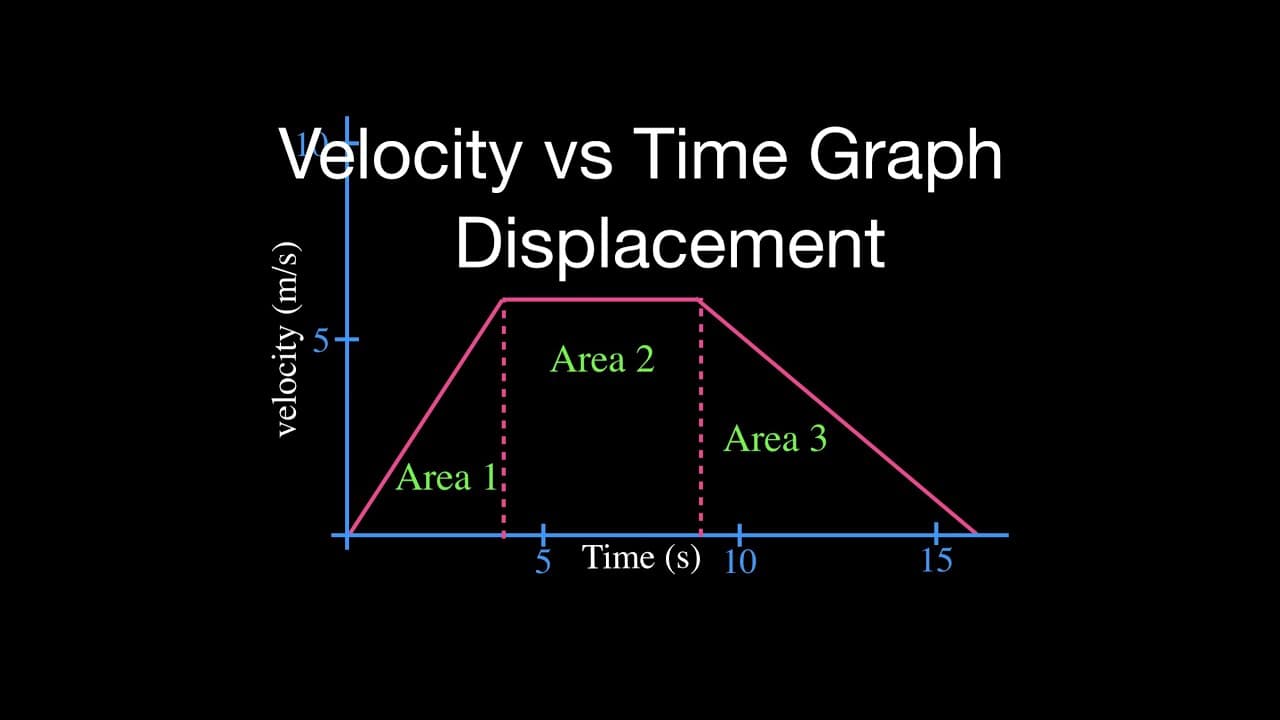
To calculate displacement from a velocity vs time graph, find the area under the curve, which represents displacement. This involves summing the areas of shapes like triangles and rectangles, while considering the sign of velocity to determine direction. If the total displacement is zero, the object has returned to its starting point.
Transcript
okay in today's video I'm going to go over how to determine the displacement or the change in position of an object from its velocity versus time graph okay here is our first velocity versus time graph and the question is what is the change in position for the time interval from 0 to 24 seconds okay that's what we have shown on this graph we have v... Read More
Key Insights
- ⌛ The area under the curve on a velocity vs time graph represents the displacement of an object.
- ❎ Positive velocity indicates movement in one direction, while negative velocity indicates movement in the opposite direction.
- 📈 Displacement can be calculated by finding the area of triangles and rectangles on the graph.
- 🍹 The total displacement is the sum of the displacement calculated for each section of the graph.
- 🤒 If the total displacement is zero meters, it means the object moved both forward and backward and returned to the starting point.
- 😒 It is important to use the correct signs in velocity when calculating displacement.
- ⌛ The length and width of rectangles on the graph correspond to time and velocity, respectively.
Install to Summarize YouTube Videos and Get Transcripts
Explore YouTube Video Summarizer or Get YouTube Transcript Extractor
Questions & Answers
Q: How can you determine displacement from a velocity vs time graph?
To determine displacement, one needs to calculate the area under the curve on the velocity vs time graph. The area under the curve represents the displacement of the object.
Q: Why is it important to consider the signs of velocity when calculating displacement?
The signs of velocity indicate the direction in which an object is moving. Positive velocity indicates movement in one direction, while negative velocity indicates movement in the opposite direction. Considering the signs helps determine the correct displacement.
Q: What does it mean if the total displacement is zero meters?
If the total displacement is zero meters, it means that the object moved both forward and backward and ended up at the starting point. The object's movement canceled out, resulting in no net displacement.
Q: How can displacement be calculated for different sections of the graph?
Displacement can be calculated by dividing the graph into sections, such as triangles and rectangles. For triangles, the formula is 0.5 times the base times the height, while for rectangles, it is the length times the width.
Summary & Key Takeaways
-
The video discusses how to find the change in position or displacement of an object using a velocity vs time graph.
-
The area under the curve of the graph represents the displacement of the object.
-
The video demonstrates finding displacement for different sections of the graph and explains the significance of the signs in velocity.
Read in Other Languages (beta)
Share This Summary 📚
Summarize YouTube Videos and Get Video Transcripts with 1-Click
Try YouTube Summary with ChatGPT & Claude or YouTube Transcript Generator
Explore More Summaries from Step by Step Science 📚
Summarize YouTube Videos and Get Video Transcripts with 1-Click
Try YouTube Summary with ChatGPT & Claude or YouTube Transcript Generator