How Does AI Predict Human Perception of Images?
TL;DR
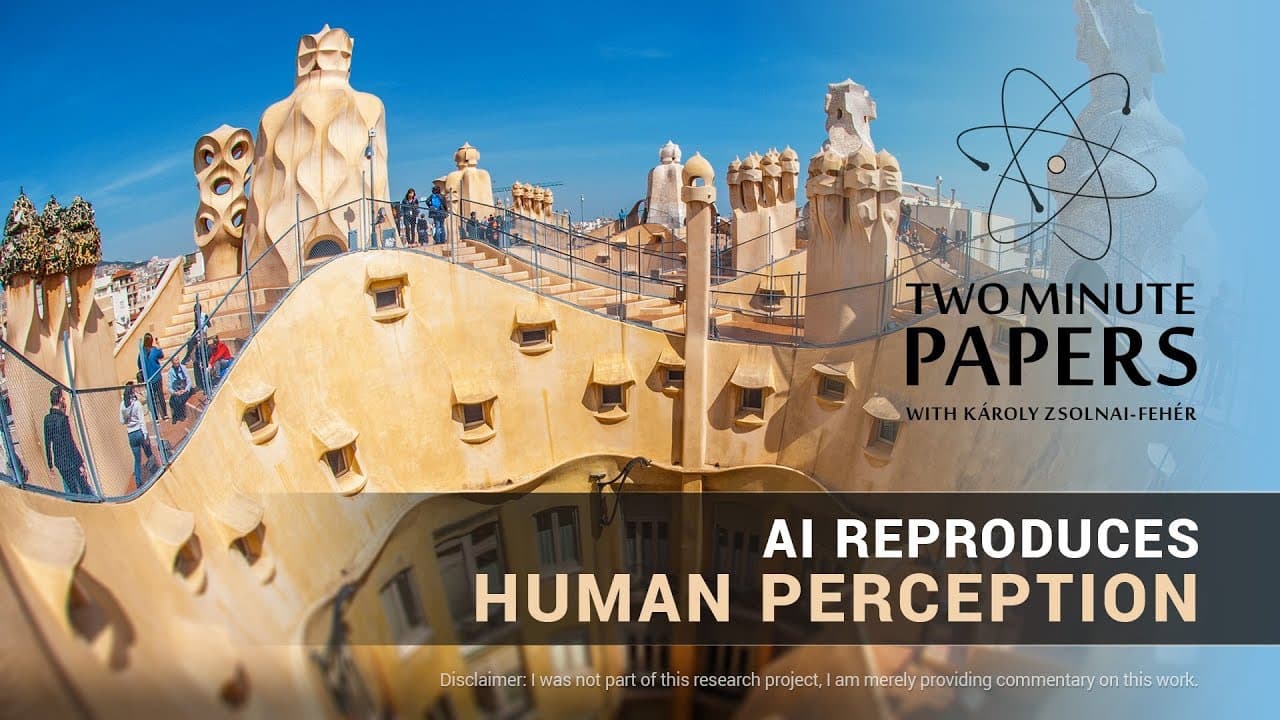
AI can predict human perception of image similarity by using a deep neural network trained on a database of human decisions. This new method, called LPIPS, aligns more closely with how people perceive differences, addressing limitations of traditional metrics that often disagree with human assessments.
Transcript
Dear Fellow Scholars, this is Two Minute Papers with Károly Zsolnai-Fehér. Assessing how similar two images are has been a long standing problem in computer graphics. For instance, if we write a new light simulation program, we have to compare our results against the output of other algorithms and a noise-free reference image. However, this often m... Read More
Key Insights
- 💻 Assessing image similarity in computer graphics has been challenging due to varying noise structures and disagreements among traditional error metrics.
- 📈 Humans often perceive noisy images as more similar to a reference image, while error metrics favor blurry images.
- 👶 A deep neural network trained on human decisions can accurately predict how humans perceive differences in images, providing a new similarity metric.
- 🤙 The proposed technique, called LPIPS, shows strong agreement with human perception across multiple neural network architectures.
- 💦 This new similarity metric has implications for image analysis and research work involving images.
- 👨🔬 The research paper also discusses failure cases and offers a more detailed analysis.
- 👨🔬 Support for the Two Minute Papers channel on Patreon can contribute to the promotion of such research.
Install to Summarize YouTube Videos and Get Transcripts
Explore YouTube Video Summarizer or Get YouTube Transcript Extractor
Questions & Answers
Q: Why is assessing image similarity important in computer graphics?
Assessing image similarity is crucial in computer graphics to compare algorithmic results, evaluate material models, and identify visually similar images for various applications.
Q: What is a similarity metric?
A similarity metric is a measure used to quantify and compare how similar two images are. It helps determine the resemblance between images based on specific criteria.
Q: How do traditional error metrics differ from human perception of image similarity?
Traditional error metrics often prioritize per-pixel differences, leading to different results compared to how humans perceive image similarity. For example, humans may find noisy images more similar to a reference image, while error metrics favor blurry images.
Q: How does the deep neural network proposed in the research align with human perception?
By training the neural network with a database of human decisions on image differences, it learns to predict how humans perceive image similarity. This provides a new similarity metric that agrees with human judgment.
Summary & Key Takeaways
-
Comparing the similarity of images has been a challenge in computer graphics, particularly when the structure of noise varies. This creates disagreements on which algorithm is better.
-
Traditional error metrics often disagree with human perception of image similarity, such as favoring blurred images over noisy ones.
-
By training a deep neural network using a database of human decisions on image differences, researchers have developed a new similarity metric that aligns with human perception.
-
The proposed technique, called LPIPS, shows promising results and can be used in various research involving image analysis.
Read in Other Languages (beta)
Share This Summary 📚
Summarize YouTube Videos and Get Video Transcripts with 1-Click
Try YouTube Summary with ChatGPT & Claude or YouTube Transcript Generator
Explore More Summaries from Two Minute Papers 📚




Summarize YouTube Videos and Get Video Transcripts with 1-Click
Try YouTube Summary with ChatGPT & Claude or YouTube Transcript Generator