Maths - Finding Bearings
TL;DR
This video provides an introduction to bearings in math, explaining true bearings and conventional bearings using illustrative examples.
Transcript
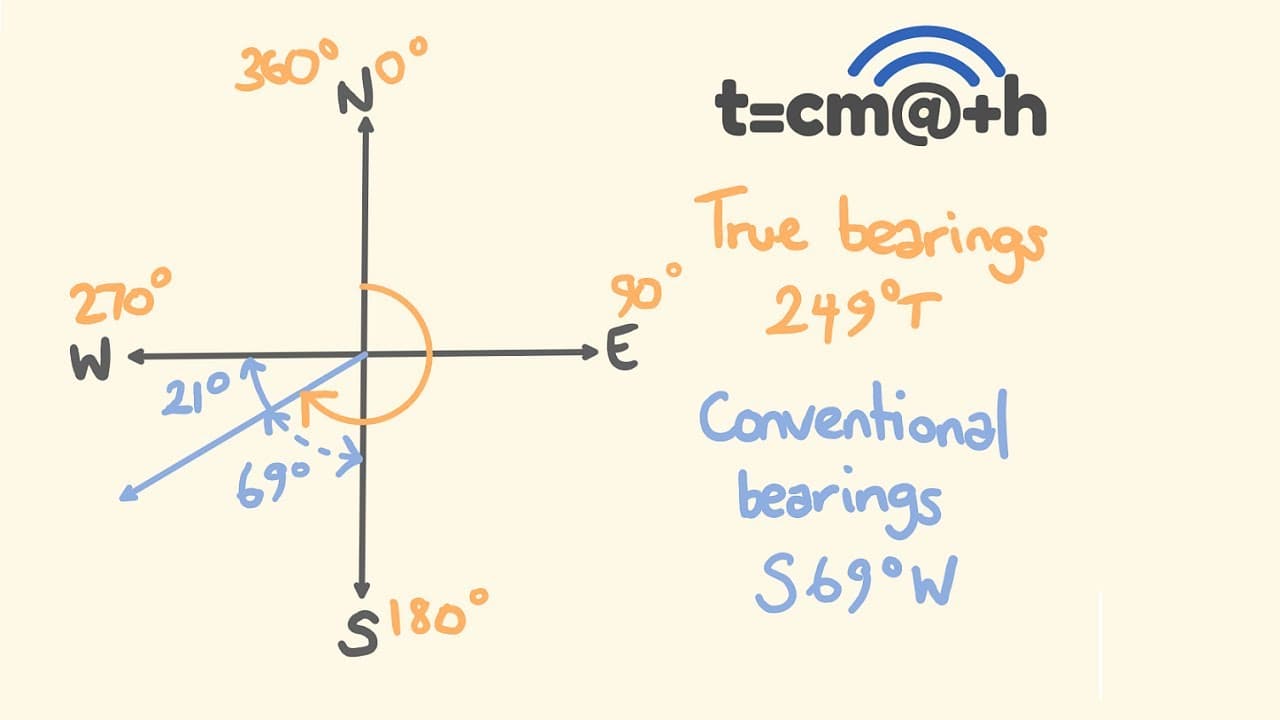
good day welcome to Tech math Channel just a quick video looking at bearings okay so bearings is a way of describing uh one point from another Point okay directions from a particular point so you're probably well aware of this type of way of doing this NorthEast Southwest we're going to be looking at ways of doing this using numbers okay so the two... Read More
Key Insights
- 😥 Bearings are used to describe directions between two points, and they can be calculated using either true bearings or conventional bearings.
- 🔄 True bearings involve counting degrees in a clockwise direction from North, while conventional bearings start with North or South and count the degrees turned East or West.
- 🪜 To calculate the true bearing, add the degrees turned from North to East or West to the angle measurement.
- ↩️ To determine the conventional bearing, subtract the given angle from 90 degrees (if starting with North) or from 270 degrees (if starting with South) to find the degrees turned East or West.
- 🔄 It is possible to measure bearings using a compass by aligning it with North and counting the degrees turned in a clockwise direction.
- 🌍 Understanding bearings is important in navigation, geometry, and various real-world applications.
- 🔺 True bearings provide a consistent reference point for measuring angles, allowing for accurate descriptions of directions.
Install to Summarize YouTube Videos and Get Transcripts
Explore YouTube Video Summarizer or Get YouTube Transcript Extractor
Questions & Answers
Q: What is the difference between true bearings and conventional bearings?
True bearings involve counting degrees in a clockwise direction from North, while conventional bearings start with North or South and count the degrees turned East or West.
Q: How do you calculate the true bearing if the angle measurement is given?
To calculate the true bearing, add the angle measurement to the degrees turned from North to East or West.
Q: How can you determine the conventional bearing if the angle is known?
Subtract the given angle from 90 degrees (if starting with North) or from 270 degrees (if starting with South) to find the degrees turned East or West.
Q: Can bearings be measured using a compass?
Yes, one can measure bearings using a compass by aligning the compass with North and then counting the degrees turned in a clockwise direction.
Summary & Key Takeaways
-
Bearings are used to describe directions from one point to another, and this video explains how to use numbers to describe bearings.
-
True bearings involve counting from North in a clockwise direction to determine the number of degrees through which we turn to face a particular point.
-
Conventional bearings start with either North or South and then count the number of degrees turned East or West to reach the desired point.
Read in Other Languages (beta)
Share This Summary 📚
Summarize YouTube Videos and Get Video Transcripts with 1-Click
Try YouTube Summary with ChatGPT & Claude or YouTube Transcript Generator
Explore More Summaries from tecmath 📚




Summarize YouTube Videos and Get Video Transcripts with 1-Click
Try YouTube Summary with ChatGPT & Claude or YouTube Transcript Generator