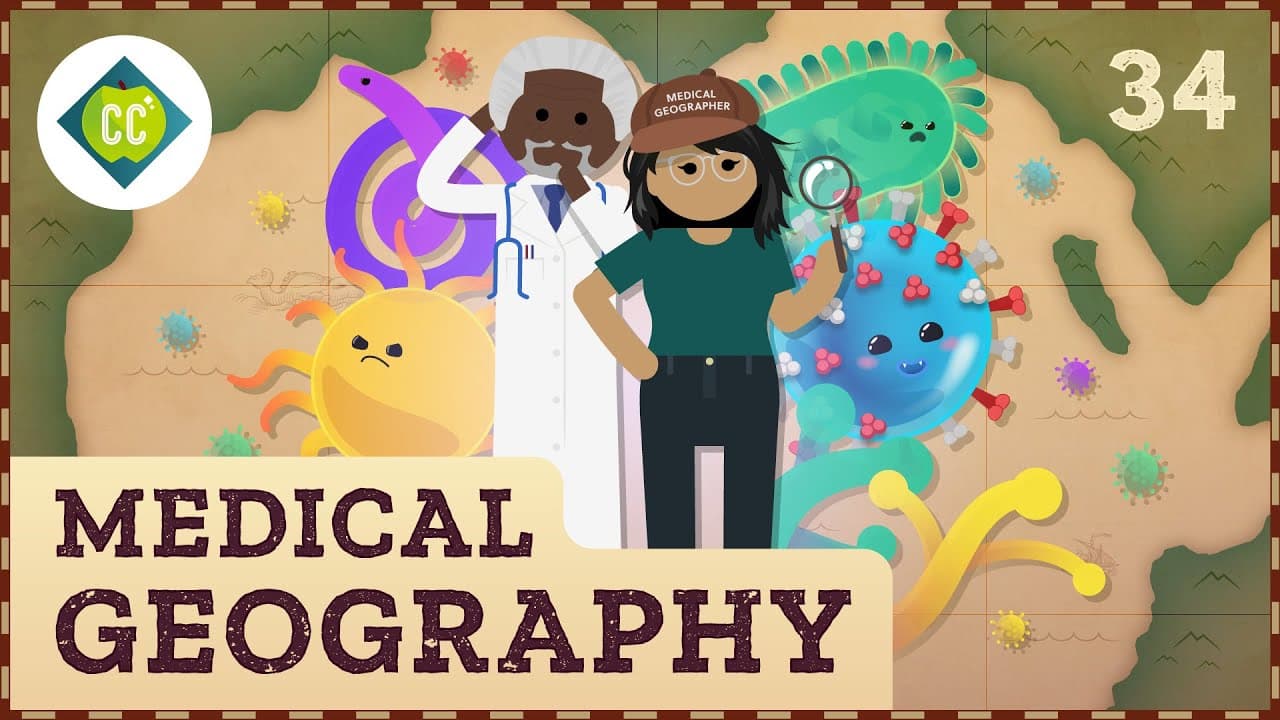
How Does Disease Move? Crash Course Geography #34
TL;DR
Disease moves through people, air, water, and environmental or social conditions, creating geographic patterns that help experts trace outbreaks. Crash Course Geography #34 examines measles spreading through travel and population mixing, alongside the 2010 cholera epidemic in Haiti linked to contamination of the Artibonite River. Read on to see how maps and spatial analysis help medical geographers identify origins and support disease response.
Transcript
in 2014 a disease that was no longer common in the united states resurfaced with a vengeance people suddenly began running high fevers and developing rashes and in some communities people became so sick they had to be hospitalized throughout 2015 other outbreaks would pop up and each time healthcare officials would leap into action trying to identi... Read More
Key Insights
- 🧑🏭 Disease patterns can be influenced by factors such as travel, globalization, and different approaches to healthcare.
- 😷 Medical geographers play a vital role in studying disease distribution, predicting disease spread, and assisting in disease response measures.
- 👨🔬 Disease outbreaks can be caused by both communicable and non-communicable diseases, highlighting the need for comprehensive research and analysis.
- 😷 Spatial skills and mapping are important tools for medical geographers in identifying disease patterns and origins.
- 💦 Environmental factors, such as water contamination, can contribute to the spread of diseases like cholera.
- ☠️ Disease outbreaks can have significant morbidity and mortality rates, impacting communities and healthcare systems.
- 😷 Access to healthcare and socio-economic factors can influence disease spread and the ability to receive appropriate medical care.
Install to Summarize YouTube Videos and Get Transcripts
Explore YouTube Video Summarizer or Get YouTube Transcript Extractor
Questions & Answers
Q: How does disease move and spread?
Communicable diseases can move from a pathogen to a host through routes such as air, water, and person-to-person contact. Travel and population mixing can carry pathogens between places, while environmental and social conditions shape where diseases appear and spread.
Q: How did measles spread in the United States beginning in 2014?
Measles first appeared in pockets, mostly in large cities where people who had traveled abroad mixed with the population. Because measles spreads through the air and is highly contagious, health officials worked to identify and isolate cases as additional outbreaks appeared throughout 2015.
Q: What is the difference between communicable and noncommunicable diseases?
Communicable diseases spread when a pathogen, such as a bacterium, virus, fungus, or parasite, reaches a host. Noncommunicable diseases are not caused by an acute infection; they arise from combinations of genetic, environmental, and behavioral conditions and are often chronic.
Q: What does epidemiology study?
Epidemiology examines how diseases are distributed and which factors influence health. It applies that knowledge to control and, when possible, eliminate diseases and other health-related problems.
Q: What do medical geographers do?
Medical geographers use spatial skills and knowledge of how society and the environment interact to identify disease patterns and conditions. They conduct research, work with the public, and support public health agencies, community health clinics, and global agencies.
Q: How do maps help trace disease outbreaks?
Maps reveal where cases begin, how they cluster, and the routes along which they spread. A map showing cholera cases beginning mid-river in Haiti and continuing downstream suggested that the pathogen entered the water at a particular point.
Q: How was the origin of Haiti’s 2010 cholera outbreak identified?
Maps helped establish that the outbreak began near a point on the Artibonite River and spread downstream. Investigators connected the contamination to UN troops from Nepal who were improperly disposing of human waste while assisting with earthquake recovery.
Q: Why was Haiti vulnerable to the 2010 cholera epidemic?
Many Haitians relied on the Artibonite River because treated water was scarce while the country recovered from a massive earthquake. Cholera had not appeared in Haiti for at least 100 years and possibly never, while the disease was endemic in Nepal and the Nepalese strain could thrive in Haiti.
Summary & Key Takeaways
-
Disease resurfaced in the United States in 2014, with measles outbreaks occurring in different communities, highlighting the need for disease response measures.
-
Disease can be communicable, spread person to person, or non-communicable, caused by genetics, environment, and behavior.
-
Medical geographers play a crucial role in identifying disease patterns, studying how environment and society connect to create conditions for disease manifestation.
Read in Other Languages (beta)
Share This Summary 📚
Summarize YouTube Videos and Get Video Transcripts with 1-Click
Try YouTube Summary with ChatGPT & Claude or YouTube Transcript Generator
Explore More Summaries from CrashCourse 📚





Summarize YouTube Videos and Get Video Transcripts with 1-Click
Try YouTube Summary with ChatGPT & Claude or YouTube Transcript Generator