How Can You Sell THIS AI Content System for $1K? (FREE TEMPLATE)
TL;DR
Build the AI content system by extracting a YouTube podcast transcript, using OpenAI to create 10 or more platform-specific posts, and scheduling them for gradual publication. Apify costs about 1 cent per transcript, while a four-column Google Sheets database tracks each post across Instagram, LinkedIn, and Facebook. Read on for the exact workflow, structured AI output, publishing process, and potential $1,000 to $2,000 service offer.
Transcript
Today, I'm going to build an AI podcast repurposing engine live in front of you that takes as input a YouTube link to a podcast and then outputs 10 or more high-quality social media posts, all beautifully formatted and ready to go. Uh, the reason I'm doing this video is because I wanted to show you guys what a live build process looks like from sta... Read More
Key Insights
- The system is designed to turn one long-form podcast episode into 10 or more formatted social media posts, allowing the original recording to support content across Instagram, LinkedIn, and Facebook without requiring additional recording time.
- A problem-first approach is central to the build process: the creator recommends confirming that customers need more content before constructing the automation, instead of building a system first and searching afterward for a problem it might solve.
- The workflow starts with a simple form that accepts a YouTube podcast URL, although monitoring a channel for new uploads could automate the trigger. Manual submission is chosen because it is the simplest input method for demonstrating and operating the system.
- Apify retrieves the YouTube transcript for roughly one cent per transcript, or about 100 podcasts per dollar. OpenAI's Whisper and numerous other transcription approaches are mentioned as alternatives, but Apify is selected as the simplest option for this workflow.
- The OpenAI module produces a large JSON response containing an index number, transcript paragraph, context, feedback, detailed section explanation, and image description. Processing a long transcript with a 128,000-token context can take about 30 seconds before the output is split.
- Platform-specific generation uses separate AI processing for Instagram, Facebook, and LinkedIn, enabling each output to match its destination. The workflow also creates image descriptions that can support a consistent visual style, such as the demonstrated watercolor treatment.
- A four-column database tracks the date added, post body, post image, and platforms where each item has appeared. This intermediate layer makes the workflow manageable and lets publishing automations identify new additions without sending every generated post immediately.
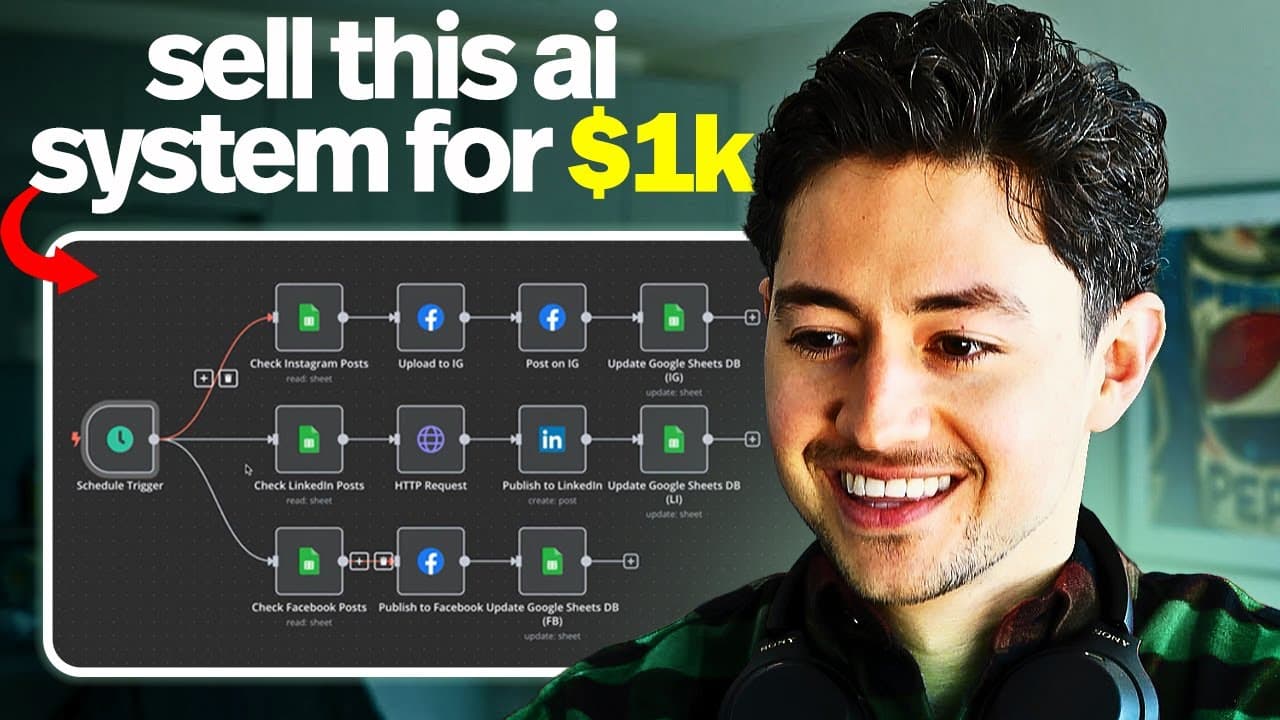
- A scheduled workflow runs every morning at 7 and drips posts out according to a predefined schedule. Instagram publishing uses the Graph API, LinkedIn requires an HTTP request, and the database is updated after posting to record completion.
- "Today, I'm going to build an AI podcast repurposing engine live in front of you that takes as input a YouTube link to a podcast and then outputs 10 or more high-quality social media posts, all beautifully formatted and ready to go." (0:00)
- "Then finally, we'll just do some merge and then update a form." (1:02)
- "So we just did Instagram, now we're doing LinkedIn." (2:59)
- "Ideally, you would start with the problem and then you build a system that solves that problem, not the other way around." (4:37)
Install to Summarize YouTube Videos and Get Transcripts
Explore YouTube Video Summarizer or Get YouTube Transcript Extractor
Questions & Answers
Q: How do you build an AI podcast repurposing engine?
Submit a YouTube podcast URL through a form, retrieve its transcript with Apify, and send the text to an OpenAI module. Split the resulting structured JSON into individual items, generate platform-specific posts and images, and add everything to a database for scheduled publishing.
Q: What does the AI podcast repurposing engine produce?
The system turns one YouTube podcast into 10 or more formatted social media posts. It generates separate content for Instagram, LinkedIn, and Facebook, along with image descriptions that can be used to create JPEGs.
Q: How much does podcast transcript extraction cost with Apify?
The transcript service is described as costing about 1 cent per transcript. That works out to roughly 100 podcast transcripts per dollar.
Q: What information should OpenAI extract from the podcast transcript?
The OpenAI module returns structured JSON containing an index number, a transcript paragraph, context, feedback, a detailed explanation, and an image description. These fields supply the material needed for later post and image generation steps.
Q: How long does OpenAI take to process a long podcast transcript?
Processing the relatively long transcript usually takes about 30 seconds. The model is described as having a context of 128,000 tokens, and the workflow splits the output into separate items afterward.
Q: How should the generated social media content be stored?
The demonstrated Google Sheets database has four columns: date added, post body, post image, and posted on. The posted-on field records which platforms have received each item, allowing the workflow to identify pending posts and update completed ones.
Q: How are podcast posts scheduled and published automatically?
A workflow runs every morning at 7 and checks the database for new additions. It can drip out batches of 10, 20, or 50 posts according to a predefined schedule instead of publishing them all at once. Instagram uses the Graph API, while LinkedIn uses an HTTP request.
Q: How much can this AI content system be sold for?
The existing offer positions the system at $1,000, while the creator suggests a service price of about $1,000 to $2,000. Its value comes from producing many posts from one long-form episode and publishing them in the background without additional recording time.
Summary & Key Takeaways
-
The system begins with a manually submitted YouTube podcast URL and retrieves the transcript through Apify, a third-party service described as costing about one cent per transcript. The transcript then enters an OpenAI module that produces structured JSON containing selected passages, context, feedback, explanations, and descriptions for generating accompanying images.
-
The structured output is split into individual items and transformed into content for Instagram, LinkedIn, and Facebook. The workflow can also prepare timestamps, hashtags, and supporting information for short clips, although the referenced clipping platform lacks an open API. Twitter or X is excluded because its API costs about $200 monthly.
-
Generated posts and images enter a Google Sheets database with four columns: date added, post body, post image, and posted on. A workflow runs every morning at 7, checks for new entries, publishes them gradually through platform integrations or HTTP requests, and updates the database to show where each item was posted.
Read in Other Languages (beta)
Share This Summary 📚
Summarize YouTube Videos and Get Video Transcripts with 1-Click
Try YouTube Summary with ChatGPT & Claude or YouTube Transcript Generator
Explore More Summaries from Nick Saraev 📚






Summarize YouTube Videos and Get Video Transcripts with 1-Click
Try YouTube Summary with ChatGPT & Claude or YouTube Transcript Generator