How to Automate Business Workflows With Codex
TL;DR
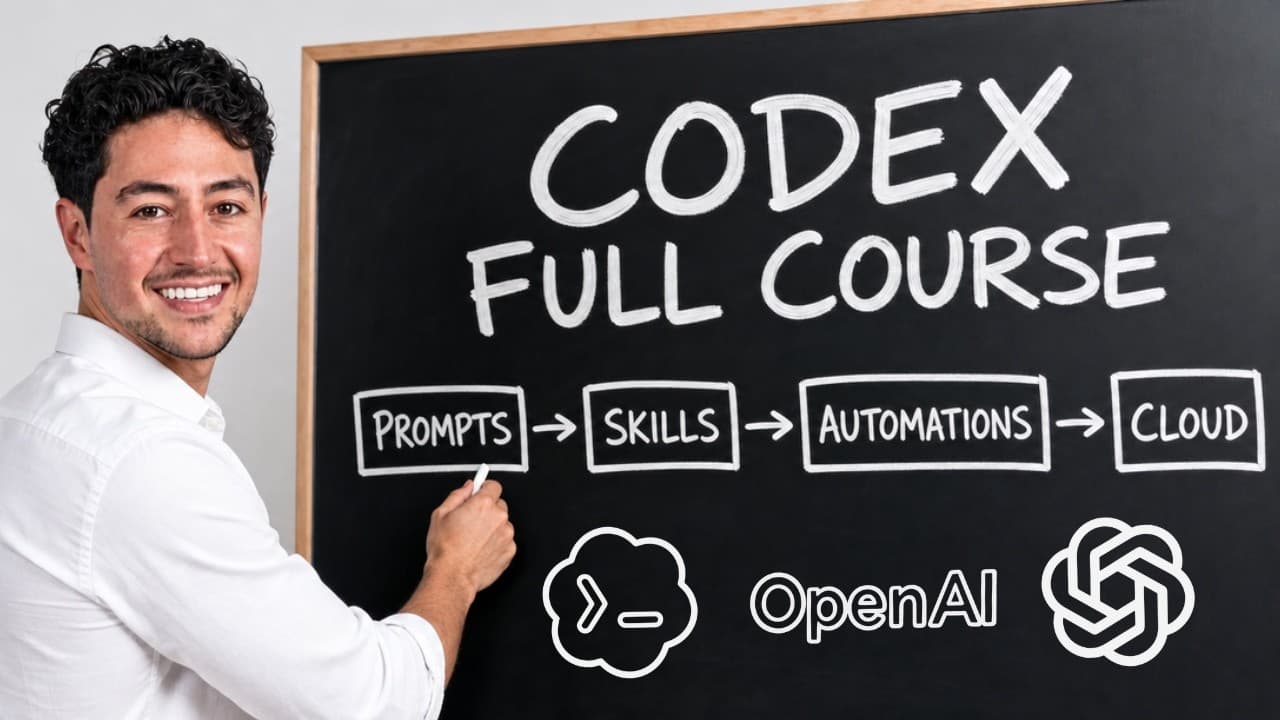
Codex can automate practical business workflows across sales, marketing, operations, and lead handling, even for users without programming experience. The course progresses from basic prompting to agent skills, local automations, and cloud automations, while demonstrating proposal generation, content repurposing, pipeline accountability, and an after-hours voice agent.
Transcript
Welcome to the comprehensive course on Codex for business. This is a step-by-step breakdown of how to actually implement codecs and other super cool intelligences into real businesses to improve revenue and then increase profit. Uh my name is Nick. I run a company that just did $500,000 last month in Rev, primarily using AI tools like Codeex, Claud... Read More
Key Insights
- Codex is presented as a tool for producing measurable business outcomes, including more revenue and lower operating costs. The course focuses on practical implementation rather than programming theory, and it is designed for viewers who have no prior experience with software development or artificial intelligence.
- The implementation framework has four levels: prompting, agent skills, local automations, and cloud automations. Each level increases the system's sophistication, moving from direct instructions toward reusable capabilities and automated processes that can support recurring business functions.
- Sales automation can transform information from a sales call into a customized proposal containing an electronic signature and checkout. This workflow is intended to reduce the manual effort between a conversation with a prospect and the delivery of materials needed to complete a purchase.
- Content repurposing can convert one source into several distribution formats. A long-form YouTube video can become short videos, LinkedIn posts, newsletters, and posts for X, while a LinkedIn post can also supply material for newsletters, X posts, and short videos.
- Effective AI-assisted marketing depends on preserving the creator's voice. The stated goal is not merely to increase top-of-funnel output, but to produce repurposed material that sounds like the original creator instead of generic AI-generated content.
- Pipeline hygiene is an operations function that supports accountability in CRM and project-management systems. The course positions consistent record maintenance as essential for mid-sized and large operations, and suggests that building AI systems for this responsibility can make an employee or contractor more valuable.
- An after-hours voice agent can automatically handle incoming leads when human staff are unavailable. The proposed system is meant to reduce leaks in the sales pipeline by providing a mechanism for responding to prospects outside normal operating hours.
- Parallelization is a core Codex working method in the course. Users can create multiple conversations and allow them to run independently, while the activity view highlights conversations that require attention and hides those that currently do not need intervention.
Install to Summarize YouTube Videos and Get Transcripts
Explore YouTube Video Summarizer or Get YouTube Transcript Extractor
Questions & Answers
Q: How can Codex automate business workflows?
Codex can support business workflows through a progression from prompting to agent skills, local automations, and cloud automations. The examples covered include converting sales calls into customized proposals, repurposing content across several channels, maintaining CRM and project-management records, and operating an after-hours voice agent that handles leads when staff members are unavailable.
Q: How do beginners install and start using Codex?
Beginners can visit the Codex page on OpenAI's website, download the application, and follow the normal installation process for their operating system. On macOS, the demonstrated process involves dragging the application into the Applications folder. After opening it, users can sign in with an existing ChatGPT account, choose another sign-in method, or create an account and complete verification.
Q: What are the four levels of Codex business automation?
The four levels are prompting, building agent skills, building local automations, and converting those systems into cloud automations. Prompting is presented as the first level, while each later stage creates a more developed capability. The framework is applied across business functions so users can progress from direct AI assistance to systems that perform recurring work.
Q: How can Codex turn a sales call into a proposal?
The sales workflow takes information from a sales call and uses it to create a customized proposal. The resulting proposal can include an electronic signature and a checkout, giving the prospect a path from the original conversation to agreement and payment. The course presents this as a practical sales automation rather than an abstract coding demonstration.
Q: How can Codex repurpose content for multiple platforms?
Codex can use one piece of content as source material for several formats. A long-form YouTube video can be repurposed into short videos, LinkedIn posts, newsletters, and posts for X. A LinkedIn post can similarly become a newsletter, an X post, or short-form video content, increasing top-of-funnel production from existing work.
Q: How can AI-generated content preserve a creator's voice?
The marketing objective is to produce more content while keeping it recognizable as the creator's own work. The course specifically distinguishes useful repurposing from generic AI output by emphasizing material that sounds like the original person. Content begins with an existing video or written post, which provides source material for adapting ideas into other formats.
Q: How does Codex help with CRM pipeline hygiene?
Codex can support daily pipeline hygiene in CRM and project-management systems. This operational work helps maintain accountability, which the course describes as essential in mid-sized and large operations. An AI system can assist with the recurring maintenance involved, making the person who implements and oversees that process more valuable within a business or client engagement.
Q: Why build an after-hours voice agent with Codex?
An after-hours voice agent can automatically handle leads when the normal team is unavailable. Its purpose is to patch leaks in the pipeline by preventing inquiries from being left entirely unattended outside business hours. The course includes this agent as a final practical build, alongside guidance for maintaining and upgrading automated systems over time.
Summary & Key Takeaways
-
The course begins with downloading, installing, and signing into Codex, then introduces its main interface. It covers chat navigation, search, settings, activity monitoring, the managed browser, and the terminal. Beginners are reassured that they need only part of the interface to start automating useful business tasks.
-
The instruction organizes Codex implementation into four levels: prompting, agent skills, local automations, and cloud automations. This progression turns one-time AI assistance into increasingly reusable systems. The intended audience includes business owners, corporate employees, and contractors who want to connect AI capabilities with revenue growth, cost savings, or operational accountability.
-
Practical demonstrations cover four business functions. Sales calls become customized proposals with electronic signatures and checkout. Long-form or written content becomes posts, newsletters, and short videos. CRM and project-management records receive daily pipeline hygiene. An after-hours voice agent handles leads, followed by guidance for maintaining and upgrading the resulting systems.
Read in Other Languages (beta)
Share This Summary 📚
Summarize YouTube Videos and Get Video Transcripts with 1-Click
Try YouTube Summary with ChatGPT & Claude or YouTube Transcript Generator
Explore More Summaries from Nick Saraev 📚





Summarize YouTube Videos and Get Video Transcripts with 1-Click
Try YouTube Summary with ChatGPT & Claude or YouTube Transcript Generator