What Are Turing Machines and How Do They Work?
TL;DR
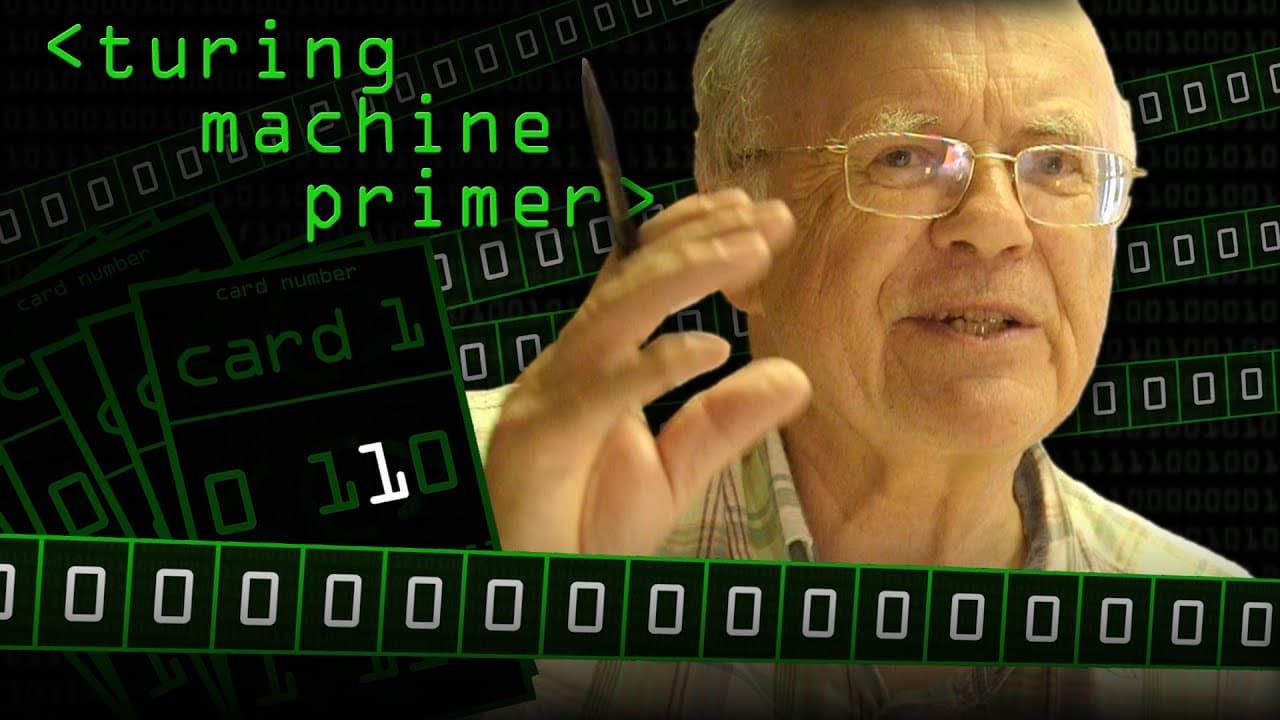
Turing machines consist of a tape divided into cells, a read/write head, and a set of program instructions. They can read and write values while shifting left or right on the tape, allowing for complex calculations. The Busy Beaver game exemplifies this concept by pushing the limits of what Turing machines can achieve.
Transcript
I've just done a film about a special class of Turing machine called busy beaver that enables you to play the busy bee of the game so there's lots of wonderful video 40g that you can see on that however for those of you new to this game who aren't familiar at all with how Turing machines work what we've now done is sectioned off a little piece of f... Read More
Key Insights
- 🫠 Turing machines consist of a tape divided into cells, a read/write head, and program code.
- 👻 The tape cells can store program instructions and data, allowing for infinite memory.
- ⤴️ The head can read or write values on the tape cells and shift left or right.
- 🤑 The busy beaver game is a specific class of Turing machines that aims to maximize the number of ones written on the tape.
- 🤟 Turing machines can be represented using Tebow Rado cards, simplifying the understanding of program instructions.
- 🤟 Different formulations of Turing machines, such as using different alphabets for the tape, do not affect their computing power.
- ❤️🩹 The layout of the program instructions on the tape can vary, with the program code often placed at one end and the data at the other end.
Install to Summarize YouTube Videos and Get Transcripts
Explore YouTube Video Summarizer or Get YouTube Transcript Extractor
Questions & Answers
Q: What is a Turing machine and how does it work?
A Turing machine is a theoretical computing model consisting of a tape divided into cells, a read/write head, and program code. The head can read or write values on the tape cells and shift left or right.
Q: How is the program code for a Turing machine typically stored?
Conventionally, the program code is stored on the tape itself, with instructions made up of ones and zeroes. The head alternates between reading program instructions and writing data.
Q: How does the busy beaver game relate to Turing machines?
The busy beaver game is a specific class of Turing machines that aims to find the longest-running program without halting. It involves maximizing the number of ones written on the tape.
Q: What is the significance of the Tebow Rado cards mentioned in the content?
Tebow Rado cards are an alternative way of representing program instructions in Turing machines. Each card represents an instruction, making it easier to understand and visualize the program flow.
Summary & Key Takeaways
-
The content introduces the concept of Turing machines, which consist of a tape divided into cells for storing program code and data.
-
A read/write head visits the tape cells and can read or write values, as well as shift left or right.
-
The program code for a Turing machine can be stored on cards, with each card representing an instruction for the machine.
Read in Other Languages (beta)
Share This Summary 📚
Summarize YouTube Videos and Get Video Transcripts with 1-Click
Try YouTube Summary with ChatGPT & Claude or YouTube Transcript Generator
Explore More Summaries from Computerphile 📚


Summarize YouTube Videos and Get Video Transcripts with 1-Click
Try YouTube Summary with ChatGPT & Claude or YouTube Transcript Generator