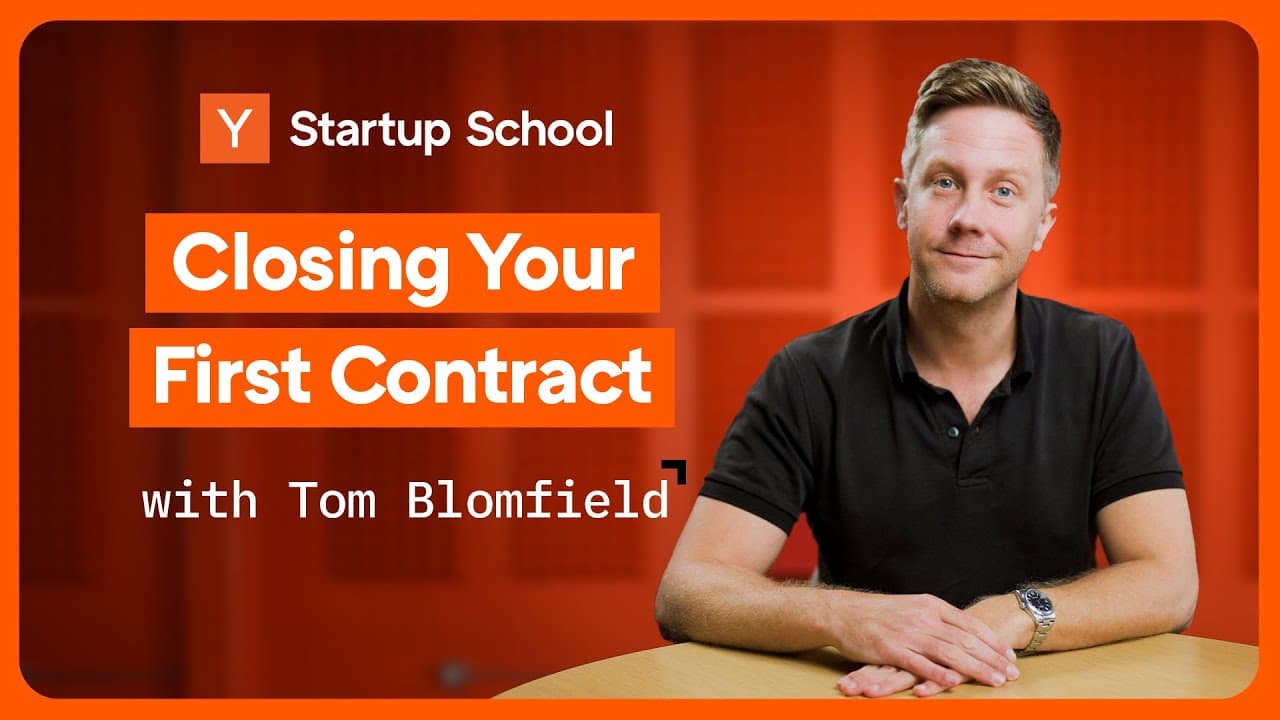
How to Close Your First B2B Contracts | The Sales Playbook for Founders | Startup School
TL;DR
To close your first B2B contracts, rapidly move from short, focused design partnerships to narrow products, paid trials, and recurring-revenue agreements with opt-out periods. Identify a burning problem, build a wedge product in as little as 48 hours, and test it with 10 similar customers before expanding. Read on for the practical stages, common mistakes, and contract tactics in the Startup School sales playbook.
Transcript
At YC, we work with a ton of founders who are navigating the B2B sales process for the very first time. And I often notice some very common and easily avoidable mistakes that I want to talk about today. So, I'm going to describe the typical progression that a B2B founder goes through. normally starting with something like a a really poorly defined ... Read More
Key Insights
- B2B founders often start with poorly defined design partnerships that hinder progress.
- Design partnerships should be short and focused on identifying specific customer problems.
- Founders should avoid overbuilding their product early on and instead focus on narrow, effective solutions.
- Free trials should have clear success metrics and aim to prove the product's value quickly.
- Paid trials require a financial commitment to ensure serious customer engagement.
- Recurring revenue contracts with opt-out periods streamline the sales process and build customer commitment.
- Customer success is crucial post-contract to ensure the product's value is realized and contracts are implemented.
- Security certifications like Sock 2 should be pursued early to avoid delays in the sales process.
Install to Summarize YouTube Videos and Get Transcripts
Explore YouTube Video Summarizer or Get YouTube Transcript Extractor
Questions & Answers
Q: How do founders close their first B2B contracts?
Start by identifying a narrow, burning customer problem and building a focused wedge product that can be tested quickly. Once customers will pay for it, sell the same product to 10 similar customers instead of immediately broadening the platform. Progress toward paid trials and recurring-revenue contracts with opt-out periods as quickly as product maturity and social proof allow.
Q: Why do B2B design partnerships often fail to produce revenue?
They are often unpaid, poorly scoped, and far too long, sometimes lasting 3 or 6 months. Because customers are not paying and have their own businesses to run, engagement stays low while the work becomes vague and meandering. A prestigious customer logo may feel like progress even when the partnership is not moving toward revenue.
Q: How should founders structure an early design partnership?
Keep it short and use it to observe the customer's work closely for a few days. Ask which part of the job they hate most or would eliminate with a magic wand, then isolate a narrow task that can be automated. The goal is a specific problem and a tightly focused solution, not an expanding list of bespoke requirements.
Q: How quickly should founders build an initial B2B wedge product?
The playbook recommends choosing a problem narrow enough that a wedge product can be built in as little as 48 hours. Bring it back to the customer, ask them to try it, and determine whether it solves the selected problem. Continue testing different problem-and-solution combinations until customers find one they love.
Q: What should founders do after a customer agrees to pay for a wedge product?
Do not immediately add more features. Take the same wedge product and try to sell it to another 10 similar customers. This tests whether demand extends beyond the original design partner before the company invests in a broader platform.
Q: Why should early-stage B2B startups avoid building broad platforms?
A small startup may lack the resources to reach feature parity with established software, and broad development can consume time without proving customer demand. Design partners may request one more feature instead of clearly rejecting an unfocused product. The recommended approach is to solve one part of the problem extremely well and sell that narrow wedge aggressively for a couple of weeks.
Q: What are the benefits of paid trials over free trials?
Paid trials create a financial commitment, making customers more likely to take the process seriously and engage with the product. Free trials should still have clear success metrics that demonstrate value quickly. Pricing should be discussed early so founders can identify prospects who are unwilling to pay.
Q: Why use recurring-revenue contracts with opt-out periods?
A recurring-revenue contract with an opt-out period allows the trial to transition into a full contract without requiring a second sales process. The existing page describes this as the sales “pro move” because it builds commitment and makes the transition more seamless. After signing, customer success remains important to ensure the product's value is realized and the contract is implemented.
Summary & Key Takeaways
-
Founders often get stuck in long, unpaid design partnerships that don't lead to revenue. Instead, they should focus on identifying specific problems and creating narrow solutions quickly. This approach allows for rapid iteration and testing with potential customers, leading to better product-market fit and faster sales progression.
-
Transitioning from free trials to paid trials is essential to secure customer commitment. Paid trials require a financial commitment, ensuring that customers take the process seriously. Founders should also discuss pricing early to disqualify uninterested customers, paving the way for successful sales.
-
Recurring revenue contracts with opt-out periods are the 'pro move' in sales, allowing for a seamless transition from trial to full contract. This approach reduces the need for a second sales process, making it easier to secure long-term commitments from customers and ensuring steady growth for the company.
Read in Other Languages (beta)
Share This Summary 📚
Summarize YouTube Videos and Get Video Transcripts with 1-Click
Try YouTube Summary with ChatGPT & Claude or YouTube Transcript Generator
Explore More Summaries from Y Combinator 📚




Summarize YouTube Videos and Get Video Transcripts with 1-Click
Try YouTube Summary with ChatGPT & Claude or YouTube Transcript Generator