How to Close Your First Enterprise Sales
TL;DR
Closing your first enterprise sales involves a structured approach starting with prospecting, outreach, and qualification, followed by pricing, closing, and implementation. Founders should leverage their expertise and conviction, avoid common pitfalls like targeting the wrong customers, and ensure a smooth implementation process to secure long-term clients.
Transcript
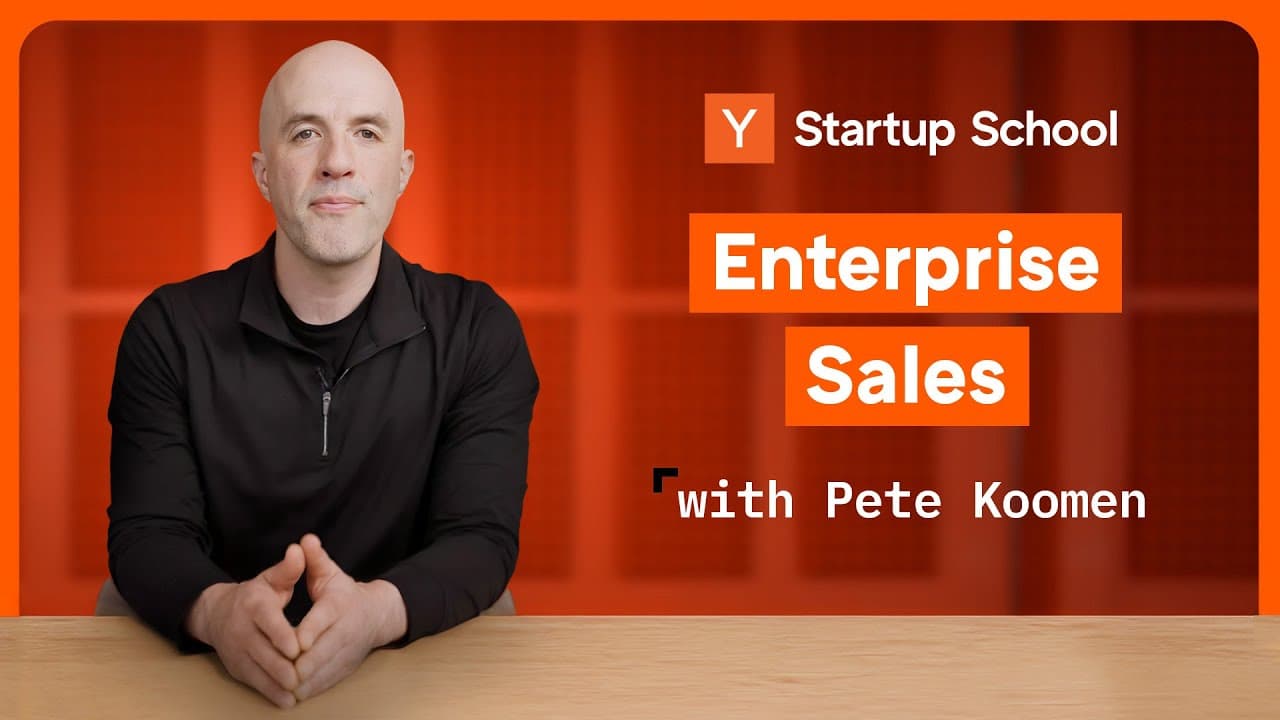
my name is Pete Kuman I'm a group partner at YC and a YC Alum I was co-founder and CTO of optimis Le in the winter 2010 batch in this talk I'm going to walk step by step through the process of closing your first Enterprise customers I'm going to do that by focusing on successive steps in the sales funnel prospecting Outreach qualification pricing c... Read More
Key Insights
- Enterprise sales for startups require founders to be deeply involved, especially before achieving product-market fit.
- Technical founders often excel in sales due to their expertise in the product and conviction in its value.
- Prospecting involves creating a hypothesis about customer needs and identifying potential leads using tools like LinkedIn Sales Navigator.
- Effective outreach includes generating inbound interest and crafting personalized cold emails that resonate with potential customers.
- Qualifying prospects is crucial; founders must ensure prospects have the problem, budget, and authority to buy the product.
- Demos should focus on solving the customer's problem, using personalized stories rather than a feature tour.
- Pricing is an experimental process; founders should not shy away from quoting high prices, as they can indicate product value.
- Implementation is a shared responsibility; founders must actively manage the process to ensure customers fully adopt the product.
Install to Summarize YouTube Videos and Get Transcripts
Explore YouTube Video Summarizer or Get YouTube Transcript Extractor
Questions & Answers
Q: How to close your first enterprise sale?
Closing your first enterprise sale involves a structured approach starting with prospecting to identify potential customers and creating a hypothesis about their needs. Effective outreach, followed by qualifying prospects to ensure they have the problem, budget, and authority to buy, is crucial. A personalized demo focusing on solving the customer's problem, rather than showcasing features, helps convince the prospect. Pricing should be experimental, and implementation requires active management to ensure full adoption.
Q: What are the key steps in the enterprise sales process?
The enterprise sales process involves several key steps: prospecting to identify potential customers, outreach to engage prospects, and qualification to ensure they have the problem, budget, and authority to buy. A demo should be personalized to address the customer's specific problem. Pricing is experimental, allowing for adjustments based on customer reactions. Finally, implementation should be actively managed to ensure the product is fully adopted by the customer.
Q: Why is prospecting important in enterprise sales?
Prospecting is crucial in enterprise sales as it sets the foundation for the entire sales process. It involves identifying potential customers and creating a hypothesis about their needs and how the product can solve their problems. Effective prospecting helps narrow down the target list, ensuring that sales efforts are focused on leads with the highest potential, saving time and resources while increasing the chances of closing a sale.
Q: How should founders approach pricing their product?
Founders should approach pricing as an experimental process, testing different price points to gauge customer reactions. It's important not to shy away from quoting high prices, as they can indicate the product's value and help identify serious customers. Founders should ask questions during the sales process to understand the customer's budget and the problem's cost, using this information to inform pricing decisions. Flexibility in pricing allows for adjustments based on market feedback.
Q: What role does a demo play in the sales process?
A demo plays a critical role in the sales process by demonstrating how the product solves the customer's specific problem. It should be personalized, using information gathered during the initial call to tailor the presentation to the customer's needs. Rather than a feature tour, a demo should tell a story that highlights the product's value and how it addresses the customer's challenges, making it a persuasive tool to convince prospects of the product's benefits.
Q: Why is implementation important after closing a sale?
Implementation is crucial after closing a sale because it ensures that the customer fully adopts and uses the product, turning them into a long-term client. Founders must actively manage the implementation process, treating it like a high-priority project with clear roadmaps and regular check-ins. Successful implementation leads to customer satisfaction and retention, as the product effectively solves the customer's problem, justifying their investment and fostering a positive relationship.
Q: What mistakes do founders commonly make in enterprise sales?
Common mistakes in enterprise sales include targeting the wrong customers, such as those who are easy to talk to but unlikely to buy, and diving into pitches without understanding the prospect's needs. Founders may also underprice their product out of fear of scaring customers away, and they might neglect active management of the implementation process, leading to poor product adoption. Avoiding these pitfalls requires strategic prospecting, personalized engagement, and proactive implementation management.
Q: How can founders effectively manage the sales funnel?
Founders can effectively manage the sales funnel by following a structured approach: starting with prospecting to identify and qualify leads, engaging them through personalized outreach, and conducting demos that focus on solving specific problems. Pricing should be flexible, allowing for adjustments based on customer feedback. Throughout the process, founders should ask questions to understand the customer's needs and buying process, ensuring a smooth transition from interest to purchase and successful implementation.
Summary & Key Takeaways
-
Enterprise sales for startups involve a detailed process starting with prospecting, where founders identify potential customers and create a hypothesis about their needs. Outreach is crucial, with an emphasis on generating inbound interest and crafting personalized communication to engage prospects effectively.
-
Qualifying prospects is a critical step where founders determine if potential customers have the problem, budget, and decision-making authority to purchase the product. Demos should be personalized and focus on how the product solves the customer's specific problem, rather than showcasing all features.
-
Pricing should be approached as an experiment, with founders testing different price points to find the optimal value. Implementation requires active management, with founders ensuring that the product is fully adopted by the customer, turning them into long-term clients.
Read in Other Languages (beta)
Share This Summary 📚
Summarize YouTube Videos and Get Video Transcripts with 1-Click
Try YouTube Summary with ChatGPT & Claude or YouTube Transcript Generator
Explore More Summaries from Y Combinator 📚






Summarize YouTube Videos and Get Video Transcripts with 1-Click
Try YouTube Summary with ChatGPT & Claude or YouTube Transcript Generator