Testing different Peltier coolers by cooling/freezing water - Part 5 - TEC12710
TL;DR
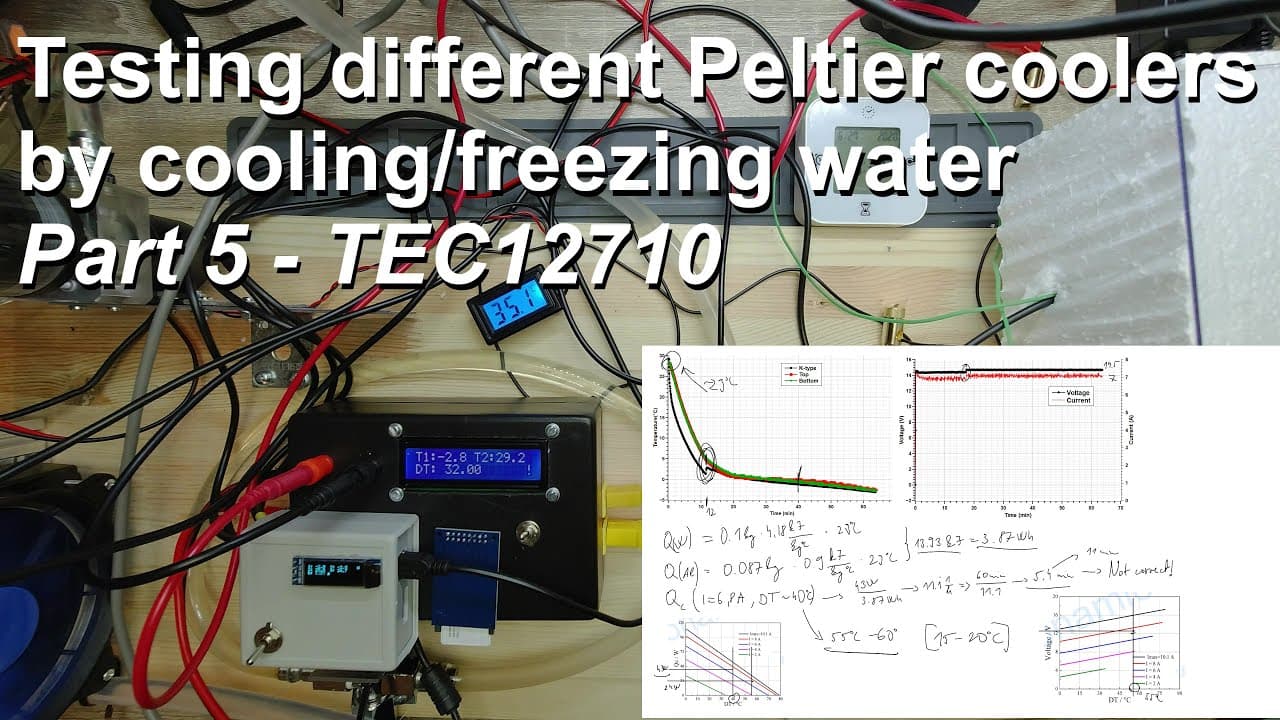
This video tests the cooling efficiency of the TEC 12 710 unit with water and temperature monitoring.
Transcript
welcome everyone in this video I'm going to test the Tec 12 710 particular and this is another freezing test so what I will do I will monitor the temperature of 100 grams of water inside an aluminum container which is also inside the polystyrene box so it's more or less insulated from the environment and I will see how the temperature changes at a ... Read More
Key Insights
- 😎 The TEC 12 710 showed a maximum cooling temperature of around -2.7 degrees Celsius after extended periods of operation.
- 🥵 The experiment emphasizes the need for efficient heat transfer methods and improved water agitation to enhance cooling.
- 😎 Monitoring various temperature points in the cooling setup allows for a comprehensive analysis of performance and discrepancies.
- 😎 The relationship between current draw and cooling power is critical; higher amperage does not always yield proportional cooling results.
- 🧡 Precision in equipment and control ranges is essential for obtaining reliable data, which could guide further experiments and improvements.
- 🥶 Phase changes from liquid to solid (ice formation) can affect temperature stability during cooling trials.
- 🥵 An understanding of thermodynamics and specific heat capacities is fundamental to interpreting the results of such cooling tests accurately.
Install to Summarize YouTube Videos and Get Transcripts
Explore YouTube Video Summarizer or Get YouTube Transcript Extractor
Questions & Answers
Q: What is the main objective of the TEC 12 710 cooling test?
The primary goal of the experiment is to assess the cooling efficiency of the TEC 12 710 unit by measuring how effectively it can lower the temperature of water under controlled conditions, comparing its performance against previous units.
Q: What specific parameters are monitored during the experiment?
During the test, parameters such as the temperature of the cold side of the cooler, water temperature at the top and bottom of the container, and electrical measurements like voltage and current are logged to assess cooling performance accurately.
Q: How does the lack of stirring affect the cooling results?
The absence of stirring results in uneven heat distribution within the water, where only areas in contact with the container's walls cool down effectively. This leads to reduced overall cooling efficiency, as stagnant water hinders the removal of heat throughout the volume.
Q: What conclusions can be drawn regarding the cooling efficiency of the TEC 12 710?
While the TEC 12 710 showed potential for cooling, its efficiency appears to be lower than expected when faced with a heat load. The experiment indicates that the device struggles to maintain a significantly low temperature over time, which may affect its practical applications.
Q: Why is monitoring the temperature difference (DT) important in this experiment?
Monitoring the temperature difference between the cold and hot sides of the cooler helps in evaluating the thermal performance of the TEC 12 710 unit. A higher DT indicates better cooling efficiency, allowing for assessment against the manufacturer's specifications and performance of competing models.
Q: What were the challenges faced during the experiment?
Challenges included the inability to stir the water, leading to ineffective heat distribution, and variability in temperature readings from different measuring devices. Additionally, achieving consistent voltage and current levels posed difficulties, complicating the analysis of cooling effectiveness.
Q: How does the amount of ice formed relate to the cooling unit's performance?
The amount of ice formed serves as a direct indicator of the cooling unit's performance. In this experiment, less ice than expected was produced, suggesting a limitation in the TEC 12 710's cooling capacity compared to previously tested models, indicating lower overall efficiency.
Q: What are the implications of the temperature and current measurements taken during the test?
The results imply that while the TEC 12 710 can reach low temperatures, the current draw and corresponding cooling power may not adequately address significant heat loads. This highlights the importance of optimizing the cooling system and load management for better performance.
Summary & Key Takeaways
-
The video demonstrates a freezing test using the TEC 12 710 unit, monitoring the temperature change of water in an insulated setup.
-
The results indicate the cooling performance of the device, highlighting the difficulty of achieving low temperatures due to heat load and lack of water agitation.
-
Data collected during the experiment shows variable temperature measurements and ice formation, suggesting the cooling unit's efficiency may be limited compared to other models.
Read in Other Languages (beta)
Share This Summary 📚
Summarize YouTube Videos and Get Video Transcripts with 1-Click
Try YouTube Summary with ChatGPT & Claude or YouTube Transcript Generator
Explore More Summaries from Curious Scientist 📚

![Building a Peltier cooler-based cooling box - First iteration, improvements [Part 2/6] thumbnail](/_next/image?url=https%3A%2F%2Fi.ytimg.com%2Fvi%2F0YlNw0EGnzI%2Fhqdefault.jpg&w=750&q=75)



Summarize YouTube Videos and Get Video Transcripts with 1-Click
Try YouTube Summary with ChatGPT & Claude or YouTube Transcript Generator