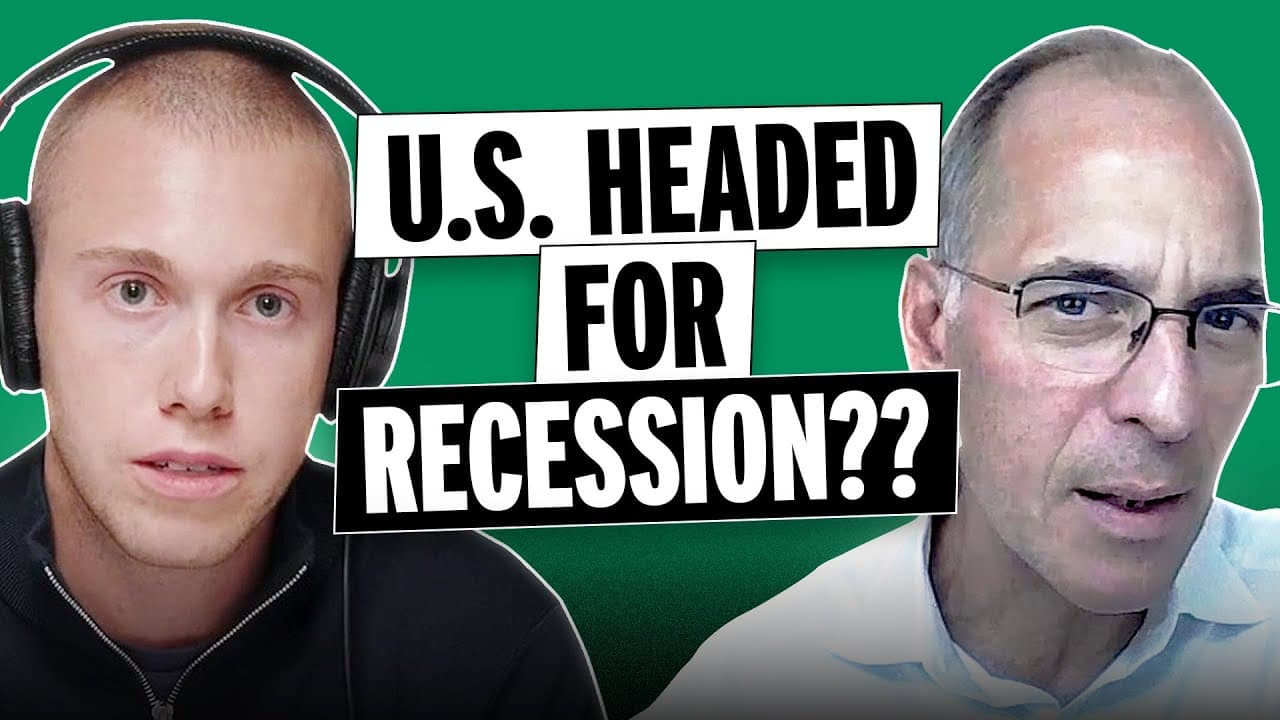
Why Is the U.S. on the Precipice of a Recession? Mark Zandi on Prof G Markets
TL;DR
The U.S. is near a recession because GDP grew just over 1% in the first half of the year while consumer spending stagnated, construction declined, manufacturing weakened, and job growth stalled. Low layoffs remain a firewall against a downturn, but a sustained S&P 500 correction could cause wealthy consumers to reduce spending. Read on for Mark Zandi’s explanation of the risks and warning signs.
Transcript
Today's number, 100,000. That is the average number of hairs on the human head. According to scientists, hair is important for regulating your body temperature and also perceiving sensations. Put another way, we now know why Scott Galloway is so cold and unfeilling. All right, welcome to Propy Markets. It is our final day of scot-free August. We're... Read More
Key Insights
- The economy is growing too slowly to absorb unexpected shocks comfortably. GDP increased just over 1% in the first half of the year, while inflation-adjusted consumer spending was slightly below its level at the end of the previous year.
- The labor market has nearly reached a standstill in job creation. Hiring resembles a nationwide freeze, but layoffs remain low, creating what Zandi describes as the principal firewall between a struggling economy and an actual recession.
- The stock market is not a complete measure of domestic economic health. Its gains are concentrated in a few large technology and AI companies, while major publicly traded businesses also receive substantial revenue from outside the United States.
- A sustained 10% decline in the S&P 500 could help trigger recession. If such a correction lasted one to three months, affluent consumers might feel less wealthy and reduce spending, turning currently flat consumption into an outright decline.
- Zandi’s machine-learning recession indicator places the probability of a downturn beginning within 12 months at 49%. Since 1960, every reading above 50% has been followed by recession, with no false positives after that threshold was breached.
- Traditional leading indicators also signal substantial recession risk. The Conference Board leading economic indicator has declined consistently and recently more sharply, the yield curve is inverted, consumer confidence is weak, and 53% of the industries surveyed for payroll estimates are reducing employment.
- Tariffs are expected to increase prices and weaken household purchasing power. The effective tariff rate rose from 2% at the beginning of the year to 10%, with Zandi saying it appeared headed toward approximately 15% to 20%.
- Restrictive immigration policy is reducing labor-force growth. The foreign-born labor force had been growing 4% to 5% year over year, but it is now falling following tighter asylum restrictions and subsequent policy changes.
- "The economy is on the precipice of a recession." (1:31)
- "While our baseline most likely outlook does not feature a downturn, the economy is struggling and it wouldn't take much to push the economy over." (1:31)
- "Job growth in the last few months has come to a standstill." (2:45)
- "Uh hiring is really it's almost like we have a hiring freeze across the country." (2:51)
- "If stocks go down and they feel well less wealthy many of them are older in retirement or close to retirement they'll pull back uh on their spending consumer spending instead of going flat here will go down and that's recession." (5:21)
Install to Summarize YouTube Videos and Get Transcripts
Explore YouTube Video Summarizer or Get YouTube Transcript Extractor
Questions & Answers
Q: Why is the U.S. on the precipice of a recession?
Mark Zandi says the economy is struggling across GDP, consumer spending, construction, manufacturing, and employment. GDP grew just over 1% in the first half of the year, inflation-adjusted consumer spending went nowhere, and recent job growth came to a standstill. Because growth is already weak, an unexpected shock could push the economy into recession.
Q: What is preventing the U.S. economy from entering a recession?
Low layoffs are the main firewall between the struggling economy and a recession. Hiring resembles a nationwide freeze, but businesses have not begun laying off workers heavily. This means the economy is weak, but it is not yet in recession.
Q: Why can the stock market reach record highs while the economy struggles?
Mark Zandi says gains are driven significantly by a few technology companies, including the Magnificent 7 and AI-related stocks. Major S&P 500 companies also earn substantial revenue overseas, while business tax cuts increase after-tax earnings. After accounting for those factors, he describes the broader market as essentially flat and consistent with an economy moving sideways.
Q: How could an S&P 500 correction trigger a recession?
Zandi says an S&P 500 decline of about 10% that lasted one to three months could push the economy into recession. Wealthy consumers, particularly older people in or near retirement, closely watch their portfolios. Feeling less wealthy could make them cut spending, turning flat consumer spending into a decline.
Q: How fast did the U.S. economy grow in the first half of the year?
GDP, defined in the discussion as the value of everything produced, grew just over 1% in the first half of the year. Zandi characterizes that pace as weak. Such limited growth leaves the economy vulnerable to developments that go off script.
Q: What is happening to consumer spending?
After adjusting for inflation, consumer spending went nowhere during the year. It was slightly below its level at the end of the previous year. A stock market decline could cause high-end consumers to pull back further and turn stagnant spending into contraction.
Q: What is happening in construction and manufacturing?
Construction spending is falling despite booming data-center construction, meaning spending outside that area is declining. Manufacturing activity is consistent with a recession in manufacturing. These weaknesses contribute to Zandi’s view that the wider economy is struggling.
Q: What is happening in the U.S. job market?
The job market has hit a wall, with job growth coming to a standstill in recent months. Hiring is so weak that Zandi compares it to a nationwide hiring freeze. Layoffs remain low, however, which currently separates the weak economy from an outright recession.
Summary & Key Takeaways
-
The U.S. economy is struggling but has not entered recession. GDP grew just over 1% during the first half of the year, inflation-adjusted consumer spending has gone nowhere, construction spending is falling outside data centers, manufacturing activity is consistent with contraction, and recent job growth has nearly stopped.
-
Low layoffs currently separate the weak economy from an outright recession. Businesses appear to have imposed a broad hiring freeze, but they have not begun dismissing workers heavily. A lasting stock market correction could weaken spending among affluent consumers, especially older people approaching or already in retirement, and help trigger a downturn.
-
Economic policy is presented as the main source of heightened risk. The effective tariff rate increased from 2% at the start of the year to 10% and appeared headed toward 15% to 20%. Zandi expects tariffs to raise inflation, reduce household purchasing power, and weaken consumer spending during the next 6–12 months.
Read in Other Languages (beta)
Share This Summary 📚
Summarize YouTube Videos and Get Video Transcripts with 1-Click
Try YouTube Summary with ChatGPT & Claude or YouTube Transcript Generator
Explore More Summaries from The Prof G Pod – Scott Galloway 📚
Summarize YouTube Videos and Get Video Transcripts with 1-Click
Try YouTube Summary with ChatGPT & Claude or YouTube Transcript Generator