How to Choose Books Worth Reading Before You Commit
TL;DR
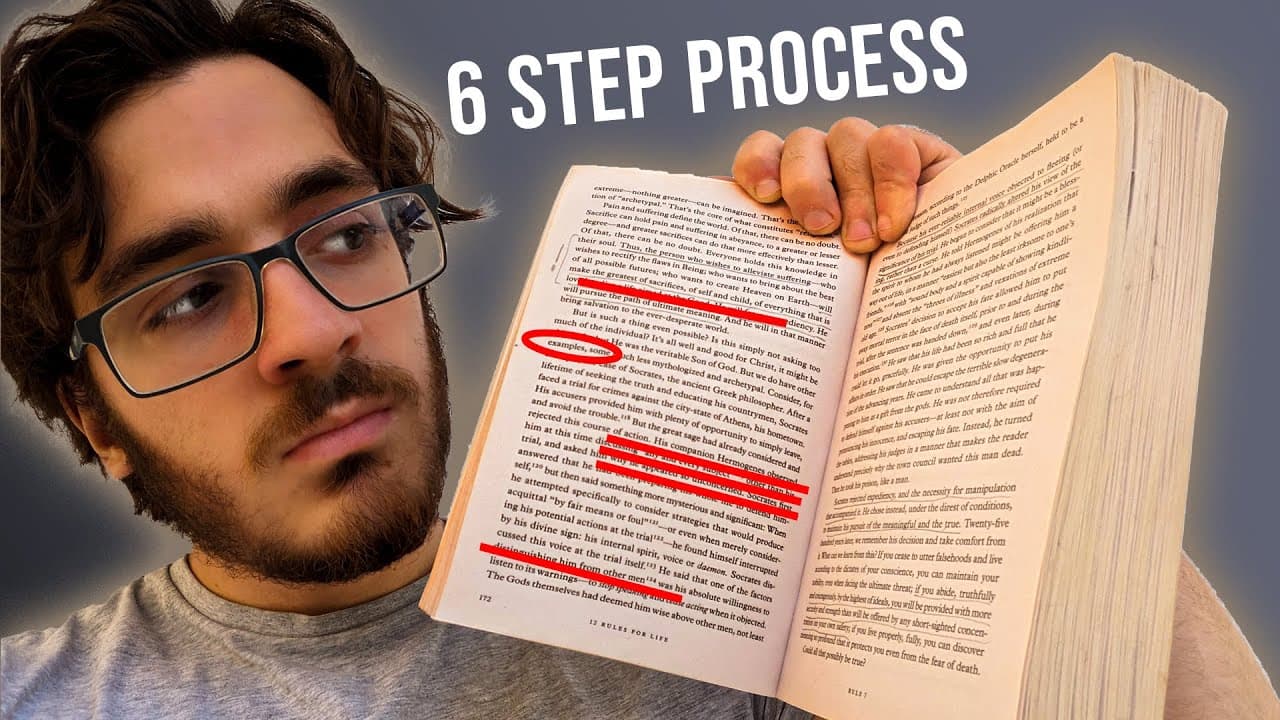
Inspect a book before committing to it by examining its title, subtitle, contents, index, blurb, key chapters, and important paragraphs. This six-step process reveals the author’s scope, central message, recurring vocabulary, and major arguments, helping you reject irrelevant or poorly presented books and reserve deeper analytical reading for books that offer personal value.
Transcript
learning how to read inspectionally might change your reading career forever I think it's one of the single most underrated and undervalued skills that exists in the reading world at all and most people don't know how to do it or even what it know what it is inspectional reading is the odds of being able to decipher whether a book is worth it in th... Read More
Key Insights
- Inspectional reading is a preliminary screening skill that helps readers decide whether a book is relevant, valuable, and well presented before investing time in a complete reading. It reduces time spent on books that feel uninspiring or fail to meet the reader’s needs.
- The title and subtitle are the first indicators of an author’s aim and scope. They can reveal whether the book offers a broad treatment, addresses a narrow issue, or approaches a familiar subject from a particular angle that matches the reader’s interests.
- The contents page is a structural map of the book. Its chapter titles can expose the main points, arguments, periods, or stages covered, although modern chapter names may be more mysterious and less informative than the detailed contents commonly found in older books.
- The index is evidence of the book’s recurring vocabulary and priorities. Terms with numerous page references are likely important to the author’s argument, and visiting those pages can quickly uncover significant passages explaining how those terms function within the book.
- The blurb is a concise guide to the book’s subject and argument when it is clear and informative. A useful blurb may establish immediately whether the book fits the reader’s needs, while praise, reviews, or cryptic marketing language should be treated cautiously.
- Chapter conclusions often contain compact summaries of the author’s main arguments. Reading the final paragraphs of selected chapters can provide the gist of individual sections, and combining those conclusions can create a useful outline of the book’s overall message.
- Important paragraph sentences are commonly located at the beginning or end. The opening sentence often introduces the point, the middle supplies details, stories, or experiences, and the final sentence reinforces or summarizes the idea being developed.
- Practice is necessary to make inspectional reading efficient and reliable. Trying the six-step process on unfamiliar books helps readers become better at recognizing central themes, rejecting unsuitable choices, and selecting material worthy of more demanding analytical or syntopical reading.
Install to Summarize YouTube Videos and Get Transcripts
Explore YouTube Video Summarizer or Get YouTube Transcript Extractor
Questions & Answers
Q: What is inspectional reading?
Inspectional reading is a method for examining a book quickly before deciding whether to read it in depth. It involves looking for the author’s aim, scope, structure, recurring terms, central message, and supporting arguments. The purpose is to determine whether the book applies to the reader, provides personal value, and performs its intended job well enough to justify deeper analytical reading.
Q: How can inspectional reading help you choose better books?
Inspectional reading helps you compare a book’s actual subject and argument with what you want to gain from reading it. By checking its framing, structure, vocabulary, summary, and selected passages, you can reject books that are irrelevant, poorly presented, or uninspiring. This prevents wasted time and directs sustained attention toward books that are more likely to improve understanding, wisdom, or skills.
Q: What are the six steps for inspecting a book?
The six steps are to read the title and subtitle, study the contents page, examine the index, read the blurb, investigate key chapters and their main arguments, and flick through chapters for important paragraphs and sentences. Together, these checks reveal the book’s scope, structure, recurring concepts, summarized purpose, central arguments, and running message before a complete reading begins.
Q: Why should you examine a book’s title and subtitle?
A title and subtitle can quickly disclose the author’s aim, subject, and intended scope. They may show whether the treatment is broad or narrow and identify the particular angle being taken. This first check helps determine whether the subject matches your interests or needs and establishes expectations that can be tested against the contents, blurb, and sampled passages.
Q: How does the contents page reveal a book’s structure?
The contents page presents the book’s chapters in sequence, providing a view of its underlying structure or skeleton. Chapter titles may correspond to main points, arguments, stages, or historical periods. Even when modern chapter names are vague or mysterious, the contents can still suggest how the author organizes the subject and what the reader is likely to encounter.
Q: Why is the index useful when choosing a book?
The index shows which terms and subjects appear throughout a book and where they are discussed. Words with many entries are likely part of the book’s central vocabulary and may play an important role in the author’s argument. Readers can visit the listed pages to inspect significant sentences or paragraphs and judge whether those ideas are relevant to their purposes.
Q: What should you look for in a book’s blurb?
A useful blurb should provide a clear, concise overview of the book and the author’s argument. It may be enough to confirm that the book offers exactly what you need or that it covers something you do not care about. If the blurb consists mainly of positive reviews, praise, or cryptic language, its claims should be treated cautiously and checked against the book itself.
Q: How can you find a book’s central arguments quickly?
Start by reading the concluding paragraphs of key chapters because they often wrap up each chapter’s principal argument. Then scan important paragraphs elsewhere, paying particular attention to their first and last sentences. Opening sentences commonly state the point, middle sections supply details or examples, and closing sentences reinforce the conclusion. Combining these signals creates a framework of the book’s central themes and running message.
Summary & Key Takeaways
-
Inspectional reading is a preliminary method for deciding whether a book deserves deeper attention. It helps readers identify books that address their needs, offer personal value, and present their ideas effectively. By screening books before reading them fully, readers can avoid uninspiring choices and spend more time on worthwhile material.
-
The six-step process begins with the title and subtitle, then moves through the contents page, index, and blurb. These elements reveal the author’s subject, angle, structure, recurring terminology, and summarized argument. Together, they provide a quick framework for understanding what the book intends to cover and how it develops its message.
-
The final steps involve sampling key chapters and scanning important paragraphs, especially their opening and closing sentences. Chapter endings often summarize major arguments, while paragraph openings and conclusions usually state or reinforce central points. Practicing this process helps readers select suitable books before moving into analytical or syntopical reading.
Read in Other Languages (beta)
Share This Summary 📚
Summarize YouTube Videos and Get Video Transcripts with 1-Click
Try YouTube Summary with ChatGPT & Claude or YouTube Transcript Generator
Explore More Summaries from Odysseas 📚


Summarize YouTube Videos and Get Video Transcripts with 1-Click
Try YouTube Summary with ChatGPT & Claude or YouTube Transcript Generator