How to use Jev judgment model with Claude
TL;DR
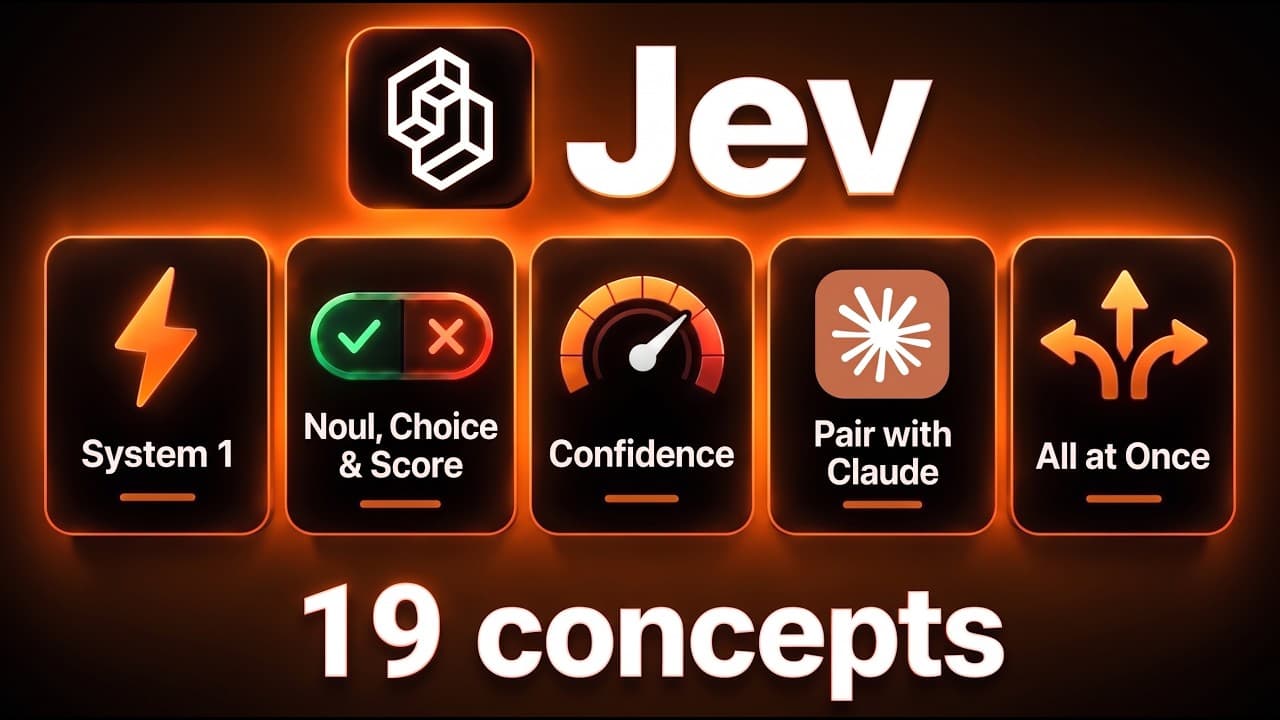
Jev outputs probabilities and categories rather than text, enabling automatic routing and decision making in software. It is cheaper and faster than traditional LLMs and works alongside Claude rather than replacing it. The video covers three question types, calibration, and a live example of triage and routing.
Transcript
the most talked about AI model this month. Can't even write a sentence. You can't chat with it. And it can't explain itself. And this is what people built with it in the first week it was released. We've got a browser that fills in Google flights in about 7 seconds. And if you've ever tried to use Claude with a browser, by the way, you'll know that... Read More
Key Insights
- Jev is described as a judgment model that replaces only a specific category of work that Claude does today, not Claude itself.
- Jev outputs numerical probabilities or scores instead of natural language text, enabling deterministic software actions.
- The model uses three types of questions: yes no, choice, and score, each returning different kinds of results.
- Outputs are calibrated probabilities, meaning, for example, 0.8 should be correct about eight times out of ten.
- Jev is touted as cheap and fast compared to traditional large language models, with significant efficiency advantages.
- The workflow integrates Claude for conversation while Jev handles the fast bulk decision tasks, acting as plumbing under Claude’s interface.
- Confidence scores accompany choice results, helping determine how much trust to place in the selected option.
- The video demonstrates practical applications like browser automation and triage systems, illustrating real-world value of the technology after initial setup.
Install to Summarize YouTube Videos and Get Transcripts
Explore YouTube Video Summarizer or Get YouTube Transcript Extractor
Questions & Answers
Q: What is Jev and how does it differ from traditional chat models?
Jev is described as a judgment model that does not generate sentences or engage in dialogue. Instead, it provides calibrated numbers or categories that software can act on directly. Unlike chat models, Jev emphasizes deterministic outputs and reliability, making it suitable for bulk, fast decision making in software workflows.
Q: How does Jev interact with Claude in practical use?
Jev works alongside Claude rather than replacing it. Claude handles conversation and reasoning, while Jev handles fast, deterministic decisions from structured questions. This separation allows Claude to stay as the conversational interface while Jev supplies quick routing or scoring signals to software.
Q: What are the three question types in Jev and how do they function?
The three types are yes no, choice, and score. Yes no gives a probability of a binary condition, like whether an issue is suspicious. Choice returns probabilities for predefined categories to route to a team. Score provides a numeric assessment used for ordering or gating downstream actions.
Q: Why is Jev described as cheaper and faster than LLMs?
Jev is reported to be 40 to 1,000x cheaper and 20 to 400x faster than traditional LLMs. It outputs a small number or category rather than generating long text, which reduces computation, latency, and token usage while still guiding automated decisions effectively.
Q: What does 'calibrated probabilities' mean in the context of Jev?
Calibrated probabilities mean the numbers Jev outputs are reliable indicators of truth likelihoods. For example, a reported 0.8 should be correct roughly eight times out of ten. This calibration lets software trust the score to drive routing or actions without human intervention.
Q: How is confidence used with the choice question type?
When Jev returns probabilities for multiple options, it also provides a confidence score. This reflects how evenly spread the probabilities are. A high confidence supports trusting the chosen option, while a low confidence signals caution or the need for fallback logic.
Q: What is an example workflow shown in the video using Jev?
The video shows installing the Typesafe skill in Claude Code and building an email triage system that sorts 50 emails into four piles in four seconds at very low cost. This demonstrates Jev’s practical impact on batch processing and decision routing.
Q: What are the practical benefits of using Jev for browser automation or customer support?
Jev enables fast, scripted decision making in workflows like filling form fields, prioritizing customer inquiries, or routing support requests. By converting messy inputs into structured scores or choices, it reduces latency, cost, and manual effort while maintaining consistent outputs across runs.
Summary & Key Takeaways
-
A live overview of Jev as a judgment model that produces probabilities instead of writes, enabling deterministic actions in software. It contrasts Jev with chat models and explains why a separate integration is beneficial.
-
The video details three output formats for Jev: yes no, choice, and score, including how confidence is calculated and used for routing decisions.
-
A practical demonstration shows installing a Typesafe skill in Claude Code and building a live email triage system, routing 50 emails into four piles in four seconds for minimal cost.
Read in Other Languages (beta)
Share This Summary 📚
Summarize YouTube Videos and Get Video Transcripts with 1-Click
Try YouTube Summary with ChatGPT & Claude or YouTube Transcript Generator
Explore More Summaries from Simon Scrapes 📚





Summarize YouTube Videos and Get Video Transcripts with 1-Click
Try YouTube Summary with ChatGPT & Claude or YouTube Transcript Generator