Why Does Basic Life in America Cost $70K?
TL;DR
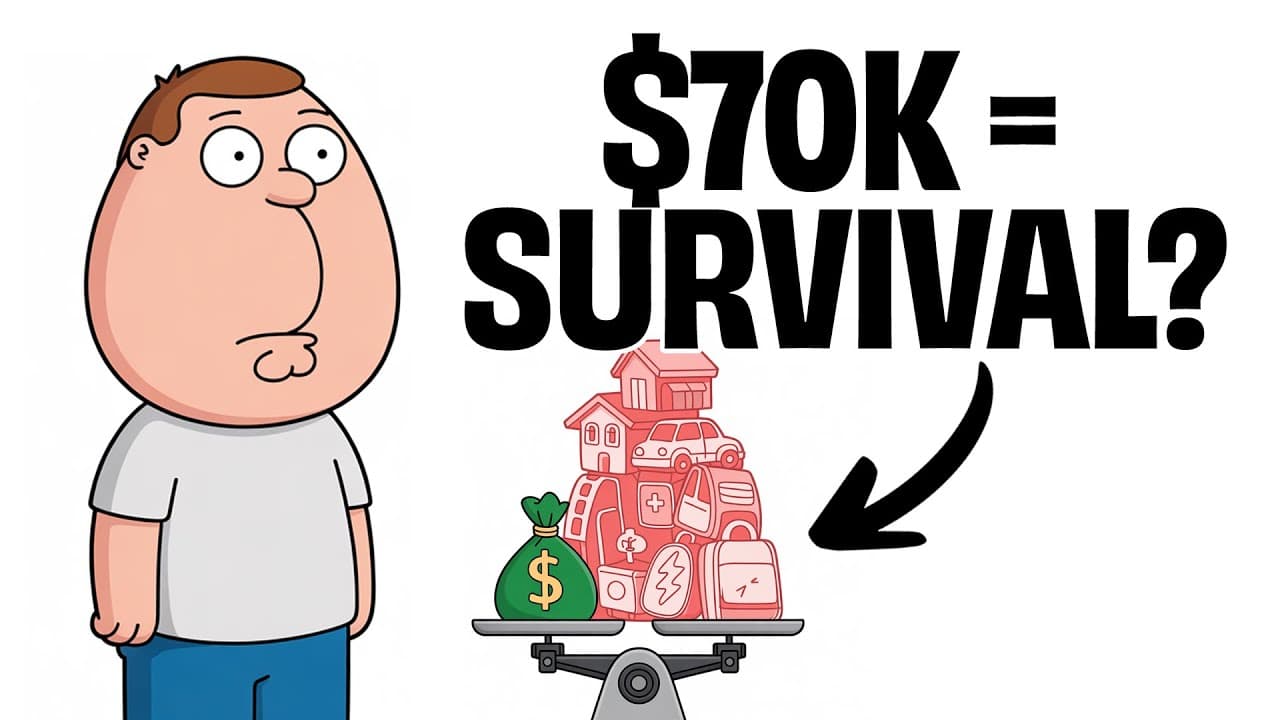
Essential expenses have risen faster than wages, making roughly $70,000 feel like a survival income rather than a comfortable salary for many American households. Housing, insurance, food, transportation, and healthcare now absorb so much income that people can earn seemingly good money while struggling to save, afford treatment, or maintain a basic middle-class lifestyle.
Transcript
You know that moment when you're sitting at your kitchen table late at night with all your bills spread out in front of you, calculator in hand, and you're just doing the math over and over hoping the numbers somehow change. You've got your mortgage or rent, your car payment, your groceries, your utilities, your insurance, your kids school stuff, y... Read More
Key Insights
- The cost-of-living crisis is presented as a broad structural problem rather than a personal budgeting failure. Households can avoid extravagant spending, earn respectable incomes, and still struggle because the prices of multiple necessities have risen faster than the wages available to pay for them.
- Housing is the largest financial burden for many households because rent, mortgage payments, property taxes, insurance, and utilities combine into a major annual expense. The presentation argues that typical housing costs have moved beyond the affordability level traditionally recommended by financial experts.
- Renting does not eliminate housing pressure because monthly rent excludes utilities and may also be affected by algorithmic pricing systems. The transcript claims that such software can push rental prices higher, leaving individual tenants with little ability to challenge the broader pricing mechanism.
- Homeowners insurance is becoming increasingly difficult to afford as premiums continue rising faster than general inflation. Some lower-income homeowners have gone without coverage, leaving their homes and financial futures exposed because the cost of protection itself has become unmanageable.
- Food affordability has permanently shifted because grocery prices established a much higher baseline after sustained increases. Lower-income households are especially vulnerable because food consumes a large share of their after-tax income, while continued price growth makes repeated shopping trips a source of widespread stress.
- Transportation is more than the purchase price of a vehicle because mobility also requires fuel, insurance, maintenance, and registration. These combined expenses have risen sharply, creating a particularly heavy burden in places where workers need cars and already face elevated housing costs.
- Healthcare remains unaffordable for some insured Americans because coverage does not remove deductibles, cost-sharing requirements, or prescription expenses. The transcript describes people rationing medicine, avoiding needed care, and skipping mental health treatment, decisions that can worsen both health risks and future financial pressure.
- Middle-class status depends heavily on geography because national income ranges do not reflect the different costs faced across American cities and regions. A salary that supports a basic middle-class life in a less expensive area may feel inadequate in a high-cost market.
Install to Summarize YouTube Videos and Get Transcripts
Explore YouTube Video Summarizer or Get YouTube Transcript Extractor
Questions & Answers
Q: Why does basic life in America require about $70K?
Basic life is described as requiring about $70K because several essential costs now place simultaneous pressure on household budgets. Housing, utilities, insurance, food, transportation, and healthcare can absorb most available income before savings or discretionary purchases are considered. The argument is not that every household has identical expenses, but that an apparently strong salary may now function primarily as a survival income.
Q: What expenses are driving the American cost-of-living crisis?
The main expenses identified are housing, homeowners or renters insurance, groceries, transportation, utilities, prescription drugs, and other healthcare costs. Each category represents a basic need rather than an optional luxury. Because these costs have increased together while wages have not always kept pace, households can struggle even when they maintain modest lifestyles and make careful spending decisions.
Q: Why is housing unaffordable for many American households?
Housing is unaffordable for many households because rent or mortgage payments are only part of the total obligation. Property taxes, insurance, utilities, and other basic costs add to the monthly burden. The transcript says housing consumes a much larger share of typical household income than the affordability threshold traditionally recommended by financial experts, leaving less money for every other necessity.
Q: How are rising insurance costs affecting homeowners?
Rising insurance premiums are forcing some homeowners to devote a substantial portion of their budgets simply to protecting their property. In heavily affected states, the burden can rival other major household expenses. Some homeowners, particularly those with lower incomes, have dropped coverage because they cannot afford it, effectively risking severe financial loss if their homes are damaged or destroyed.
Q: Why do grocery bills remain high after pandemic-era inflation?
Grocery bills remain high because earlier price increases created a new and elevated baseline rather than a temporary spike that fully reversed. Food prices continued rising after that shift, with some categories increasing more sharply than others. As a result, shoppers can buy the same basic products and still face significantly greater pressure, especially when food already consumes a large share of household income.
Q: What makes transportation a major household expense?
Transportation costs include much more than buying or financing a vehicle. Households must also pay for fuel, auto insurance, maintenance, repairs, and registration. These recurring expenses make basic mobility costly, particularly in regions where driving is necessary for work and everyday responsibilities. When high transportation costs are combined with expensive housing, the financial burden becomes even more difficult to manage.
Q: Why do insured Americans still avoid healthcare?
Health insurance does not necessarily make care affordable because patients may still face high deductibles, cost-sharing requirements, and prescription expenses. The transcript reports that some insured people do not take medicine as prescribed, avoid needed medical care, or skip mental health treatment because of cost. Delaying treatment can create immediate health risks and may lead to more serious, expensive conditions later.
Q: How does location change the income needed for a middle-class life?
Location changes the required income because housing, transportation, insurance, and other necessities vary greatly across cities and states. The transcript contrasts a less expensive city with the San Francisco area to show that the lower boundary of middle-class income is not uniform. National averages can therefore misrepresent whether a household can actually afford a modest and financially stable lifestyle where it lives.
Summary & Key Takeaways
-
Basic middle-class life has become much harder to afford because several essential expenses have increased together. A modest home, reliable transportation, groceries, insurance, utilities, and medical care can consume most household income. The resulting pressure is structural, according to the presentation, rather than evidence that individual families are simply managing money poorly.
-
Housing is presented as the largest source of financial strain, but it does not operate alone. Insurance premiums, grocery prices, transportation expenses, and healthcare costs have also climbed. When these categories are combined, an income that once suggested comfort can now provide little more than the ability to cover necessities without building meaningful savings.
-
National income labels can conceal major differences in actual living standards. The amount required to maintain a middle-class lifestyle changes substantially by location, particularly between less expensive cities and costly regions. A salary may therefore appear strong on paper while leaving a household financially vulnerable after essential monthly bills and unexpected expenses are paid.
Read in Other Languages (beta)
Share This Summary 📚
Summarize YouTube Videos and Get Video Transcripts with 1-Click
Try YouTube Summary with ChatGPT & Claude or YouTube Transcript Generator
Explore More Summaries from Nick Invests 📚




Summarize YouTube Videos and Get Video Transcripts with 1-Click
Try YouTube Summary with ChatGPT & Claude or YouTube Transcript Generator