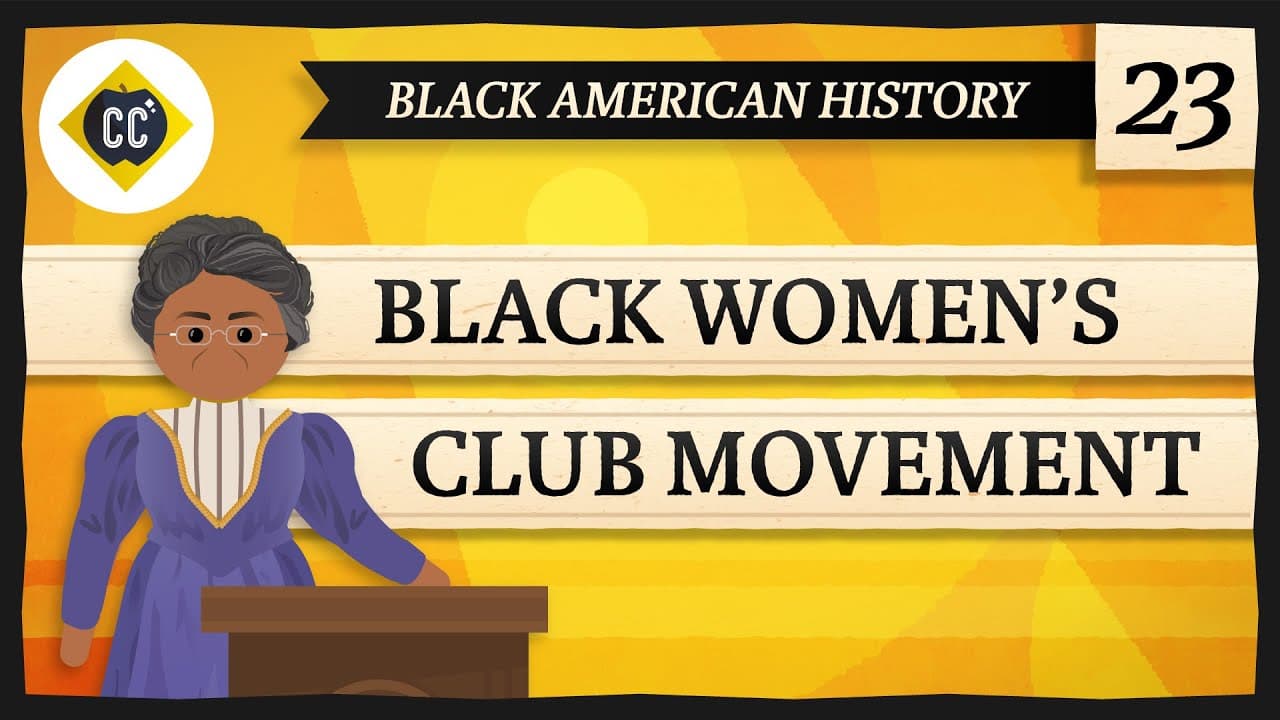
What Was the Black Women's Club Movement and Its Impact?
TL;DR
The Black Women's Club movement emerged during the Jim Crow era as a grassroots effort by educated Black women to combat violence and societal oppression. Founded by leaders like Josephine St. Pierre Ruffin and Mary Church Terrell, the movement advocated for the rights of Black women and provided a platform for community-building and activism, influencing contemporary civil rights efforts.
Transcript
Hi I’m Clint Smith and this is Crash Course Black American History. Today we’ll be talking about the Black women’s Club movement. Women have always been central to the creation of social movements and have been able to find unique voices for themselves in spaces that did not always want to acknowledge their power. Black women were present in so man... Read More
Key Insights
- 🤽♀️ Black women have always played crucial roles in American social movements, yet their contributions have often been overlooked.
- 🖤 The Black Women's Club movement emerged as a response to violence and oppression against Black women during the Jim Crow era.
- 🖤 The movement aimed to challenge societal stereotypes, protect Black women's rights, and promote self-improvement and community-building.
- 👩🚒 Key figures like Josephine St. Pierre Ruffin and Mary Church Terrell led the movement and fought for intersectional rights for Black women.
- 🤨 The movement's impact extended beyond advocacy, with organizations providing social services, raising awareness about lynching, and supporting community building.
- 😮 Changing gender norms and the rise of working-class Black women brought new approaches and challenges to the movement.
- 🥺 The legacy of the movement can still be seen today, as many contemporary civil rights efforts are led by Black women.
Install to Summarize YouTube Videos and Get Transcripts
Explore YouTube Video Summarizer or Get YouTube Transcript Extractor
Questions & Answers
Q: What role did the Black Women's Club movement play in addressing violence against Black women?
The movement sought to protect Black women from physical and sexual assault by raising awareness, promoting self-improvement, and advocating for their rights.
Q: How did the Black Women's Club movement challenge societal stereotypes of Black women?
By establishing their own careers and identities separate from their husbands, these women defied notions of Black women as hypersexualized and immoral, asserting their worth and agency.
Q: Who were some key figures in the Black Women's Club movement?
Josephine St. Pierre Ruffin, founder of the Woman's Era Club and pioneer of Black women's activism, and Mary Church Terrell, the first president of the National Association of Colored Women, were influential leaders in this movement.
Q: How did the movement evolve over time?
The movement expanded its scope to include raising awareness about social issues like lynching, advocating for political rights, and providing social services for Black communities.
Summary & Key Takeaways
-
Black women played vital roles throughout American history, including as orators, spies, and soldiers, but their contributions have often been overlooked.
-
The Black Women's Club movement was a grassroots movement led by educated, independent Black women who sought to protect their families and challenge social and political oppression.
-
Organizations such as the National Federation of Afro-American Women and the National Association of Colored Women served as platforms for Black women's activism and community-building.
Read in Other Languages (beta)
Share This Summary 📚
Summarize YouTube Videos and Get Video Transcripts with 1-Click
Try YouTube Summary with ChatGPT & Claude or YouTube Transcript Generator
Explore More Summaries from CrashCourse 📚






Summarize YouTube Videos and Get Video Transcripts with 1-Click
Try YouTube Summary with ChatGPT & Claude or YouTube Transcript Generator