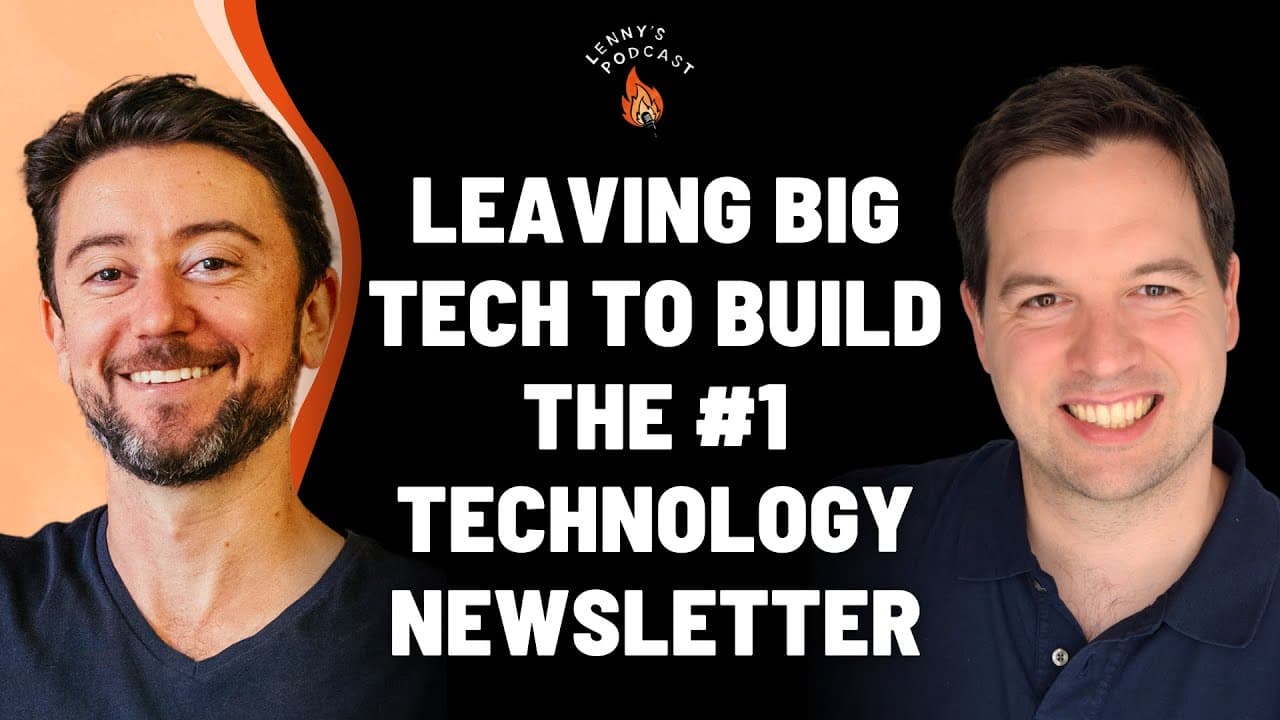
Gergely Orosz on Leaving Big Tech for a Newsletter
TL;DR
Writing a newsletter full time can pay more than a big tech job, and earnings keep rising as long as the audience grows, with no theoretical cap. Gergely Orosz left a promising engineering management path at Uber, built The Pragmatic Engineer on Substack, and now earns more than he did there, mostly from paid subscriptions.
Transcript
in my best year at Uber I made about like 320 or 330 000 in total compensation and when I quit my job I was actually thinking like am I am I crazy because I'm leaving especially in Europe This is a lot of money disabled this will be similar to something you know someone in a similar position would have made like five or six hundred K in in total in... Read More
Key Insights
- A newsletter business can out-earn a senior big tech career. Gergely Orosz says his current compensation exceeds his best year at Uber, even though he feared that leaving would mean earning much less.
- Newsletter income scales with audience, unlike salary. Earnings keep going up as long as the newsletter is growing, so there is no theoretical cap, although churn and slowing growth create a real practical limit.
- Substack recommendations became a massive growth engine. A Tipping Point arrived when the platform introduced recommendations, and top publications benefited most, adding subscribers far faster than in the earliest months.
- Revenue can come mainly from subscriptions without sponsorships or ads. Both Gergely and Lenny rely on paid subscribers, with free readers getting occasional articles and paying readers getting more frequent, deeper pieces.
- A small paying share of a large free audience is still a healthy business. Only a single digit percentage of subscribers pay, yet that is enough to support a full-time living for the author.
- European tech pay sits below US pay but above many other regions. Gergely compares his Uber compensation with what a similar role would earn in the US, which made quitting feel risky.
- A long, steady career path builds the credibility a newsletter needs. Gergely moved from consulting to a bank, Skype, Skyscanner and Uber, growing from engineer to manager of managers before writing full time.
- Years of blogging prepared the ground for newsletter success. Even so, the growth rate and audience size exceeded anything he expected, and the pace appeared to be accelerating.
Install to Summarize YouTube Videos and Get Transcripts
Explore YouTube Video Summarizer or Get YouTube Transcript Extractor
Questions & Answers
Q: Can a full-time newsletter pay more than a big tech job?
According to Gergely Orosz, yes. His best year at Uber paid strongly for a European role, and he feared that quitting would mean a big drop. Instead, his newsletter income now exceeds his Uber total compensation, and it rises as long as the newsletter keeps growing.
Q: Why did Gergely Orosz worry about leaving Uber?
He was on a strong career path toward senior engineering management and possibly director level, with very high total compensation made up of base salary, stock and bonus. He wondered whether he was crazy to walk away, and he expected to earn far less but enjoy the work.
Q: How does newsletter income differ from a salary?
A salary is fixed within a band, while newsletter earnings keep going up as long as the audience is growing. There is no theoretical cap on this. In practice, churn and slowing growth over time create a real limit, so growth is not unlimited.
Q: How did Substack recommendations affect newsletter growth?
Recommendations were described as a massive growth engine. After the feature launched, the newsletter went from a relatively slow first stretch to adding subscribers at a much faster pace, close to a thousand people per day. Top publications on the platform benefited especially from the feature.
Q: How does The Pragmatic Engineer make money?
Most of the revenue comes from paid subscriptions rather than sponsorships or ads. Free subscribers receive articles every now and then, while paying subscribers get far more content and greater depth. Only a single digit percentage of readers pay, but that share is healthy.
Q: What career path led Gergely Orosz to writing a newsletter?
He studied computer science, then worked at a consulting company in Hungary and later in the UK. He moved to London, worked at an investment bank, then Skype, then the startup Skyscanner, and finally Uber in Amsterdam, where he became a manager and then a manager of managers.
Q: Do the hosts accept sponsorships or ads in their newsletters?
No. Both Gergely and Lenny make most of their revenue from subscriptions and do not run sponsorships or ads in the newsletter. Their setups share this model, offering free articles occasionally to everyone and more frequent, in-depth content to paying subscribers.
Q: What does this episode cover for people thinking of writing full time?
The conversation explores the life of full-time newslettering, including the decision to leave a comfortable tech job, the daily routine, the pros and cons, what it takes to succeed, and advice for getting started. It is aimed at anyone curious about writing or a creative career path.
Summary & Key Takeaways
-
Gergely Orosz describes a classic software engineer career that started in Hungary, moved through the UK and London, and passed through a bank, Skype, Skyscanner and Uber. At Uber he rose from senior engineer to manager of managers before deciding to leave and write a newsletter.
-
He explains that his newsletter has grown to a very large audience, with a sharp acceleration after Substack introduced recommendations. A small percentage of readers pay, yet the business is healthy, and it relies on subscriptions rather than sponsorships or advertising.
-
On income, he explains that his best Uber year paid very well for Europe, but his newsletter earnings now exceed it. Unlike a salary, newsletter earnings rise with audience growth, though churn and slowing growth mean the ceiling is real in practice.
Read in Other Languages (beta)
Share This Summary 📚
Summarize YouTube Videos and Get Video Transcripts with 1-Click
Try YouTube Summary with ChatGPT & Claude or YouTube Transcript Generator
Explore More Summaries from Lenny's Podcast 📚

Summarize YouTube Videos and Get Video Transcripts with 1-Click
Try YouTube Summary with ChatGPT & Claude or YouTube Transcript Generator