Why Is Netflix Stock Down 30%? A Dead Money Buy
TL;DR
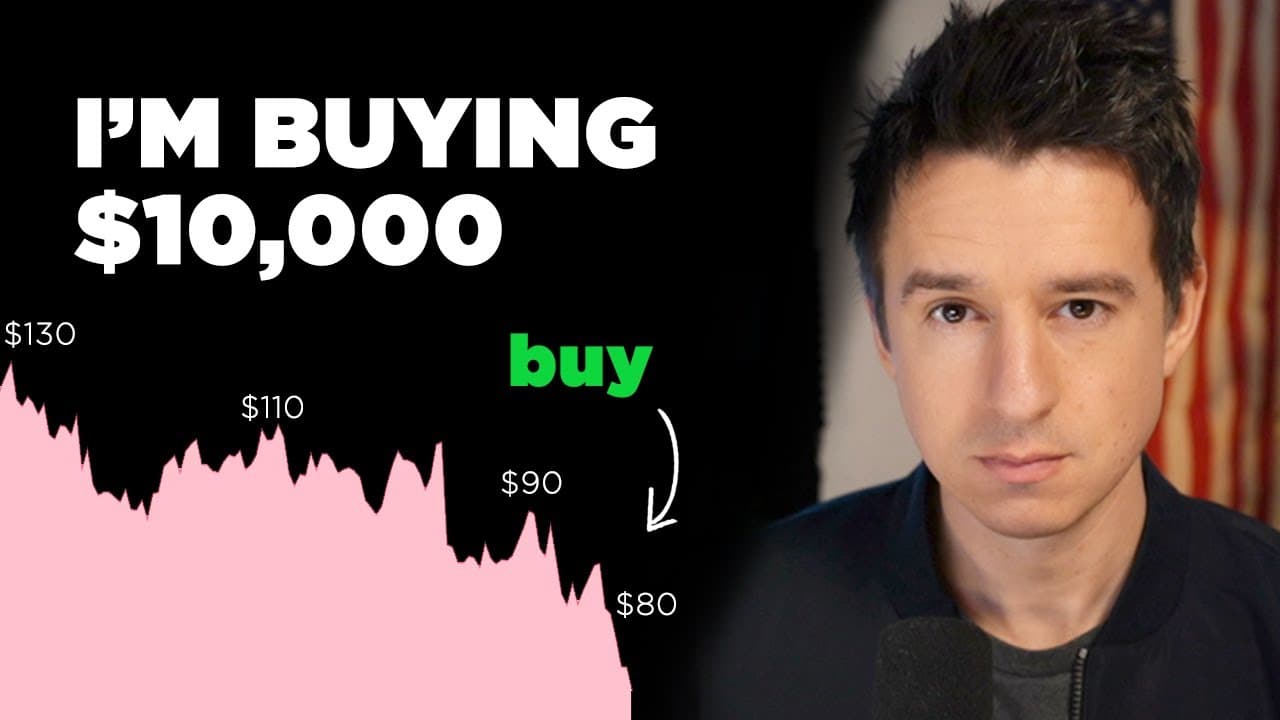
Netflix has fallen roughly 30% to about $95 per share, its biggest sell-off in three years, because a bidding war over Warner Brothers Discovery created heavy uncertainty. Joseph Carlson calls it 'dead money' for the next 12 to 18 months yet is adding $10,000, betting on Netflix's 5 to 20 year weighing-machine value.
Transcript
Welcome back everyone. Today on the Joseph Carlson show, I am buying $10,000 more of a stock that I already own. The company's in the story fund, my secondary portfolio, and the stock is Netflix. I already own $109,000 of this company, and I'm buying another $10,000 because Netflix is a company that's in the red today. It's down 2% down below $95 p... Read More
Key Insights
- Netflix stock has fallen at least 30% to around $95 per share, its biggest sell-off in the past three years, after trading as high as $133 in mid 2025.
- Dead money is when a stock faces so much uncertainty and regulatory scrutiny that it can't go higher for the foreseeable future, so short-term investors avoid it and the price drops.
- The sell-off stems from Netflix agreeing to buy Warner Brothers Discovery while Paramount, led by David Ellison, threatens a higher hostile bid, sparking a bidding war investors expect Paramount to win.
- Warner Brothers Discovery stock rose 5% to as high as $30 per share because investors believe Paramount will bid even higher and take the asset from Netflix.
- The investment thesis is long-term: the speaker judges companies over 20 years, not the next 12 to 18 months, citing that markets are a short-term voting machine but a long-term weighing machine.
- Game theory, mapping likely outcomes across scenarios, is the speaker's method for complex deals; he used it on Netflix's password crackdown and concluded Netflix wins in almost any case.
- The buy is staged: $5,000 today, another $5,000 within two weeks, and more if the price keeps falling, since the speaker expects it to drop below $90 or into the low $80s.
- Netflix management, per co-CEO Greg Peters, insists it faces intense competition from YouTube, Disney, Paramount, Apple TV, Amazon Prime, and TikTok, arguing it is nowhere near a streaming monopoly.
Install to Summarize YouTube Videos and Get Transcripts
Explore YouTube Video Summarizer or Get YouTube Transcript Extractor
Questions & Answers
Q: Why is Netflix stock down 30%?
Netflix has fallen at least 30% to around $95 per share, its biggest sell-off in three years, because it agreed to buy Warner Brothers Discovery and now faces a bidding war. Paramount, led by David Ellison, is threatening a higher hostile bid, and investors are uncertain whether Netflix can win the bid or clear regulatory hurdles. This uncertainty makes the stock 'dead money' that can't rise for the foreseeable future.
Q: What is dead money in investing?
Dead money is when a stock faces so much uncertainty and regulatory scrutiny that it really can't go higher for the foreseeable future, maybe the next 12 to 18 months. Because most investors want gains every month and don't want to wait over a year, they avoid dead money stocks, so the price falls. The speaker says Netflix became dead money once the complex Warner Brothers Discovery deal introduced heavy uncertainty.
Q: Why is the speaker buying Netflix if it's dead money?
The speaker agrees Netflix is dead money for the next 12 to 18 months but buys anyway because he invests on a 20-year horizon, not for maximizing 2026 gains. He looks for companies he believes will be extremely heavy and large 20 years out. He cites that markets are a short-term voting machine but a long-term weighing machine, and believes Netflix will weigh a lot over the next 5 to 10 years.
Q: What is happening with Warner Brothers Discovery and Paramount?
Warner Brothers Discovery signed a deal with Netflix, but Paramount swooped in with a hostile bid to try to steal the asset away. Warner Brothers Discovery stock rose 5% to as high as $30 per share because investors, per the Wall Street Journal, believe Paramount and David Ellison will bid even higher and take the asset from Netflix. This has created a messy bidding war fueling Netflix's sell-off.
Q: How is the speaker structuring his Netflix buy?
The speaker is buying $10,000 of Netflix in his story fund, staged into two parts: $5,000 today and another $5,000 within the next two weeks, with plans to keep buying if the price trends lower. He expects the stock to fall further, possibly below $90 or into the low $80s. He already owns $109,000 of Netflix with a cost average around $45 per share.
Q: How does the speaker use game theory to evaluate Netflix?
The speaker uses game theory, a way of looking at the likely outcome of events and assessing what happens in different scenarios, whenever there's a complex deal. He mapped out possible outcomes for the Warner Brothers Discovery situation, including one where Netflix closes the deal. He previously applied this to Netflix's password crackdown and concluded Netflix wins in almost any case, which is what happened.
Q: Does Netflix consider itself a streaming monopoly?
No. According to co-CEO Greg Peters, Netflix management believes it operates in a highly competitive field and is nowhere close to having a monopoly in video entertainment or streaming. Netflix says in every earnings report that it competes with YouTube, Warner Brothers Discovery, Paramount, Disney, Apple TV, Amazon Prime, and TikTok. The speaker argues Netflix could use this competition argument to help pass regulatory review of the acquisition.
Q: Why does a 30% drop not worry the speaker?
The speaker has covered Netflix for a long time and held the stock through a 75% decline years ago, when many declared the company dead as it lost subscribers and faced heavy competition. He notes Netflix had to reinvent its business model and introduce an ad tier to grow. Since he has been through far worse with the stock, a 30% fall from premium valuation levels does not scare him.
Summary & Key Takeaways
-
Netflix is down about 30% to $95 per share, its worst sell-off in three years, driven by its plan to acquire Warner Brothers Discovery and Paramount's threatened higher hostile bid. This uncertainty makes it 'dead money,' a stock unlikely to rise for 12 to 18 months, so short-term investors are fleeing it.
-
Despite agreeing Netflix is dead money short-term, the speaker is buying $10,000 more on top of a $109,000 position with a roughly $45 cost basis. He invests on a 20-year horizon, expecting Netflix to become one of the world's heaviest companies, and is willing to raise his cost basis buying at $95.
-
The buy is staged, $5,000 now and $5,000 later, anticipating the price could fall below $90 or into the low $80s. Using game theory across outcomes, the speaker argues Netflix wins in nearly every scenario, noting the same critics who now call it a juggernaut declared it dead just years ago.
Read in Other Languages (beta)
Share This Summary 📚
Summarize YouTube Videos and Get Video Transcripts with 1-Click
Try YouTube Summary with ChatGPT & Claude or YouTube Transcript Generator
Explore More Summaries from Joseph Carlson After Hours 📚
Summarize YouTube Videos and Get Video Transcripts with 1-Click
Try YouTube Summary with ChatGPT & Claude or YouTube Transcript Generator