What Is Circular Financing Among AI Giants
TL;DR
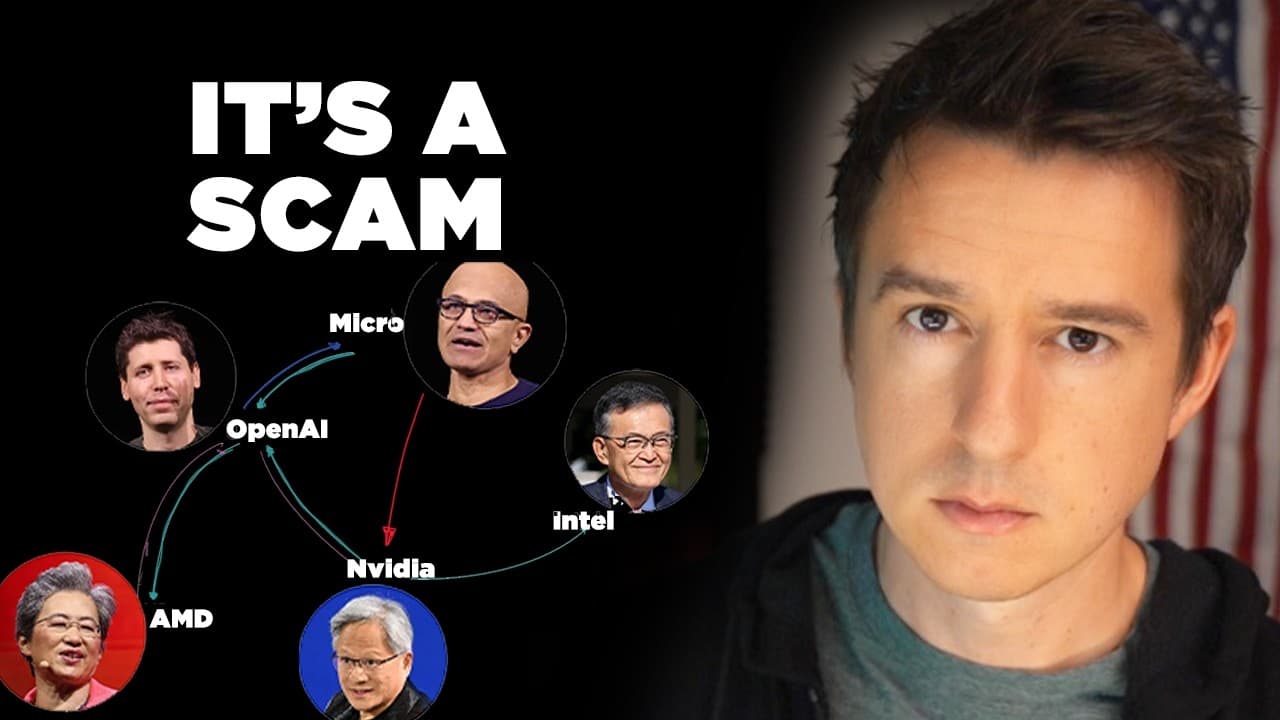
Circular financing means two or more companies invest in each other to create artificial demand, inflating revenue without real growth. The video traces how Nvidia, OpenAI, and AMD related deals form a web that investors worry could mislead on profitability and sustainability. It also notes other AI industry moves like Equifax, FICO, and Netflix related topics.
Transcript
Welcome back everyone. Today on the JO Carlson show, we're going to be breaking down one of the biggest concerns growing in the general market. And that is that the companies you hear about every single day, the biggest most important companies in the market, the Nvidas, the Open AIs, the Oracles, the AMDs, all these companies that you're hearing a... Read More
Key Insights
- Circular financing is defined as investments among the same companies that create artificial demand and can inflate revenue without genuine growth.
- Investors worry that a web of interconnected deals makes it hard to distinguish organic revenue growth from money moving within a closed network.
- Nvidia is portrayed as a central hub or potential banking backbone of AI deals, with multiple partnerships feeding back into the company.
- OpenAI maintains multiple agreements with Nvidia, AMD, Oracle, and others, creating a network that can resemble circular financing at scale.
- The deals between Nvidia and OpenAI, and then OpenAI and Oracle, can result in money cycling through the system and returning to original backers.
- Analysts warn that if AI project profitability remains thin, such circular deals may be early indicators of a bubble rather than sustainable value creation.
- The episode highlights that the rapid pace and scale of these agreements make it difficult for investors to assess true profitability and future cash flows.
- Beyond AI financing, the show touches on consumer and corporate financial topics like Equifax vs FICO and Netflix stock movements as part of the broader market context.
Install to Summarize YouTube Videos and Get Transcripts
Explore YouTube Video Summarizer or Get YouTube Transcript Extractor
Questions & Answers
Q: What is circular financing in the context of AI firms?
Circular financing refers to a pattern where two or more companies invest in each other, creating a loop of cash flow that is recorded as growth or revenue. This can be used to present stronger performance or partnerships than the underlying business activity would imply. The video illustrates this with examples where funds flow between Nvidia, OpenAI, and other partners, making the setup appear more expansive than it may be in organic terms. It highlights concerns that such loops can mislead investors about true demand and profitability, particularly when the same players repeatedly fund each other.
Q: Why are investors concerned about these AI deals forming a network?
Investors are concerned because a dense network of deals among the same group of firms can obscure the source of revenue and growth. When money circulates within a closed loop, reported revenue may reflect internal transfers rather than external demand. This can distort valuation, make profitability harder to judge, and raise questions about sustainability if the growth relies on ongoing funding rather than genuine market expansion.
Q: Which companies are repeatedly cited as central to the circular financing narrative?
Nvidia and OpenAI are repeatedly cited as central to the narrative, with multiple agreements and partnerships linking them to Microsoft, Oracle, AMD, and others. Nvidia is described as a hub that interfaces with many entities, while OpenAI maintains strong ties that extend to compute provisioning and equity arrangements. The pattern is that many key AI players are interconnected through a web of deals that could be interpreted as circular financing.
Q: What specific deals illustrate circular financing in the video?
The video mentions a $100 billion investment from Nvidia to OpenAI, followed by a $300 billion deal between OpenAI and Oracle to build data centers, with Oracle paying Nvidia for chips. It also notes a tie between OpenAI and AMD, and Nvidia’s shares in CoreWeave and other cloud partnerships. These arrangements show how funds move between the same set of firms, creating a cycle where investments and purchases loop back to the originators.
Q: What did Morningstar analysts say about potential AI bubble risk?
Morningstar analysts suggested that if there were a point a year from now where an AI bubble could pop, the described deals might be among the early breadcrumbs. This implies concerns that the rapid, expansive financial commitments in AI could be unsustainable if revenue growth cannot keep pace with capital expenditure and if the interconnected deals fail to convert into lasting profitability.
Q: How does the video connect AI financing to real profitability concerns?
The video points out that while AI deals involve vast spending, some partners report very slim gross margins, like the Oracle example with chip-powered servers yielding minimal gross profit per dollar of sales. This contrast between large-scale investment and thin margins fuels concerns that the value created by the AI boom might be overstated if circular financing inflates top-line revenue without improving underlying profitability.
Q: What other topics are covered in the episode besides circular financing?
Besides circular financing, the episode covers Equifax versus FICO, Amazon’s pharmacy vending machines, Netflix stock movement after a boycott, and a segment about people pursuing income through covered calls. These topics provide a broader market context, illustrating that concerns about business models and investor returns extend beyond AI to other sectors.
Q: What is the tone of the discussion regarding the AI financing web?
The tone is analytical and cautious, focusing on how rapid, large-scale deals can form a complex, interconnected web that may be difficult to interpret. It emphasizes the need for careful appraisal of whether growth is genuinely driven by demand or by self-reinforcing investment loops, signaling prudent skepticism about near-term profitability and sustainability in the AI sector.
Summary & Key Takeaways
-
A high level overview explains circular financing as interlinked investments among the same group of firms to simulate growth. This creates a risk of misleading revenue signals and challenges investors who try to separate true demand from artificial loops.
-
The discussion maps specific deals around Nvidia, OpenAI, Oracle, and AMD, showing how the money flows back and forth and how that might look like real market momentum while remaining highly interconnected.
-
The episode broadens to additional topics such as Equifax vs FICO, Amazon pharmacy vending, Netflix boycott momentum, and a light look at people quitting jobs to pursue covered calls, framing them within the risk and opportunity landscape for AI stocks.
Read in Other Languages (beta)
Share This Summary 📚
Summarize YouTube Videos and Get Video Transcripts with 1-Click
Try YouTube Summary with ChatGPT & Claude or YouTube Transcript Generator
Explore More Summaries from Joseph Carlson After Hours 📚


Summarize YouTube Videos and Get Video Transcripts with 1-Click
Try YouTube Summary with ChatGPT & Claude or YouTube Transcript Generator