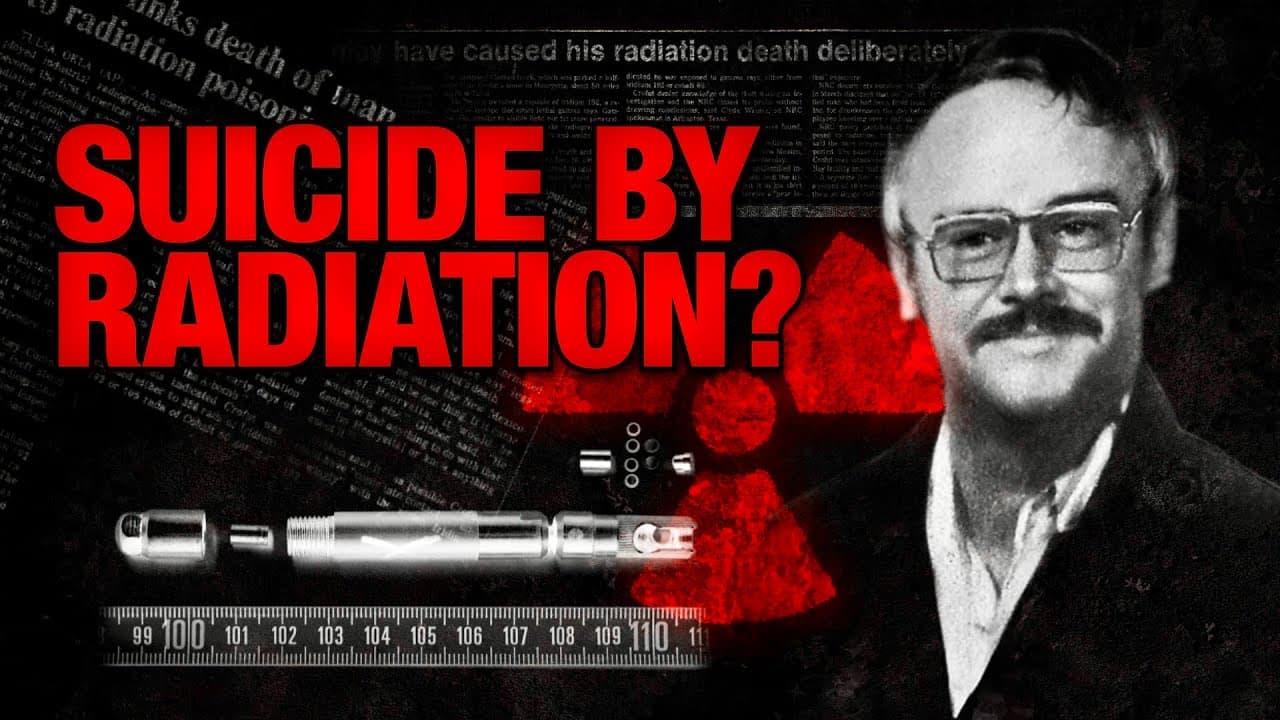
How Did Unknown Radiation Kill Douglas Crofut?
TL;DR
Douglas Crofut died after a massive, localized gamma-ray exposure destroyed tissue in his left arm and chest, but investigators never identified the source conclusively. A stolen iridium-192 capsule, his industrial-radiography experience, and the timing of his injuries supported suspicions of deliberate exposure, yet Crofut denied involvement until his death and the case remained unresolved.
Transcript
his cells were degenerating before our very eyes so far the situation defies explanation he was always kind of a loner on june 1st 1981 douglas crowfoot died in intensive care by then everyone knew that a lethal dose of radiation had killed him but no one knew why at the moment douglas died he became the only person in united states history to succ... Read More
Key Insights
- Douglas Crofut is described as the only person in United States history to die from an unidentified source of radioactive decay. Although investigators knew that powerful gamma rays caused his fatal injuries, they never conclusively determined the specific source or reconstructed the exposure.
- Industrial radiography uses radioactive pellets that emit gamma rays to inspect pipeline joints and welds through thick metal. Operators move a shielded capsule into imaging position with a corkscrewing wire called a pigtail, creating an image comparable to a medical X-ray.
- Crofut's exposure was localized rather than contaminating because his sister and former wife showed no signs of radiation poisoning. Investigators therefore concluded that the event affected Crofut alone, happened quickly, and did not leave radioactive contamination throughout his surrounding environment.
- The Nuclear Regulatory Commission estimated that Crofut's left arm and torso received between 350 and 400 rads. Investigators believed the exposure occurred between December 15, 1980, and January 10, 1981, and described that dose as fatal for half of exposed people.
- Iridium-192 is described as a category 2 radioactive source that can deliver a fatal dose within hours when mishandled. The transcript contrasts it with category 5 sources, which are unlikely to cause permanent harm, and category 1 sources, which can become lethal within minutes.
- A capsule of iridium-192 was stolen on December 30 from a locked radiography truck parked less than half a mile from Crofut's home. It was found on January 5, safely inside its shielded container on the back porch of another radiographer living nearby.
- Crofut had direct experience with iridium-192 and other industrial gamma-ray sources. In 1979, according to the account, an employer found him intoxicated and kneeling alone over an unshielded iridium-192 capsule, demonstrating both his access to the material and prior unsafe conduct around it.
- The evidence for deliberate exposure remained circumstantial because investigators found no actual connection between Crofut and the stolen capsule. Crofut denied knowing how he received the burns and denied involvement in the theft, leaving accident, negligence, and intentional self-exposure unresolved possibilities.
Install to Summarize YouTube Videos and Get Transcripts
Explore YouTube Video Summarizer or Get YouTube Transcript Extractor
Questions & Answers
Q: How did radiation kill Douglas Crofut?
A powerful gamma-ray exposure caused severe localized injuries to Douglas Crofut's left arm and chest. His burns progressively destroyed tissue, eventually reaching more than two inches into his chest. The exposure also nearly eliminated his bone marrow, which produced his blood cells. After months of worsening damage, Crofut died on June 1, 1981, following an ongoing infection and admission to intensive care.
Q: What radioactive source may have exposed Douglas Crofut?
Investigators suspected an industrial gamma-ray source containing iridium-192, although cobalt was also considered possible. Iridium-192 was commonly used in the radiography equipment Crofut knew how to operate. A capsule of that material disappeared near his home during the calculated exposure period, but the source responsible for his injuries was never officially identified, and no conclusive connection to the stolen capsule was established.
Q: Why did investigators suspect Douglas Crofut exposed himself deliberately?
Suspicion centered on Crofut's professional knowledge, the timing of the exposure, and the nearby theft of iridium-192. He knew how to operate radiography equipment and safely handle its source capsule. Investigators also knew about his alcohol problems, debt, arrests, unemployment, and an earlier incident involving an unshielded capsule. However, these circumstances did not prove deliberate self-exposure, and Crofut denied involvement.
Q: When was Douglas Crofut exposed to radiation?
The Nuclear Regulatory Commission calculated that the exposure occurred sometime between December 15, 1980, and January 10, 1981. A capsule of iridium-192 was stolen from a locked radiography truck on December 30 and recovered on January 5. Crofut's serious burns were discovered after his sister noticed bleeding, and he was brought to Okmulgee Memorial Hospital on January 22, 1981.
Q: What evidence connected Crofut's injuries to the stolen iridium-192 capsule?
The capsule vanished during the same period in which investigators calculated that Crofut was irradiated. Its truck was parked less than half a mile from his home, and Crofut had years of experience with the same type of industrial equipment. The source was later returned safely to shielding, suggesting knowledgeable handling. Despite these coincidences, theft investigators found no actual connection between Crofut and any involved radiographer.
Q: What injuries did Douglas Crofut suffer from radiation exposure?
Crofut initially had bleeding and extensive burns on his left arm and chest, including destruction severe enough to remove his left nipple. Over the following months, the burns failed to heal and eventually penetrated more than two inches into his chest. His bone marrow was almost gone, and doctors feared the continuing cellular destruction would reach a vital organ, probably his heart. He also developed an ongoing infection.
Q: How is iridium-192 used in industrial radiography?
Industrial radiographers use radioactive material such as iridium-192 to produce gamma rays powerful enough to pass through pipeline walls and inspect joints or welds. The material sits in a small capsule inside lead or depleted uranium shielding. An operator attaches a corkscrewing wire called a pigtail and pushes the capsule into position, where its gamma rays expose radiographic film and create an X-ray-like image.
Q: Why does Douglas Crofut's death remain unexplained?
Investigators could determine that Crofut received a massive, localized gamma-ray dose, but they could not identify the source conclusively or establish how contact occurred. The stolen iridium-192 capsule and Crofut's expertise created a compelling circumstantial theory, yet the theft investigation found no direct connection. Crofut maintained until his death that he knew nothing about either his burns or the missing capsule, taking any personal explanation with him.
Summary & Key Takeaways
-
Douglas Crofut, a 38-year-old former industrial radiographer, entered medical care in January 1981 with severe burns on his left arm and chest. Doctors concluded that only massive radiation exposure could explain the injuries. His condition deteriorated across several months as tissue damage, bone-marrow loss, and infection overwhelmed his body.
-
Nuclear Regulatory Commission investigators estimated that Crofut received 350 to 400 rads from a gamma-ray source between December 15, 1980, and January 10, 1981. They considered iridium-192 or cobalt likely candidates because these powerful materials were used in industrial radiography, work Crofut had performed repeatedly during his career.
-
An iridium-192 capsule disappeared from a locked radiography truck parked less than half a mile from Crofut's home and was later returned to shielding at another radiographer's house. Although the timing and Crofut's expertise prompted suspicions of intentional exposure, investigators established no connection, and Crofut consistently denied knowing how he was irradiated.
Read in Other Languages (beta)
Share This Summary 📚
Summarize YouTube Videos and Get Video Transcripts with 1-Click
Try YouTube Summary with ChatGPT & Claude or YouTube Transcript Generator
Explore More Summaries from Kyle Hill 📚
![What Made MEGALODON So Huge? | [OFFICE HOURS] Podcast #025 thumbnail](/_next/image?url=https%3A%2F%2Fi.ytimg.com%2Fvi%2F2F_zCTfPt-I%2Fhqdefault.jpg&w=750&q=75)
![🔴 Viral "Hanger Reflex" Explained! | [OFFICE HOURS] Podcast 090 thumbnail](/_next/image?url=https%3A%2F%2Fi.ytimg.com%2Fvi%2F-GQPNu0erKc%2Fhqdefault.jpg&w=750&q=75)




Summarize YouTube Videos and Get Video Transcripts with 1-Click
Try YouTube Summary with ChatGPT & Claude or YouTube Transcript Generator