How to Build Hybrid Search RAG with Pinecone
TL;DR
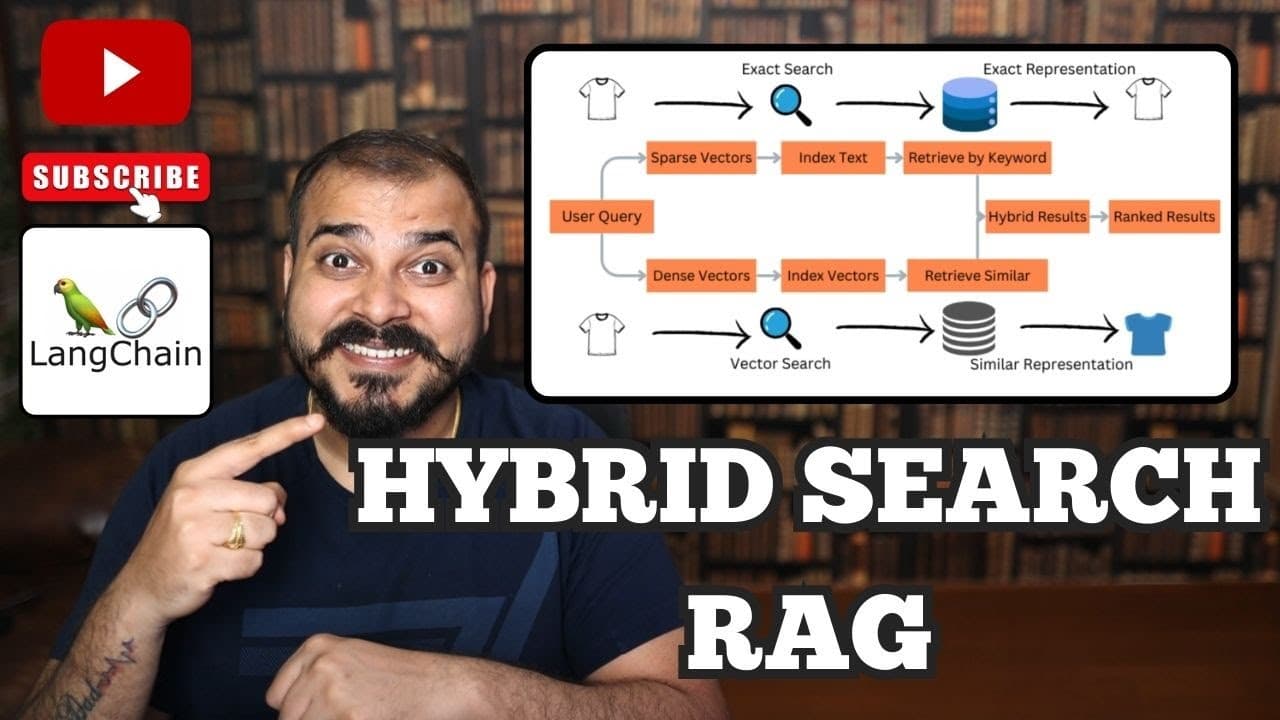
Hybrid search improves retrieval by combining semantic dense-vector matching with exact keyword matching based on sparse vectors. Documents and user queries are represented in both formats, producing separate top-k result sets that can support a RAG pipeline before the retrieved information is combined with a prompt template and language model.
Transcript
hello all my name is krishn and welcome to my YouTube channel so guys in this specific video we are going to implement an amazing hybrid search Rag application initially we will go ahead with the theoretical understanding about hybrid search and then we will proceed with developing an amazing endtoend project where we will be creating Vector databa... Read More
Key Insights
- Hybrid search is a retrieval approach that combines multiple search techniques, specifically semantic dense-vector search and syntactic keyword search, instead of depending on only one matching mechanism for a RAG application.
- Standard RAG retrieval is a process in which documents are divided into chunks, converted into embedding vectors, stored in a vector database, and searched using a vectorized version of the user query.
- Semantic search is dense-vector retrieval that identifies content with similar vector representations. The transcript presents cosine similarity as one algorithm that can compare query vectors with stored document vectors and help retrieve a response.
- Keyword search is syntactic or exact retrieval that focuses on the presence of specific terms. It uses sparse vector representations rather than relying exclusively on the similarity relationships captured by dense embeddings.
- Sparse matrices are text representations containing many zero values, with nonzero values associated with words present in a sentence. The transcript identifies one-hot encoding, bag of words, and TF-IDF as techniques for producing them.
- Dense vectors are document or query representations produced through embedding techniques. The transcript mentions OpenAI, Ollama, and Hugging Face embedding techniques as options for converting text into dense vectors before database storage.
- A hybrid-search database is designed to store both sparse and dense representations of the same documents. Supporting both formats enables one collection of content to be retrieved through keyword evidence and semantic similarity.
- A hybrid query is converted into both a sparse vector and a dense vector. These representations produce separate top-k result sets, one from keyword search and another from semantic vector search.
Install to Summarize YouTube Videos and Get Transcripts
Explore YouTube Video Summarizer or Get YouTube Transcript Extractor
Questions & Answers
Q: What is hybrid search in a RAG application?
Hybrid search is a retrieval method that combines multiple search techniques within a RAG application. The approach described combines semantic search, which uses dense vectors to find similar content, with syntactic or keyword search, which uses sparse vectors to locate exact terms. This allows retrieval to consider both meaning-based similarity and direct keyword matches.
Q: How does standard vector search work in RAG?
Standard vector search begins by dividing source documents into smaller document chunks. Each chunk is converted into an embedding vector and stored in a vector database. When a user submits a query, that query is also converted into a vector. The database then finds similar stored vectors, with cosine similarity presented as one possible comparison algorithm.
Q: What is the difference between dense and sparse vector search?
Dense vector search supports semantic retrieval by comparing embedded representations and finding content with similar meaning. Sparse vector search supports syntactic, exact, or keyword retrieval by representing the occurrence of particular words. Hybrid search uses both approaches so that retrieval is not dependent exclusively on semantic similarity or exact keyword presence.
Q: How are sparse vectors created for keyword search?
Sparse vectors can be created from text using techniques such as one-hot encoding, bag of words, or TF-IDF. The resulting sparse matrix contains many zero values, while positions associated with words found in a sentence receive nonzero values. This representation allows the retrieval system to focus on specific keywords and exact matches.
Q: How are documents stored for hybrid search?
Documents are stored in two representational formats inside a vector database that supports both dense-vector and keyword search. Their text is converted into sparse matrices for exact or keyword matching and into dense vectors through an embedding technique for semantic matching. Both representations correspond to the same underlying document content.
Q: How is a user query processed during hybrid search?
A user query is converted into two representations before retrieval. One is a sparse vector used for keyword or exact search, and the other is a dense vector used for semantic vector search. Each search path queries the stored document representations and returns its own top-k results based on its matching method.
Q: What role does cosine similarity play in semantic search?
Cosine similarity is presented as one algorithm that can compare the vector representation of a user query with vectors stored in a vector database. This comparison supports semantic search by identifying similar vectors. The retrieved response can then be combined with a prompt template and a language model to produce summarized output.
Q: Why combine keyword search with semantic search?
Combining keyword and semantic search allows retrieval to use two different forms of evidence. Keyword search focuses on specific terms and exact matches through sparse vectors, while semantic search identifies similar content through dense vectors. The hybrid approach therefore avoids relying on only one search mechanism when retrieving information for a RAG application.
Summary & Key Takeaways
-
Standard RAG retrieval divides documents into chunks, converts their text into embedding vectors, and stores those vectors in a vector database. A user query is also converted into a vector, then matched against stored vectors through semantic search, with cosine similarity presented as one possible matching method for retrieving relevant content.
-
Hybrid search combines semantic search with syntactic, exact, or keyword search. Semantic retrieval uses dense vectors to identify similar content, while keyword retrieval uses sparse representations. Sparse matrices can be created with techniques such as one-hot encoding, bag of words, or TF-IDF and typically contain many zero values.
-
A hybrid-search database stores dense and sparse representations of the same documents. Each user query is likewise converted into dense and sparse vectors. The sparse representation produces keyword-based top-k results, while the dense representation produces semantic top-k results, allowing retrieval to use both similarity and exact-term evidence.
Read in Other Languages (beta)
Share This Summary 📚
Summarize YouTube Videos and Get Video Transcripts with 1-Click
Try YouTube Summary with ChatGPT & Claude or YouTube Transcript Generator
Explore More Summaries from Krish Naik 📚






Summarize YouTube Videos and Get Video Transcripts with 1-Click
Try YouTube Summary with ChatGPT & Claude or YouTube Transcript Generator