How to Design Scalable Production Systems
TL;DR
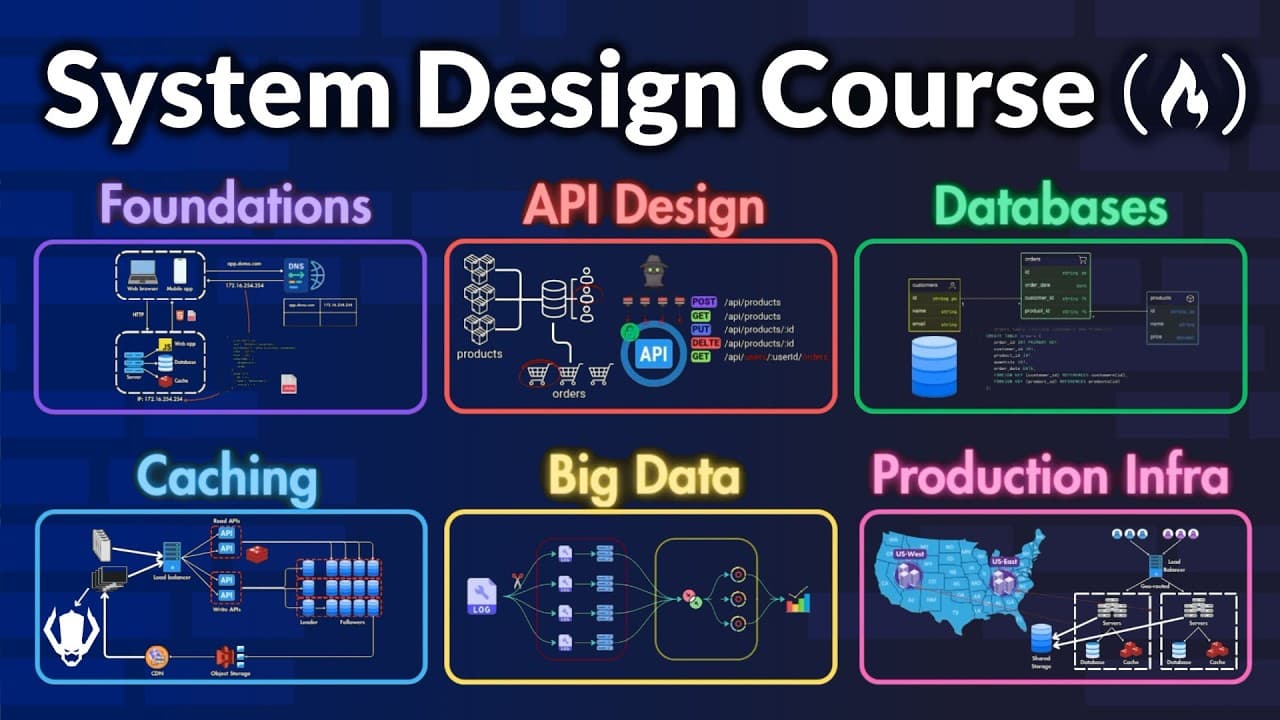
Start with a single-server architecture, understand how requests move through DNS and HTTP, then separate and scale components as demand grows. Choose SQL when structured relationships, joins, and transactional integrity matter, or select an appropriate NoSQL model for flexible data and specialized access patterns. Reliable production design also requires deliberate API design, load balancing, health checks, authentication, authorization, and security.
Transcript
Transitioning from a mid-level developer to a senior engineer requires shifting your focus from simply writing code to mastering high-level architectural design. This video breaks down the essential road map for building scalable productionready systems from the ground up covering everything from API protocols to database selection. You will learn ... Read More
Key Insights
- Senior system design is the ability to create architectures from rough requirements, evaluate tradeoffs, and make decisions that influence performance, data storage, customers, and the resulting software, rather than only adding code to an established system with clearly defined tasks.
- A single-server setup places the web application, database, cache, and other components on one machine, making it a useful starting point for understanding request flow and essential architecture before introducing the additional complexity required for larger user demand.
- DNS is the service that maps a domain such as app.demo.com to the server's IP address, allowing a browser or mobile application to locate the server before sending an HTTP request for a page, API resource, or other data.
- Web and mobile clients can have different response needs: browsers may receive HTML, CSS, and JavaScript for presentation, while mobile applications commonly call API endpoints and receive lightweight JSON containing requested fields and useful metadata.
- Separating the web tier from the data tier allows each server to scale according to its specific workload. This becomes important when increased demand makes a single machine insufficient for handling both application traffic and database operations effectively.
- Relational databases organize records into tables, columns, and rows and support SQL operations across structured data. Their ability to perform joins makes them appropriate when an application must connect related records, such as customers, products, and orders.
- SQL transactions follow atomicity, consistency, isolation, and durability. A transaction succeeds or fails as one unit, moves data between valid states, prevents concurrent operations from improperly interfering, and preserves committed data even when the database server or system fails.
- NoSQL databases include document, wide-column, key-value, and graph models. Document stores hold JSON-like records with complex structures, while wide-column stores use rows and dynamic columns and are presented as suitable for massive scale and workloads involving many write operations.
Install to Summarize YouTube Videos and Get Transcripts
Explore YouTube Video Summarizer or Get YouTube Transcript Extractor
Questions & Answers
Q: How do you start designing a scalable system?
Start with a straightforward single-server architecture containing the web application, database, cache, and related components. Trace how a user enters a domain, receives an IP address from DNS, sends an HTTP request, and receives HTML or JSON. Once that flow is understood, identify the parts that become constrained as demand grows, then separate and scale those components deliberately.
Q: What separates a senior engineer from a mid-level developer?
A senior engineer can make architectural decisions from rough requirements, design systems or features from scratch, and reason about tradeoffs. The role extends beyond writing code or completing clearly specified tasks within a mature architecture. Senior-level decisions include improving performance, optimizing data storage, and considering how technical choices affect customers and the software being built.
Q: How does a single-server architecture handle user requests?
A user begins with a domain name rather than the server's IP address. DNS maps that domain to the IP address and returns it to the browser or mobile application. The client then sends an HTTP request to the server. The server processes the request and returns the required data, such as an HTML page for a browser or JSON for an application.
Q: When should the web tier and data tier be separated?
The web tier and data tier should be separated when growing demand makes a single server insufficient. The web tier handles traffic from browsers and mobile applications, while the data tier manages the database. Placing them on different servers lets each tier scale according to its own load instead of forcing application processing and database operations to share one machine.
Q: When should a relational database be selected?
A relational database should be considered when data fits structured tables and the application needs relationships, complex joins, consistency, or transactional integrity. Examples in the course include PostgreSQL, MySQL, Oracle Database, and SQLite. A relational design can connect customers and products through orders while preserving valid data through transactions governed by atomicity, consistency, isolation, and durability.
Q: What does ACID mean for SQL transactions?
ACID describes four transaction properties. Atomicity means all operations succeed together or fail together. Consistency means a transaction changes the database from one valid state to another. Isolation prevents concurrent transactions from improperly interfering with each other. Durability means committed data remains stored even when the system or database server experiences a failure.
Q: What types of NoSQL databases are covered?
The course identifies document stores, wide-column stores, key-value stores, and graph stores. MongoDB represents document storage using JSON-like records that can contain complex structures. Cassandra and Cosmos DB represent wide-column storage with rows and dynamic columns. Redis is listed as a key-value example, while Neo4j represents databases focused on graph data.
Q: What production system design topics should engineers study?
Engineers should study foundational request flow, database selection, vertical and horizontal scaling, load balancing, health checks, and single points of failure. The course also covers API design and protocols, TCP and UDP, RESTful APIs, GraphQL, authentication, authorization, and security. Together, these topics support systems intended to operate beyond one laptop or a single production machine.
Summary & Key Takeaways
-
Senior-level system design requires more than implementing predefined tasks within an established architecture. Engineers must be able to interpret rough requirements, create architectures from scratch, evaluate tradeoffs, optimize data storage, and make decisions affecting performance, customers, and the software being built. These abilities also support system design interview performance.
-
A basic architecture can place the web application, database, cache, and related components on one server. DNS translates the application domain into the server's IP address, after which a browser or mobile application sends an HTTP request. The server processes it and returns HTML or a lightweight JSON response.
-
As demand increases, the web tier and data tier can be separated so each can scale according to its own load. Database selection then depends on application requirements. Relational databases provide tables, joins, and transactional integrity, while document, wide-column, key-value, and graph databases support different data structures and access patterns.
Read in Other Languages (beta)
Share This Summary 📚
Summarize YouTube Videos and Get Video Transcripts with 1-Click
Try YouTube Summary with ChatGPT & Claude or YouTube Transcript Generator
Explore More Summaries from freeCodeCamp.org 📚




Summarize YouTube Videos and Get Video Transcripts with 1-Click
Try YouTube Summary with ChatGPT & Claude or YouTube Transcript Generator