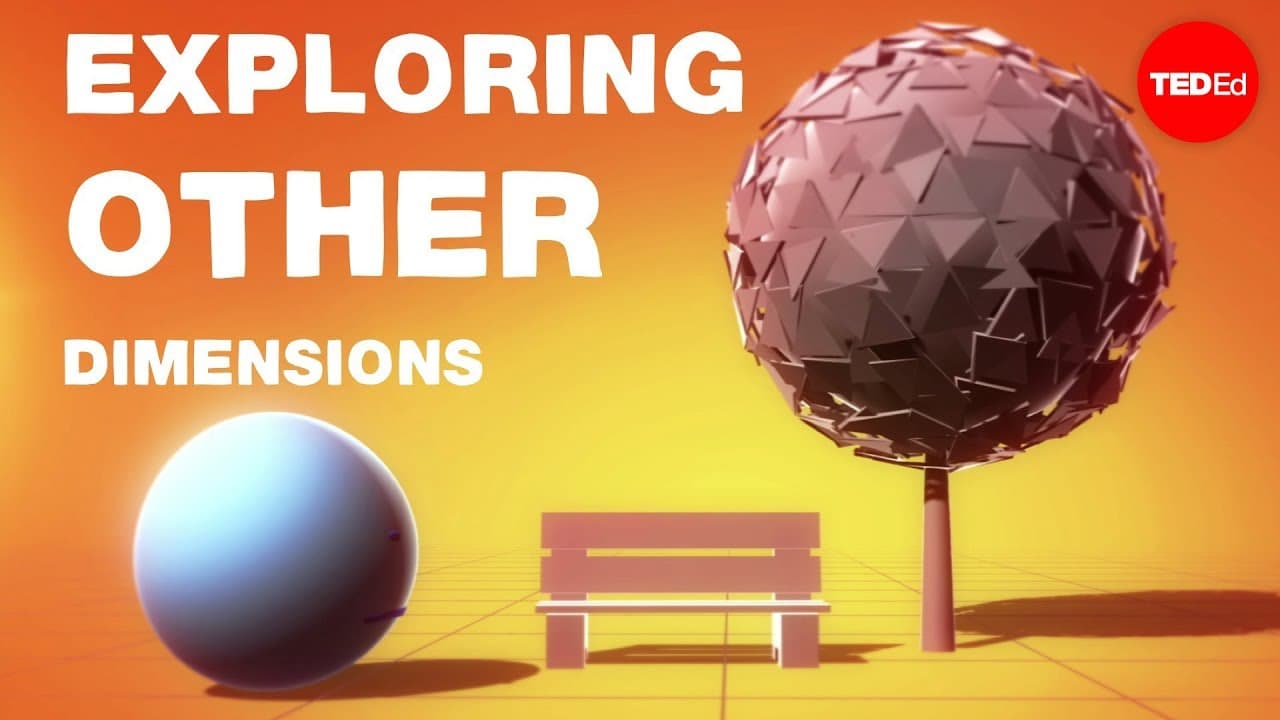
Exploring other dimensions - Alex Rosenthal and George Zaidan
TL;DR
Higher dimensions can be understood as new directions perpendicular to every existing dimension, even though they lie outside ordinary three-dimensional experience. Edwin Abbott’s 1884 novella “Flatland” illustrates this through a square who discovers height after a sphere lifts him out of his two-dimensional world. Cross-sections and the construction of a 4D hypercube, or tesseract, offer ways to represent a fourth dimension. Read on to see how each analogy works.
Transcript
We live in a three-dimensional world where everything has length, width, and height. But what if our world were two-dimensional? We would be squashed down to occupy a single plane of existence, geometrically speaking, of course. And what would that world look and feel like? This is the premise of Edwin Abbott's 1884 novella, Flatland. Flatland is a... Read More
Key Insights
- 🤔 "Flatland" serves as a thought experiment that challenges our understanding of dimensions and expands our perception by exploring a two-dimensional world.
- 👻 Dimensions are direction-like entities that are perpendicular to all other dimensions, allowing for added spatial aspects.
- ⁉️ The introduction of a higher-dimensional entity in "Flatland" prompts the protagonist to question and desire to explore dimensions beyond the third.
Install to Summarize YouTube Videos and Get Transcripts
Explore YouTube Video Summarizer or Get YouTube Transcript Extractor
Questions & Answers
Q: What is a dimension?
For the explanation given here, a dimension is a direction that can be pictured as a line. To count as a new dimension, that direction must be at right angles to all the other dimensions.
Q: What is Edwin Abbott’s “Flatland” about?
Edwin Abbott’s 1884 novella is a mathematical thought experiment set in a two-dimensional world populated by geometric shapes. It follows a square whose understanding of reality changes when he is exposed to the third dimension.
Q: How do Flatland’s inhabitants perceive their two-dimensional world?
Although they occupy a flat plane, the inhabitants essentially see a one-dimensional line. Closer objects appear brighter, allowing them to distinguish depth and tell shapes such as triangles, squares, and circles apart.
Q: How does the sphere prove that a third dimension exists?
The sphere first passes through Flatland, appearing to the square as circles that grow and then shrink. It then lifts the square into the height direction, where he can look down on buildings, hidden gems, and the insides of other shapes.
Q: Why do the Flatlanders deny the third dimension?
Their brains cannot comprehend the third dimension because it is not part of their world or experience. They therefore strongly deny its existence until the square is physically lifted beyond the plane.
Q: How can cross-sections help explain a fourth dimension?
A sphere moving through a two-dimensional plane appears as a sequence of circles, beginning as a point, growing larger, and then shrinking. By analogy, a four-dimensional object passing through three-dimensional space would appear as a changing series of 3D cross-sections.
Q: What is a tesseract, and how is it constructed conceptually?
A tesseract is a four-dimensional hypercube. The explanation builds from a point extended into a line, a line extended into a square, and a square extended into a cube; extending the entire cube one inch in a direction perpendicular to all three existing directions produces the tesseract.
Q: What happens when the square asks to visit dimensions higher than three?
After accepting the third dimension, the square asks the sphere to take him into the fourth and higher dimensions. The sphere rejects the suggestion that dimensions above three exist and exiles the square back to Flatland.
Summary & Key Takeaways
-
"Flatland" is a mathematical thought experiment that imagines a two-dimensional world and follows the experiences of a square in this world.
-
Dimensions can be understood as directions that are perpendicular to all other dimensions, with each dimension adding an additional spatial aspect.
-
"Flatland" introduces the idea of higher dimensions and explores how beings in lower-dimensional worlds struggle to comprehend and visualize them.
Read in Other Languages (beta)
Share This Summary 📚
Summarize YouTube Videos and Get Video Transcripts with 1-Click
Try YouTube Summary with ChatGPT & Claude or YouTube Transcript Generator
Explore More Summaries from TED-Ed 📚


Summarize YouTube Videos and Get Video Transcripts with 1-Click
Try YouTube Summary with ChatGPT & Claude or YouTube Transcript Generator