How to Secure Docker Containers in Production
TL;DR
Secure Docker deployments by treating development, operations, and security as one collaborative process, minimizing each container, and replacing compromised instances with rebuilt versions. Containers improve environment reproducibility, dependency management, testing, and update speed, but immutability alone does not stop attackers from returning. Production teams must account for security flaws, container escapes, cloud architecture, and incident response throughout the software lifecycle.
Transcript
Good afternoon. Thank you for joining us. Let me introduce Paul Asiado, the founder and CEO of Security Weekly. Please welcome. Thank you. Thank you everyone for coming today. Um, I don't wanna disappoint you, but I am not an expert in Docker or containers. And I know that sounds kind of weird 'cause here we are at RSA, we're on a stage, and I'm pr... Read More
Key Insights
- Docker is valuable for reproducing consistent environments because the same packaged application can move among development, QA, production, and cloud deployments without recreating every dependency manually. This directly addresses the environment mismatch problems the presenter encountered with Python libraries, PIP, and virtual environments.
- Container security is a shared responsibility because container deployment combines development, systems administration, operations, networking, and security decisions within one process. The presenter argues that these groups must work together rather than assume that a single traditional role automatically owns every security choice.
- Container immutability changes traditional administration because instances are expected to disappear and be replaced instead of remaining as carefully maintained servers. The presenter initially struggled with this model after working with long-lived bare-metal Unix and Solaris systems, but later recognized its operational and security benefits.
- Replacing a compromised container is useful but incomplete because an attacker can repeatedly regain access if the underlying weakness remains. Removing an instance addresses the current foothold, while preventing recurrence requires identifying and correcting the vulnerability or insecure deployment decision that enabled the compromise.
- Containers can accelerate security updates because teams can build, test, and release new versions when libraries, application servers, operating-system components, or other dependencies need changes. This model can reduce the burden associated with updating traditional environments and conducting regression testing around major system modifications.
- Minimal container contents improve security thinking because packaging an application forces teams to identify exactly what it needs. The presenter contrasts this approach with building a large general-purpose operating system, emphasizing that unnecessary components should be stripped out during application containerization.
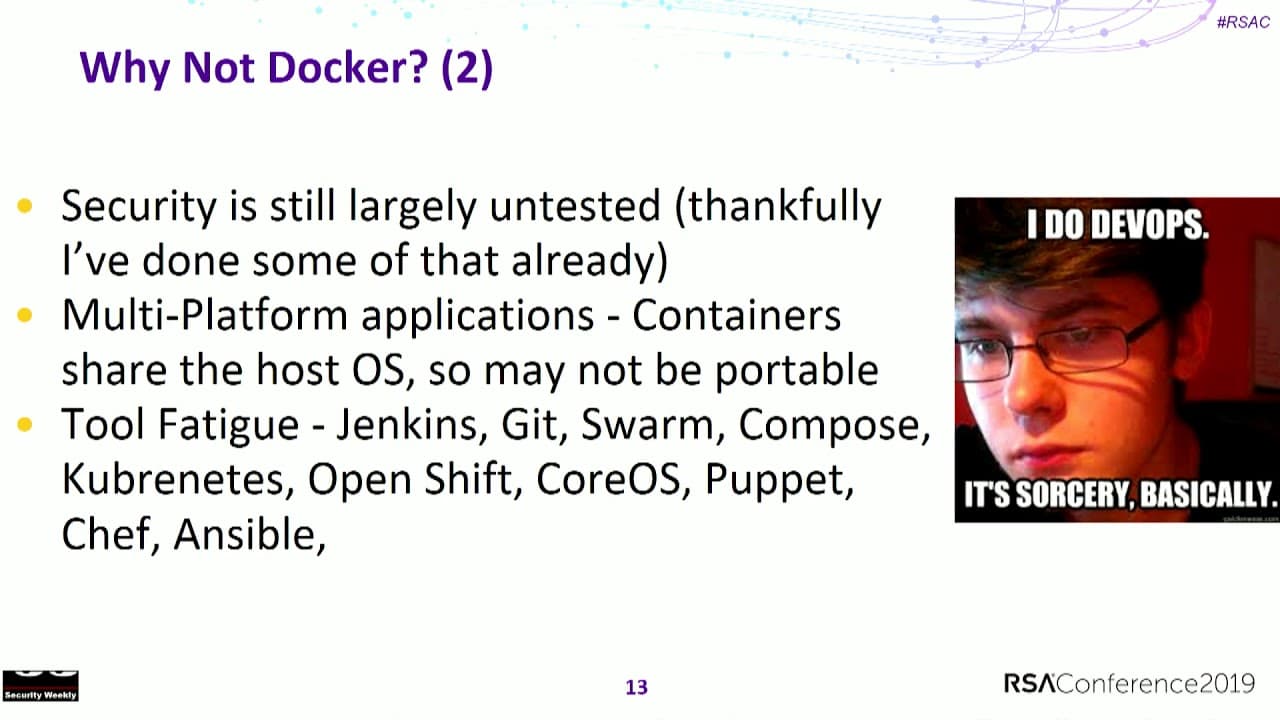
- Docker adoption has a substantial learning curve because examples that work on a laptop may not explain how to operate several production environments in AWS. The presenter found production guidance rough or incomplete during the project, although he believed the documentation situation was improving.
- Container security requires active testing because attackers may seek ways to escape containers or abuse exposed applications. The talk connects this concern with runC vulnerabilities, an actual attack against the presenter’s cloud deployment, and the need for secure architecture, threat modeling, incident response, and SDLC controls.
Install to Summarize YouTube Videos and Get Transcripts
Explore YouTube Video Summarizer or Get YouTube Transcript Extractor
Questions & Answers
Q: How can Docker improve environment reproducibility?
Docker can package an application and its required components so development, QA, production, and cloud environments are easier to recreate consistently. The presenter previously spent substantial effort building environments and struggled when Python libraries, PIP dependencies, and virtual environments did not match. Containerization changed his approach by reducing those mismatches and making repeated environment creation more practical.
Q: Why is Docker security a shared responsibility?
Docker combines activities that were traditionally separated among software development, systems administration, operations, networking, and security. A single deployment process can now include choices previously owned by several specialists. Because those security decisions cross organizational boundaries, the presenter concludes that developers, operations staff, and security practitioners need to collaborate and establish responsibility for the resulting architecture and deployment.
Q: What does container immutability mean for administrators?
Container immutability means administrators should expect an instance to be replaced by a newly built version rather than treated as a long-lived server that is continually modified. This mindset was difficult for the presenter because his Unix and Solaris background emphasized carefully building and maintaining bare-metal systems. Once understood, replacement became a useful model for deployment, updates, and recovery.
Q: Can replacing a hacked container remove an attacker permanently?
Replacing a hacked container can remove the attacker’s current foothold, but it does not guarantee that the attacker is permanently excluded. The presenter compares the situation to an attacker repeatedly reappearing while defenders repeatedly wipe the container. If the vulnerability or deployment mistake remains present in every replacement, the attacker may continue returning until the underlying cause is corrected.
Q: How does Docker make security updates easier?
Docker allows teams to create, test, and deploy new application versions when a library, application server, operating-system component, or other dependency needs an update. The presenter contrasts this with traditional updates that could become major regression-testing efforts. Rebuilding and releasing containers can make those changes faster and supports more frequent versions without manually modifying every existing environment.
Q: Why should a Docker container include only necessary components?
A Docker container should include only the components required by its application because unnecessary software increases complexity and works against the security practice of stripping out what is not needed. The migration forced the presenter to examine the application’s actual requirements instead of relying on a large operating-system installation. He viewed that constraint as a meaningful security benefit.
Q: What problems did Docker solve for the Python application?
Docker addressed the presenter’s difficulty moving Python code between development and production when libraries, PIP packages, virtual environments, and other dependencies did not match exactly. Those inconsistencies made deployments unreliable and made every additional environment harder to construct. Packaging the application in containers provided a more reproducible structure for operating the legacy web application across multiple environments.
Q: What should teams consider before deploying Docker in production?
Teams should account for the technology’s learning curve, limited production guidance encountered by the presenter, shared security ownership, cloud architecture, application vulnerabilities, and possible container escapes. They should also threat model modern applications, harden relevant systems, secure SDLC and DevOps processes, and prepare incident-response procedures. Laptop examples alone may not cover the demands of several AWS production environments.
Summary & Key Takeaways
-
Docker helped move a legacy Python application away from fragile bare-metal environments, mismatched libraries, PIP dependencies, and virtual environments. Containers made development, QA, and production environments easier to reproduce while forcing the application owner to identify exactly which components were necessary. The migration also introduced a significant learning curve.
-
Container adoption combines decisions traditionally divided among developers, systems administrators, operations teams, network staff, and security practitioners. Secure deployment therefore depends on collaboration and clear ownership. The technology can accelerate releases, regression testing, library updates, application-server changes, and operating-system updates, but production documentation was difficult for the presenter to find.
-
The application was eventually deployed in containers to cloud environments and was hacked, creating a practical incident-response lesson. Replacing a compromised container can remove an attacker’s current foothold, but an unresolved weakness may let the attacker return repeatedly. Secure architecture, threat modeling, application hardening, and safer DevOps processes remain necessary.
Read in Other Languages (beta)
Share This Summary 📚
Summarize YouTube Videos and Get Video Transcripts with 1-Click
Try YouTube Summary with ChatGPT & Claude or YouTube Transcript Generator
Explore More Summaries from RSAC Cybersecurity 📚



Summarize YouTube Videos and Get Video Transcripts with 1-Click
Try YouTube Summary with ChatGPT & Claude or YouTube Transcript Generator