Where Is Simon Sinek Going After Start With Why?
TL;DR
Build identity around enduring beliefs rather than job titles or past accomplishments, so change does not erase your sense of value. Simon Sinek frames life as an infinite journey shaped by reinvention, friendship, and optimism, while also examining how artificial intelligence and commercial incentives are changing creativity, media, trust, and personal reflection.
Transcript
The common thread in all of my work was a friend there to support me was a friend there to hold me up. And I know who those people are. It's Jen. It's Johnny Quest. It's Johnny Bravo. It's Kendra. I'm writing about friendship now because it's my oh, it's going to bring me to tears. It's a letter of gratitude. I'm writing this book to say thank you.... Read More
Key Insights
- Identity is more resilient when it rests on enduring beliefs rather than a job title, award, or former accomplishment. Sinek identifies himself first as an optimist because that description can remain true even as his projects, professional roles, and circumstances change.
- The infinite game is a way to understand life as a continuing journey rather than a single achievement. Difficult climbs, easy stretches, scenic pauses, and encounters with friends are all parts of that journey, so no individual stop should define a person completely.
- Reinvention becomes harder when self-worth depends on work that may disappear. Technology, culture, politics, and changing tastes can transform an industry, leaving people disoriented if they have treated one professional activity as the entirety of who they are.
- Accomplishments are temporary markers rather than permanent identities. Sinek notes that biographies and political introductions often emphasize titles and old achievements instead of beliefs, even though public recognition fades and later generations may not remember once-famous people.
- Friendship is the common thread Sinek recognizes across his work. He names friends who supported and sustained him, and he describes his emerging writing about friendship as a letter of gratitude intended to thank the people who repeatedly held him up.
- News was originally presented as a public service connected to broadcasters' use of public airwaves. According to Sinek's account, entertainment generated money while news lacked its own business model, which helped trusted news figures operate without the same ratings incentives.
- Commercial incentives changed journalism when news ratings demonstrated that news programming could attract large audiences. As advertising and competition became integrated into news, organizations gained stronger incentives to maximize viewership, weakening the traditional separation between editorial judgment and business interests.
- Behavior follows the rewards built into a system. Sinek argues that rewarding attention above other goals encourages news organizations to say or do whatever attracts viewers, making the underlying business model, rather than individual journalists alone, central to understanding declining trust.
Install to Summarize YouTube Videos and Get Transcripts
Explore YouTube Video Summarizer or Get YouTube Transcript Extractor
Questions & Answers
Q: How can people build an identity that survives career changes?
People can build a more durable identity by defining themselves through lasting beliefs and values instead of job titles, awards, or completed projects. Simon Sinek uses optimism as his own anchor because it can remain part of him regardless of what work he performs. When an industry changes or a role ends, accomplishments still matter, but they become chapters in a longer journey rather than the sole source of personal worth.
Q: What does the infinite game mean for personal reinvention?
The infinite game frames personal development as an ongoing journey with many different stages. Some stretches are difficult, some are easy, some offer a good view, and some bring supportive friends. This perspective makes reinvention less threatening because losing or leaving a particular role does not end the journey. A career chapter becomes one temporary stop, not a final definition of identity, value, or future possibility.
Q: Why is tying self-worth to a job title risky?
Tying self-worth to a job title is risky because work can change or disappear through technology, culture, politics, shifting tastes, or personal choice. If someone believes being a lawyer, journalist, or executive is their complete identity, stopping that work can create a crisis of value. Sinek argues that people need a deeper understanding of what they believe, so their worth remains intact when professional circumstances force them to pivot.
Q: Why does Simon Sinek call himself an optimist first?
Simon Sinek calls himself an optimist first because optimism describes an enduring part of his identity rather than a temporary achievement. When he provides wording for a book endorsement, he asks to be identified as an optimist before listing the things he has done. That ordering serves both public communication and personal reinforcement, reminding him that projects and accomplishments can change while his central belief about a brighter future can continue.
Q: What role does friendship play in Simon Sinek's next direction?
Friendship appears to be a central subject in Sinek's next phase of writing and reflection. He recognizes that a supportive friend has been a common thread throughout his work and names several people who held him up. He describes the book he is writing about friendship as a letter of gratitude. Its purpose is not merely to analyze friendship, but to thank the people whose support made his journey possible.
Q: How did the business model of television news change?
Sinek describes early broadcast news as a public service offered in exchange for private use of public airwaves. Entertainment produced revenue, while news was not expected to operate as a profit center. He says the situation began changing after coverage of the 1979 Iran hostage crisis attracted unusually high ratings. News gradually became rated, advertised, and managed more like other television programming, integrating commercial goals with editorial operations.
Q: Why can commercial incentives reduce trust in news?
Commercial incentives can reduce trust when news organizations are rewarded primarily for attracting viewers. Sinek's argument is that systems produce the behavior they reward. If attention and ratings determine advertising value, organizations gain an incentive to present whatever keeps audiences watching. Competition then shapes editorial choices, and the news moves away from its earlier public-service role. The underlying business model becomes a major source of distrust and distortion.
Q: How are artificial intelligence and changing media connected to reinvention?
Artificial intelligence and changing media both illustrate why people need identities that extend beyond familiar professional methods. Cal Fussman describes himself as an old-school journalist who largely missed the internet, yet became deeply involved with artificial intelligence as the media environment changed. Their discussion treats technological disruption as another stage in an infinite journey, requiring people to reconsider old boundaries, adapt their work, and preserve the beliefs that matter across changing formats.
Summary & Key Takeaways
-
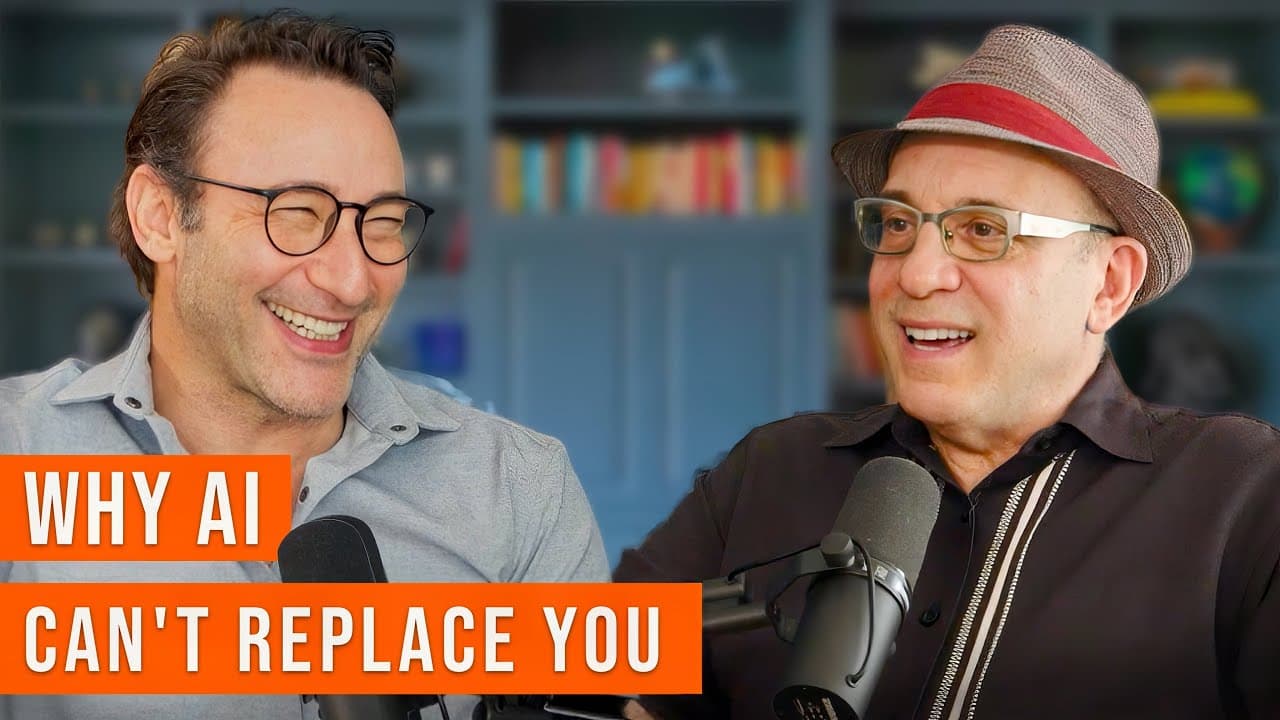
Cal Fussman takes over Simon Sinek's podcast to examine what came after Start With Why, Leaders Eat Last, and The Infinite Game. Their conversation focuses on Sinek's evolving direction, the ideas that continue to shape his identity, and his growing desire to write a grateful reflection about friendship.
-
Sinek argues that people become vulnerable when they confuse identity with employment, titles, awards, or accomplishments. Careers and industries can disappear as technology, culture, politics, and public tastes change. An infinite-game perspective makes reinvention easier because each professional chapter becomes one stop within a longer personal journey.
-
The discussion connects personal reinvention with broader changes in artificial intelligence and journalism. Sinek describes how commercial incentives transformed news from a public service into a ratings-driven business. The pair suggest that behavior follows rewards, so systems emphasizing attention can weaken editorial boundaries and public trust.
Read in Other Languages (beta)
Share This Summary 📚
Summarize YouTube Videos and Get Video Transcripts with 1-Click
Try YouTube Summary with ChatGPT & Claude or YouTube Transcript Generator
Explore More Summaries from Simon Sinek 📚


Summarize YouTube Videos and Get Video Transcripts with 1-Click
Try YouTube Summary with ChatGPT & Claude or YouTube Transcript Generator