How Societies Evolve: From Tribes to Cities
TL;DR
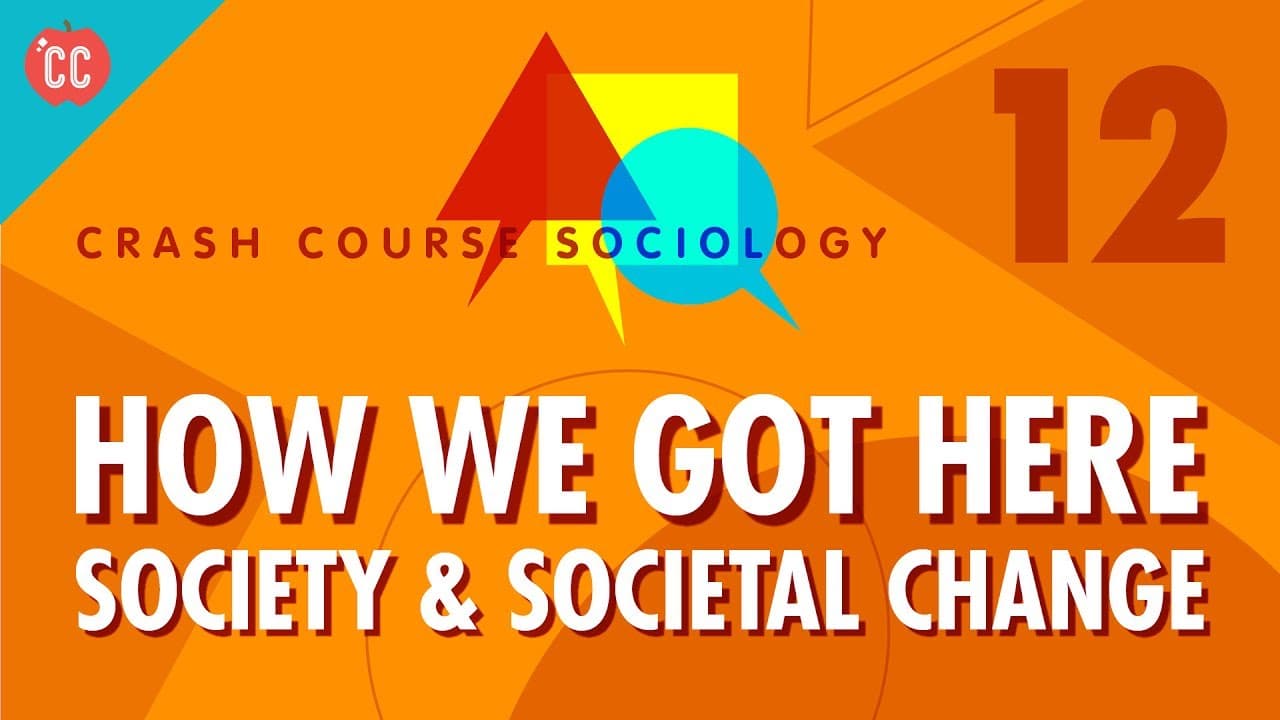
Human societies have evolved from small, nomadic groups to complex, urbanized structures due to technological advancements. Gerhard Lenski's classification outlines five societal types based on technology, with each transition marked by increased specialization and inequality. Marx, Weber, and Durkheim offer additional perspectives on societal change, focusing on conflict, ideas, and social structure, respectively.
Transcript
Until about 12,000 years ago, the largest group of people ever assembled, the most humans ever gathered in one place, was probably a crowd of about 100, tops. And there were somewhere between one and ten million people on the entire planet back then. Today, we have football stadiums that can fit a hundred people a thousand times over. The city of S... Read More
Key Insights
- Gerhard Lenski classifies societies into five types based on technology: hunting and gathering, horticultural, pastoral, agrarian, industrial, and postindustrial.
- Technological advancements drive sociocultural evolution, leading to increased specialization and inequality.
- Hunting and gathering societies are small and egalitarian due to their subsistence lifestyle.
- Agrarian societies see the emergence of surplus, permanent settlements, and social inequality.
- Industrial societies are marked by mass production, urbanization, and a shift from family-based to institutional roles.
- Postindustrial societies focus on information, services, and technology, with a decline in manufacturing.
- Marx emphasizes class struggle and revolution as drivers of societal change, alongside technological change.
- Weber highlights the role of ideas and rationalization in societal transitions, while Durkheim focuses on changes in social solidarity.
Install to Summarize YouTube Videos and Get Transcripts
Explore YouTube Video Summarizer or Get YouTube Transcript Extractor
Questions & Answers
Q: How do technological advancements drive societal change?
Technological advancements drive societal change by enabling new forms of social organization and increasing the capacity for specialization. As societies develop new technologies, they transition from subsistence-based economies to more complex structures, allowing for larger populations and more diverse roles. This process, known as sociocultural evolution, leads to increased inequality and changes in social institutions.
Q: What are the characteristics of hunting and gathering societies?
Hunting and gathering societies are characterized by small, nomadic groups that rely on subsistence living. They use basic tools to hunt animals and gather wild plants, with a primary focus on food acquisition. These societies are egalitarian, with low inequality, as resources are shared to ensure group survival. Their lifestyle limits group size to around 25 to 40 people.
Q: How did agrarian societies lead to increased social inequality?
Agrarian societies led to increased social inequality through the development of surplus resources and permanent settlements. As agricultural techniques improved, societies could produce more food than needed for immediate survival, allowing for the accumulation of wealth and resources. This surplus enabled specialization, leading to distinct political, religious, and military roles, and the emergence of social hierarchies and inequality.
Q: What role did the industrial revolution play in societal organization?
The industrial revolution fundamentally changed societal organization by shifting production from human and animal power to machine power. This shift enabled mass production and larger populations, increased specialization, and urbanization. It also marked a move away from subsistence economies to capital-based economies, leading to greater inequality and the emergence of centralized institutions for education and healthcare.
Q: How do postindustrial societies differ from industrial societies?
Postindustrial societies differ from industrial societies by focusing on information, services, and technology rather than raw materials and manufacturing. While industrial societies are characterized by mass production and urbanization, postindustrial societies emphasize knowledge-based economies, with significant growth in tech, finance, and service industries. This shift results in declining manufacturing sectors and increased global inequality.
Q: What is Marx's perspective on societal change?
Marx's perspective on societal change emphasizes class struggle and revolution as key drivers. According to Marx, technological advancements alone are insufficient for large-scale change; instead, societal transitions occur through conflicts between classes, culminating in revolutions that overthrow old production relations and establish new ones. This view highlights the role of economic forces and class dynamics in shaping societies.
Q: How does Weber's view of societal change differ from Marx's?
Weber's view of societal change differs from Marx's by focusing on the role of ideas and rationalization rather than class struggle. Weber argues that societal transitions, such as the shift from agrarian to industrial societies, begin with changes in ideas, like new accounting techniques and social organization methods. These ideas, combined with technological advances, drive the emergence of modern capitalism and societal change.
Q: What is Durkheim's concept of social solidarity?
Durkheim's concept of social solidarity describes the forces that hold societies together. In hunting and gathering societies, mechanical solidarity prevails, based on shared skills and lifestyles. As societies evolve and specialization increases, organic solidarity emerges, characterized by interdependence among individuals with different roles. Durkheim's theory highlights the transition from mechanical to organic solidarity as societies become more complex.
Summary & Key Takeaways
-
Gerhard Lenski's sociocultural evolution theory outlines five types of societies based on technological advancements, each leading to increased specialization and inequality. Hunting and gathering societies are small and egalitarian, while agrarian societies see surplus and inequality. Industrial societies introduce mass production and urbanization, and postindustrial societies emphasize information and services.
-
Marx, Weber, and Durkheim offer additional perspectives on societal change. Marx focuses on class struggle and revolution, Weber on ideas and rationalization, and Durkheim on social solidarity. Each perspective provides insights into how societies evolve and the factors driving these changes.
-
The video explores the evolution of human societies from small, nomadic groups to complex, urbanized structures. It highlights the impact of technology on societal organization and the resulting shifts in roles, inequality, and social structures. The theories of Lenski, Marx, Weber, and Durkheim provide a comprehensive understanding of these changes.
Read in Other Languages (beta)
Share This Summary 📚
Summarize YouTube Videos and Get Video Transcripts with 1-Click
Try YouTube Summary with ChatGPT & Claude or YouTube Transcript Generator
Explore More Summaries from CrashCourse 📚




Summarize YouTube Videos and Get Video Transcripts with 1-Click
Try YouTube Summary with ChatGPT & Claude or YouTube Transcript Generator