How Does AI Generate Detailed 3D Models from Images?
TL;DR
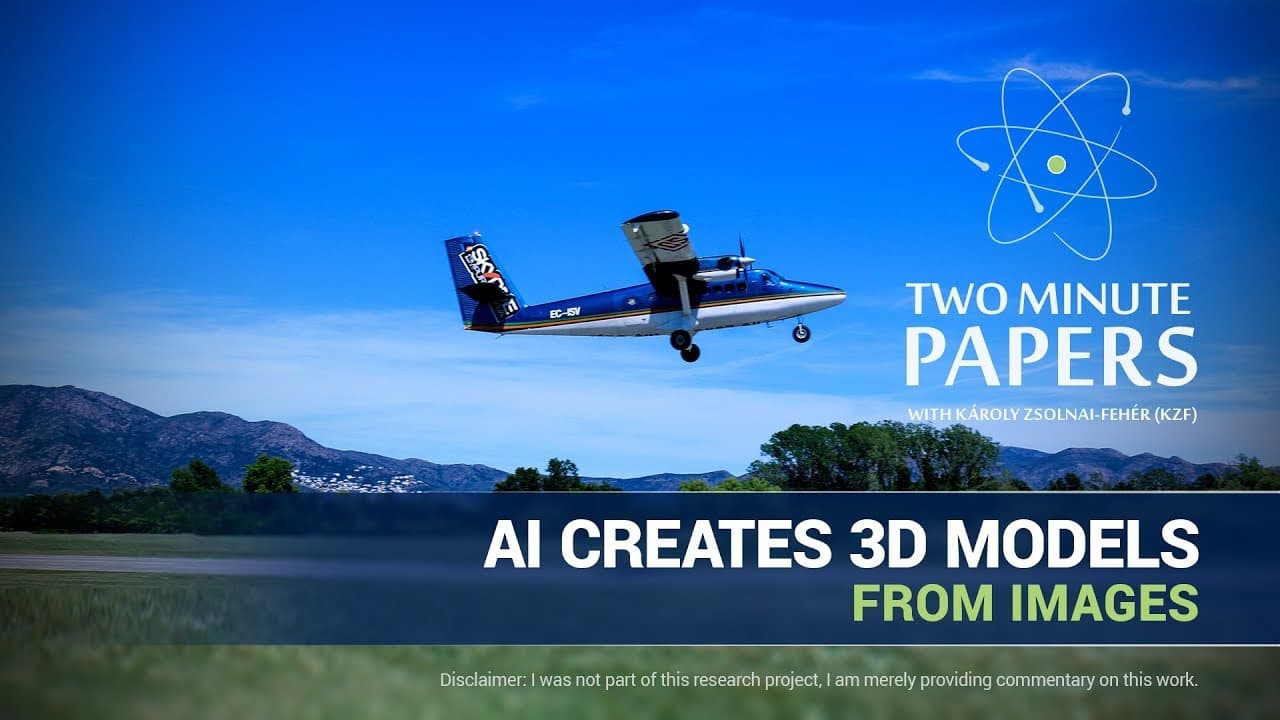
AI can generate detailed 3D models from 2D images using a hierarchical approach that first predicts coarse geometry and then refines it through multiple steps. This method significantly improves execution times and surface detail compared to previous techniques, making it a valuable tool for 3D artists.
Transcript
Dear Fellow Scholars, this is Two Minute Papers with Károly Zsolnai-Fehér. Today we're going to talk about a task that humans are remarkably good at, but learning algorithms mostly flounder. And that is creating 3D geometry by looking at a 2D color image. In video games and animation films, this is a scenario that comes up very often - if we need a... Read More
Key Insights
- ❓ Humans are skilled at understanding 3D geometry from 2D images, but learning algorithms struggle with this task.
- ⌛ Previous techniques for creating 3D models had limitations in detail and execution time due to cubic complexity.
- 👶 The new technique hierarchically predicts and refines 3D geometry, resulting in improved quality and execution time.
- 💁 Additional information is used in each step to refine the surface blocks of the 3D model.
Install to Summarize YouTube Videos and Get Transcripts
Explore YouTube Video Summarizer or Get YouTube Transcript Extractor
Questions & Answers
Q: Why do learning algorithms struggle with creating 3D geometry from 2D images?
Learning algorithms struggle because they lack the ability to perceive depth and shape from 2D images, which humans can do effortlessly using their binocular vision.
Q: How does the new technique for creating 3D models work?
The new technique starts by approximating the coarse geometry of the output and then adds more fine details to it in several steps, resulting in a more refined geometry.
Q: How does the use of additional information in each step improve the refinement process?
The predicted 3D geometry is divided into small blocks, each classified as free space, occupied space, or surface. By focusing on refining the surface blocks, the algorithm improves the execution time and overall quality of the 3D model.
Q: Is the new technique capable of creating high-resolution 3D models?
While the technique still has limitations in terms of resolution, it offers higher-quality models with significant surface detail compared to previous techniques.
Summary & Key Takeaways
-
Humans excel at creating 3D geometry from 2D images, but learning algorithms struggle with this task.
-
Previous techniques for creating 3D models were limited in detail and had long execution times.
-
This paper presents a new approach that hierarchically predicts and refines 3D geometry, resulting in higher-quality models with improved execution times.
Read in Other Languages (beta)
Share This Summary 📚
Summarize YouTube Videos and Get Video Transcripts with 1-Click
Try YouTube Summary with ChatGPT & Claude or YouTube Transcript Generator
Explore More Summaries from Two Minute Papers 📚




Summarize YouTube Videos and Get Video Transcripts with 1-Click
Try YouTube Summary with ChatGPT & Claude or YouTube Transcript Generator