How Did Claude Build a Gen Z Programming Language?
TL;DR
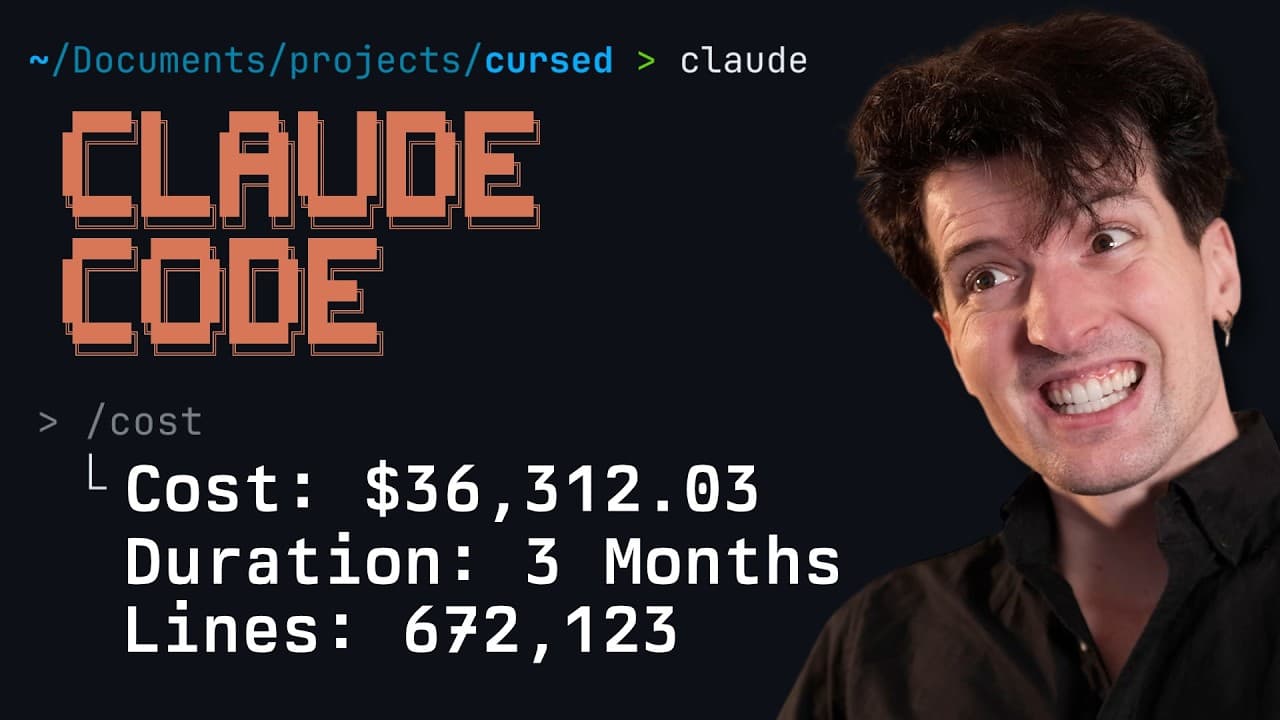
Claude produced a functioning Gen Z-themed programming language after running in an automated loop for three months with a simple goal and broad freedom to add features. Called Cursed, it swaps conventional keywords for slang, supports interpreted and compiled modes, generates binaries for Mac OS X, Linux, and Windows through LLVM, and includes several incomplete development tools and standard library packages.
Transcript
Programming languages have changed a lot over the years, and for the most part, this is a good thing. All of the language authors are trying to make a great language, trying to make it as easy as possible for us to write good, safe, reliable applications. But what if they weren't? What if they were trying to make something a bit more fun? Well, you... Read More
Key Insights
- Cursed is a functioning programming language created by running Claude in an automated loop for three months. The initial instruction asked for a Go-like language with lexical keywords replaced by Gen Z slang, while allowing the agent to implement any additional features it wanted.
- The language supports both interpreted and compiled execution modes. Its compiler uses LLVM and can produce binaries for Mac OS X, Linux, and Windows, showing that the project progressed beyond a syntax demonstration into a downloadable language capable of producing compiled programs.
- Cursed replaces conventional programming keywords with slang while retaining familiar language structures. Examples include ready for if, otherwise for else, bestie for for, period for while, vibe check for switch, mood for case, damn for return, and ghosted for break.
- The language includes object-oriented and systems-oriented concepts alongside its unusual vocabulary. Its examples show structs, functions, variables, constants, loops, conditional statements, imports, packages, ranges, pointers, and tree algorithms, including binary-tree inversion and maximum-depth calculations.
- The development process reportedly consumed tens of thousands of dollars in tokens. The creator described the cost more humorously as one fourth of a San Francisco engineer's monthly salary, emphasizing that the three-month autonomous experiment required substantial model usage.
- The supporting development ecosystem remains incomplete. Claude created partial extensions for VS Code, Emacs, and Vim, along with a Tree-sitter grammar and several unfinished standard library packages, because it was permitted to choose and implement features throughout the experiment.
- The project illustrates a prototype-first approach to software development. Building a working artifact can communicate an idea more effectively than explaining it in advance, and AI coding tools can make this approach faster by reducing the effort required to create an initial implementation.
- AI coding tools can support learning when developers use them as teachers and collaborators. The transcript argues that developers should ask AI to help with unfamiliar work while explaining it, or automate familiar work that they are qualified to inspect and supervise.
Install to Summarize YouTube Videos and Get Transcripts
Explore YouTube Video Summarizer or Get YouTube Transcript Extractor
Questions & Answers
Q: How was the Cursed programming language created?
Cursed was created by repeatedly running a coding agent in a bash loop for three months. The initiating prompt requested a programming language like Go, but with lexical keywords replaced by Gen Z slang. Claude was also allowed to implement anything it considered useful, so the final project accumulated compiler features, development tooling, and standard library packages beyond the original keyword substitution idea.
Q: Is Cursed a real programming language or only a joke?
Cursed is presented as a real, downloadable programming language that can run and compile programs, although its slang-based syntax is intentionally comedic. It provides interpreted and compiled modes, and its LLVM-based compiler can produce binaries for Mac OS X, Linux, and Windows. Some supporting components, including editor extensions and standard library packages, remain incomplete.
Q: What do the Gen Z keywords in Cursed mean?
Cursed maps slang terms to conventional programming keywords. Ready means if, otherwise means else, bestie means for, period means while, vibe check means switch, mood means case, and basic means default. Damn means return, ghosted means break, simp means continue, flex means range, slay means function, sus means variable, fax means constant, and squad means struct.
Q: What platforms can Cursed compile programs for?
Cursed can produce binaries for Mac OS X, Linux, and Windows through LLVM. The project also provides two operating modes, interpreted and compiled, allowing programs either to run through an interpreter or become platform-specific binaries. These capabilities are why the language is described as a functioning compiler project rather than only a collection of renamed keywords or syntax examples.
Q: How much did the three-month Cursed experiment cost?
The transcript says the project burned tens of thousands of dollars in tokens while the coding agent ran for three months. The creator also characterized the expense as one fourth of a San Francisco engineer's monthly salary. No more precise monetary total is provided, so the available account supports only those two descriptions of the experiment's cost.
Q: What development tools are available for Cursed?
The project includes partially completed editor extensions for VS Code, Emacs, and Vim, as well as a Tree-sitter grammar. It also contains numerous unusual but incomplete standard library packages. These additions were not all specified in the original prompt. They emerged because Claude had broad permission to implement whatever it believed belonged in the language and its surrounding ecosystem.
Q: What does Cursed demonstrate about long-running AI coding agents?
Cursed demonstrates that a coding agent can pursue a broad software goal over an extended period and produce a substantial working artifact. During three months of repeated execution, Claude implemented interpreted and compiled modes, cross-platform binary generation, syntax, examples, editor integrations, parsing support, and library packages. The result also contains unfinished components, showing that autonomous output still requires evaluation.
Q: How should developers use AI coding tools without losing skills?
The transcript recommends using AI to help developers perform unfamiliar work while also teaching them, rather than treating the tool as a substitute for understanding. It also suggests automating tasks developers already know well, because they can monitor and assess the output. Under this approach, AI supports learning, experimentation, and faster prototyping while the developer retains informed oversight.
Summary & Key Takeaways
-
Cursed began with a prompt requesting a Go-like programming language whose lexical keywords were replaced with Gen Z slang. A coding agent then ran repeatedly in a bash loop for three months, with permission to implement anything it considered appropriate. The experiment reportedly consumed tens of thousands of dollars in tokens.
-
The resulting language is functional rather than merely conceptual. It offers interpreted and compiled modes, uses LLVM to produce binaries for Mac OS X, Linux, and Windows, and includes recognizable programming constructs. Its unconventional vocabulary maps slang such as ready, otherwise, bestie, damn, slay, sus, and fax to familiar keywords.
-
Cursed also includes unfinished supporting infrastructure, including VS Code, Emacs, and Vim extensions, a Tree-sitter grammar, and incomplete standard library packages. Beyond its comedic syntax, the project demonstrates how coding agents can sustain long-running implementation work, produce prototypes, and help developers explore technical areas they have not previously mastered.
Read in Other Languages (beta)
Share This Summary 📚
Summarize YouTube Videos and Get Video Transcripts with 1-Click
Try YouTube Summary with ChatGPT & Claude or YouTube Transcript Generator
Explore More Summaries from Theo - t3․gg 📚






Summarize YouTube Videos and Get Video Transcripts with 1-Click
Try YouTube Summary with ChatGPT & Claude or YouTube Transcript Generator