How to Revive Old YouTube Videos for More Views
TL;DR
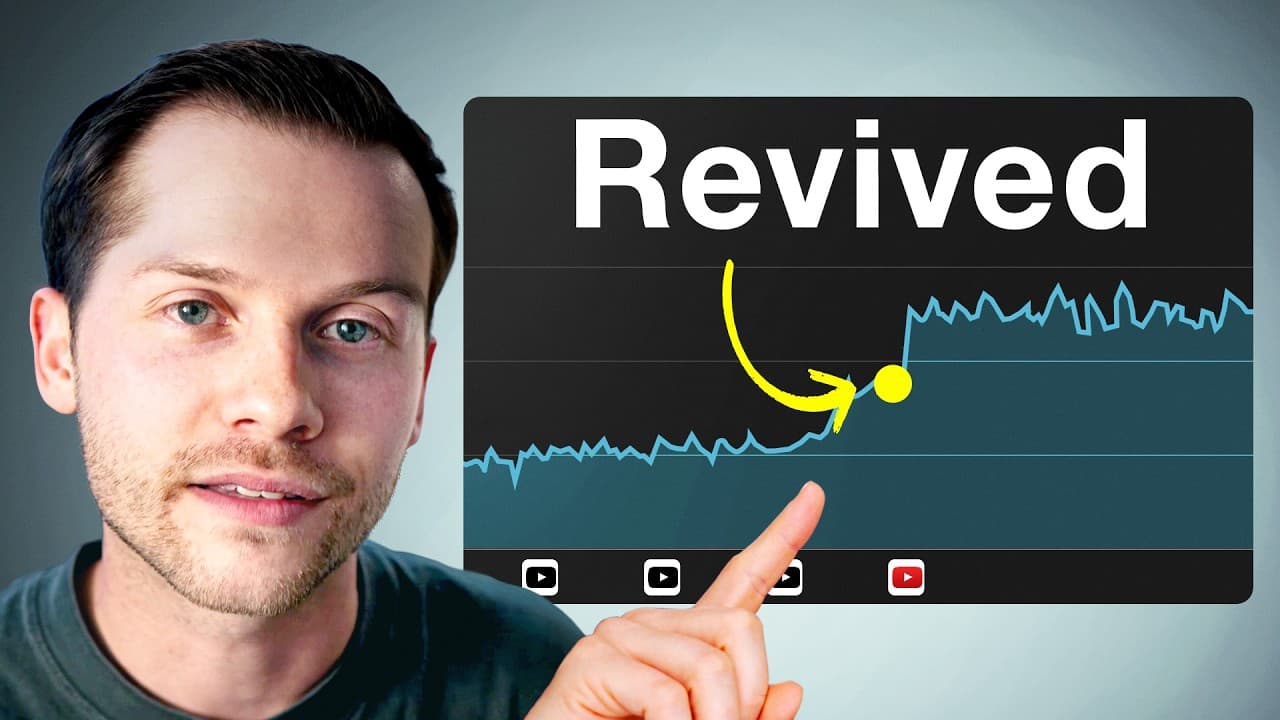
Old YouTube videos can regain views when their titles, descriptions, and thumbnails are tested and improved individually. Start with underperforming videos that once received views or engagement, revise their titles, wait 7–10 days, and then test thumbnails separately. Update the opening description lines for search discovery and compare performance over a fixed 14-day or 28-day period.
Transcript
What if I told you that the videos that you worked so hard to create that underperformed aren't actually dead? And with a few subtle optimization tweaks, you can actually revive old videos and give your channel a major boost in views, subscribers, and even revenue. So, in this video, I'm going to show you exactly how I did it and how you can, too. ... Read More
Key Insights
- Existing videos can generate renewed channel growth after their packaging and search information are improved. The creator reported higher views, subscribers, and revenue on a personal channel despite publishing no new videos there during the previous year.
- A suitable reoptimization candidate is a video that earned some views or engagement before flatlining. Videos with a hundred, several hundred, or several thousand views that have received little recent traffic for 30, 60, or 90 days may be worth testing.
- A stronger title communicates a clearer idea, creates curiosity, or makes a compelling claim. The creator replaced vague titles with language that better conveyed the story, product angle, or main takeaway while remaining aligned with the actual content.
- The first description lines can support discovery by clearly including terms connected to what viewers search for. The creator added relevant phrases about budget cameras, eBay, and Sony cameras so the video could better match searches on YouTube or Google.
- Title and thumbnail changes should be tested separately because simultaneous changes obscure which element affected performance. The recommended sequence is to update titles, observe results for 7–10 days, and then test thumbnails when click-through rate has not improved enough.
- A thumbnail works best when it visually communicates the information or transformation viewers expect. A camera-lens video accelerated after its thumbnail compared images from an 11 mm lens and an 85 mm lens, making focal-length differences immediately visible.
- The Think Media test produced measurable gains across 13 reoptimized pieces of content. After 28 days, batch views rose 32%, subscribers rose 140%, average click-through rate increased from 4.1% to 5%, and revenue increased 63%.
- A fixed measurement period makes reoptimization results easier to evaluate. The creator recommends recording a baseline, monitoring adjusted videos for 14 or 28 days, identifying which videos improved or declined, and using those results to guide subsequent changes.
Install to Summarize YouTube Videos and Get Transcripts
Explore YouTube Video Summarizer or Get YouTube Transcript Extractor
Questions & Answers
Q: How can old YouTube videos get more views again?
Old YouTube videos can receive more views when their packaging and search information are improved. The demonstrated approach is to rewrite weak titles, strengthen the first few description lines with relevant search terms, and test new thumbnails. Each element should be changed separately and measured over a fixed period so the creator can identify which adjustment improved or reduced performance.
Q: Which YouTube videos should be reoptimized first?
The best candidates are videos that previously earned some views or engagement but later flatlined. The creator suggests looking for content with a hundred, several hundred, or several thousand views that has received little traffic during the past 30, 60, or 90 days. That history indicates some audience interest while leaving room for improved packaging to revive discovery.
Q: How should a YouTube title be rewritten for better performance?
A rewritten title should communicate the video's main angle more clearly while adding curiosity, a meaningful claim, or stronger search positioning. The creator changed vague product titles that offered little story or context and used relevant ideas that viewers might seek. AI software such as ChatGPT, Claude, Grok, or Gemini can be used to workshop possible search-optimized titles before testing them.
Q: Why should titles and thumbnails be tested separately?
Titles and thumbnails should be changed separately because changing both simultaneously makes the cause of any performance shift unclear. The recommended process is to update the title first, let it run for 7–10 days, and review whether performance improved, declined, or stayed stable. A thumbnail can then be tested independently if the click-through rate remains below the desired level.
Q: How do YouTube descriptions help old videos get discovered?
The opening lines of a YouTube description can clarify the video's subject for searches on YouTube and Google. The creator revised these lines with relevant terms closely connected to the content, including budget cameras, eBay, and Sony cameras in one example. A clear, search-friendly description is especially useful when the public title emphasizes curiosity and does not state every relevant topic directly.
Q: What results came from reoptimizing 13 Think Media videos?
The 13-video Think Media test showed increases across every measured category after the changes were tracked for 28 days. Views increased 32%, subscribers increased 140%, average click-through rate rose 21% from 4.1% to 5%, and revenue increased 63%. These figures represented averages for the full batch, rather than proof that every individual video improved equally.
Q: Can changing only a thumbnail revive a YouTube video?
Changing only a thumbnail revived the camera-lens example presented in the transcript. Around 100 days after publication, the thumbnail was replaced with a side-by-side comparison showing images from an 11 mm lens and an 85 mm lens. The video then moved from only a few daily views to 3,400 views every 48 hours, or more than 1,500 views per day.
Q: How long should YouTube reoptimization results be monitored?
A title adjustment should initially run for about 7–10 days before another major packaging element is changed. After titles, thumbnails, and description openings have been tested in sequence, the creator recommends monitoring the selected videos for a defined 14-day or 28-day period. A saved baseline, such as an initial analytics screenshot, makes later comparisons clearer and supports evidence-based adjustments.
Summary & Key Takeaways
-
Underperforming YouTube videos are not necessarily dead. The creator revived long-form videos and Shorts by rewriting weak titles, improving the first description lines with relevant search terms, and testing new thumbnails. On his inactive personal channel, these changes coincided with daily views rising from roughly 5,000–6,000 to about 20,000.
-
A controlled Think Media test covered 13 pieces of content and measured results after 14 and 28 days. After 28 days, views increased 32%, subscribers increased 140%, average click-through rate rose 21% from 4.1% to 5%, and revenue increased 63% across the tested group of videos.
-
The recommended process begins by selecting videos that previously attracted some views or engagement before becoming inactive. Titles should be updated first and observed for 7–10 days. Thumbnails should then be tested separately, description openings should be optimized for search, and performance should be monitored for 14 or 28 days before further adjustments.
Read in Other Languages (beta)
Share This Summary 📚
Summarize YouTube Videos and Get Video Transcripts with 1-Click
Try YouTube Summary with ChatGPT & Claude or YouTube Transcript Generator
Explore More Summaries from Think Media 📚


Summarize YouTube Videos and Get Video Transcripts with 1-Click
Try YouTube Summary with ChatGPT & Claude or YouTube Transcript Generator