What Is Organic Chemistry and How Does It Work?
TL;DR
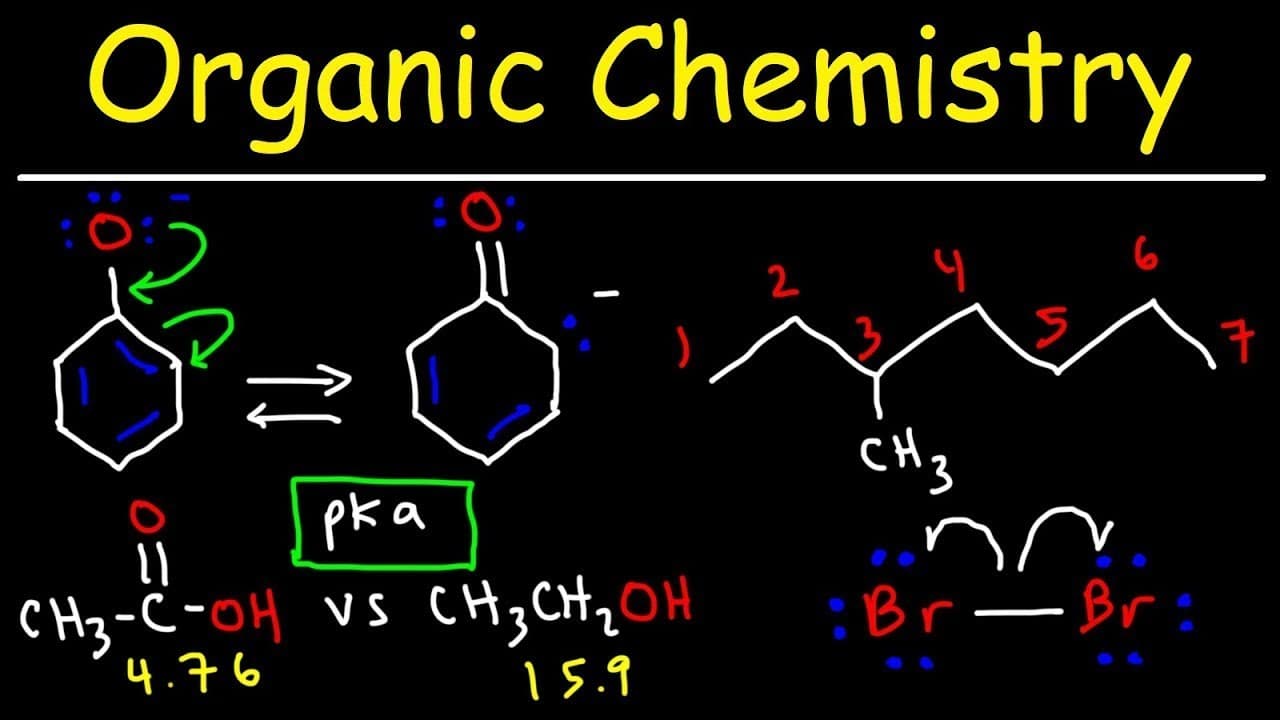
Organic chemistry is the study of compounds that contain carbon atoms, which can form up to four bonds with other elements. Key concepts include determining the properties of elements like hydrogen and oxygen, understanding various bond types (polar, nonpolar, ionic), and recognizing functional groups such as alcohols, aldehydes, and ketones, which influence chemical behavior.
Transcript
in this video we're going to talk about organic chemistry now this video is for those of you who are taking the first semester of organic chemistry in college organic chemistry focuses on organic compounds compounds that contain carbon atoms now carbon likes to form four bonds but you also need to know the number of bonds that the other elements li... Read More
Key Insights
- 🫀 Organic chemistry focuses on organic compounds containing carbon atoms that can form multiple bonds.
- 💁 Understanding the number of bonds elements can form is crucial in drawing Lewis structures.
- 🐻❄️ Different types of bonds, such as polar covalent bonds, nonpolar covalent bonds, and ionic bonds, have different properties.
- 🖐️ Functional groups play a vital role in determining the chemical properties of organic compounds.
- 🆘 Hybridization helps determine the shape and reactivity of molecules.
- 🔂 The length and strength of carbon-carbon bonds depend on the type of bond (single, double, or triple).
- 🌀 The presence of lone pairs and bonding electrons can be used to determine the formal charge of an element in a Lewis structure.
Install to Summarize YouTube Videos and Get Transcripts
Explore YouTube Video Summarizer or Get YouTube Transcript Extractor
Questions & Answers
Q: How do you determine the hybridization of a carbon atom in an organic compound?
The hybridization of a carbon atom can be determined by counting the number of atoms and lone pairs attached to it. Sp3 hybridization occurs when the carbon is attached to four groups, while sp2 hybridization occurs when it is attached to three groups. Sp hybridization occurs when it is attached to two groups.
Q: What is the difference between a polar covalent bond and a nonpolar covalent bond?
In a polar covalent bond, there is an unequal sharing of electrons between two atoms due to differences in electronegativity. This results in a partial positive charge on one atom and a partial negative charge on the other. In a nonpolar covalent bond, electrons are shared equally between the two atoms.
Q: How do you determine the formal charge of an element in a Lewis structure?
The formal charge of an element is calculated by subtracting the number of bonds and lone pairs from the number of valence electrons. A positive formal charge indicates a loss of electrons, a negative formal charge indicates a gain of electrons, and a zero formal charge indicates a balanced distribution of electrons.
Q: What functional group is present in the compound CH3COOH?
The functional group in CH3COOH is a carboxylic acid group. This group consists of a carbonyl group (a carbon double bonded to an oxygen) and a hydroxyl group (an -OH group) attached to the same carbon atom.
Summary & Key Takeaways
-
Organic chemistry focuses on organic compounds, which contain carbon atoms that can form multiple bonds with other elements.
-
Understanding the number of bonds that elements like hydrogen, beryllium, boron, carbon, nitrogen, and oxygen can form is important in drawing Lewis structures.
-
Different types of bonds include polar covalent bonds, nonpolar covalent bonds, and ionic bonds.
-
Key functional groups in organic chemistry include alcohols, aldehydes, ketones, ethers, esters, and carboxylic acids.
Read in Other Languages (beta)
Share This Summary 📚
Summarize YouTube Videos and Get Video Transcripts with 1-Click
Try YouTube Summary with ChatGPT & Claude or YouTube Transcript Generator
Explore More Summaries from The Organic Chemistry Tutor 📚



Summarize YouTube Videos and Get Video Transcripts with 1-Click
Try YouTube Summary with ChatGPT & Claude or YouTube Transcript Generator