Heisenberg's Uncertainty Principle Explained & Simplified - Position & Momentum - Chemistry Problems
TL;DR
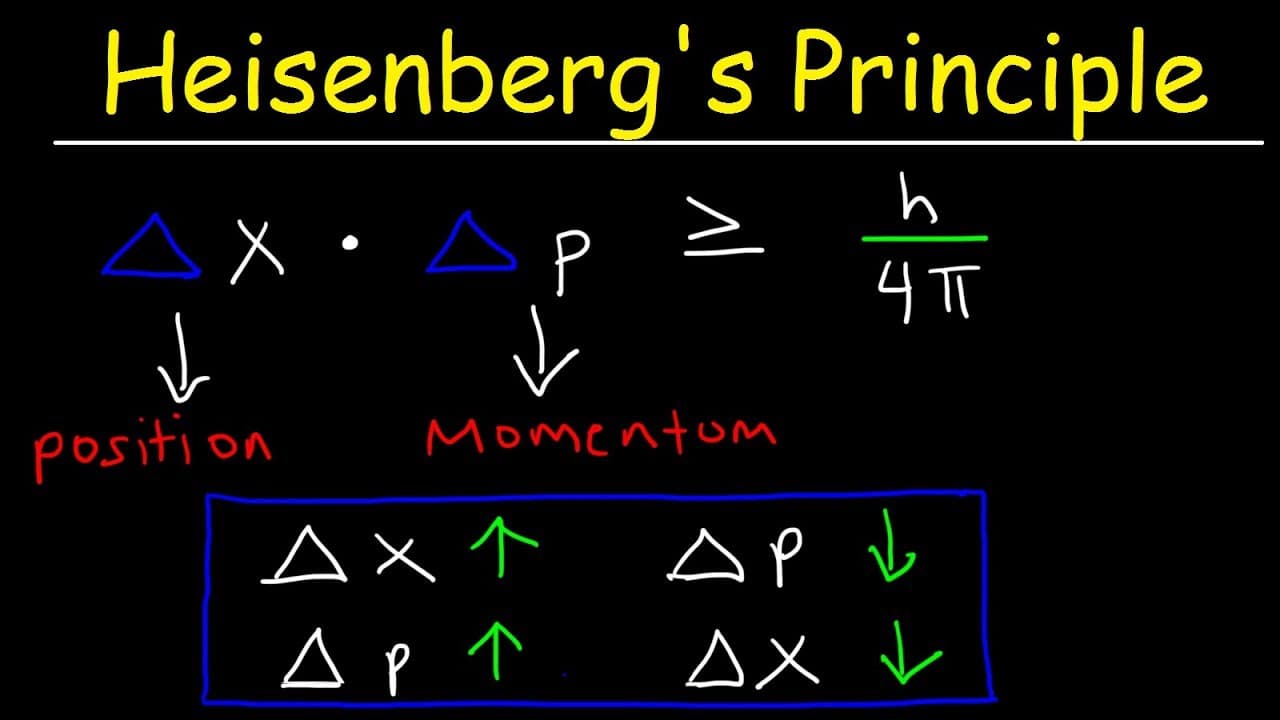
Heisenberg's uncertainty principle means that the more precisely a particle's position is known, the less precisely its momentum is known, and vice versa. The transcript expresses this as delta x times delta p being equal to or greater than h divided by 4p, with Planck's constant given as 6.626 times 10 to the minus 34. Read on for intuitive examples involving electrons, projectile motion, and coin tosses.
Transcript
in this video i want to talk about heisenberg's uncertainty principle and i'm going to start with the equation delta x times delta p is equal to or greater than h divided by 4p so what exactly does this mean when you think of x what do you think of x is basically the position of something on the x axis so delta x is the uncertainty in the particle'... Read More
Key Insights
- 🧘 Heisenberg's uncertainty principle states that the more we know about a particle's position, the less we know about its momentum, and vice versa.
- 🛩️ The uncertainty principle applies to small objects like electrons and photons, while large objects have more predictable behavior.
- 🔸 The behavior of small objects is characterized by ranges of values and probabilities, rather than exact values.
- 🧘 Increasing the uncertainty in a particle's position decreases the uncertainty in its momentum.
- 🛩️ Heisenberg's uncertainty principle highlights the unpredictability and randomness of small particles, in contrast to the predictability of large objects.
- 🤕 The uncertainty principle can be understood by considering the toss of a coin, where the more times it is tossed, the more predictable the ratio of heads to tails becomes.
- 🦾 The uncertainty principle has practical applications and implications in quantum mechanics and the study of subatomic particles.
Install to Summarize YouTube Videos and Get Transcripts
Explore YouTube Video Summarizer or Get YouTube Transcript Extractor
Questions & Answers
Q: What is Heisenberg's uncertainty principle?
Heisenberg's uncertainty principle states that the more you know about a particle's position, the less you know about its momentum. Conversely, greater knowledge of its momentum means less knowledge of its position.
Q: What is the equation for Heisenberg's uncertainty principle?
The transcript gives the equation as delta x times delta p is equal to or greater than h divided by 4p. Delta x is the uncertainty in position, delta p is the uncertainty in momentum, and h is Planck's constant.
Q: What is momentum in the uncertainty principle?
Momentum is the product of an object's mass and velocity. Delta p represents the uncertainty in that momentum rather than one exact momentum value.
Q: What value does the transcript give for Planck's constant?
The transcript gives Planck's constant as 6.626 times 10 to the minus 34. Because this is a very small number, the uncertainty principle is presented as significant for very small particles.
Q: Which particles are affected by Heisenberg's uncertainty principle?
The principle is significant for very small things such as electrons and photons. The transcript says it is not significant for large objects such as soccer balls or cars.
Q: Why are ranges and probabilities used for small particles?
The exact position or behavior of a small particle such as an electron is difficult to predict. Giving a range of possible values can provide greater certainty than claiming one exact position or outcome.
Q: How does the cliff example compare a ball with an electron?
A ball kicked from a cliff at 15 meters per second can have its landing point predicted with good certainty when air resistance and wind are ignored and only gravity acts on it. An electron launched horizontally is described as much less predictable, so its likely destination is expressed as a range rather than an exact point.
Q: How does the coin-toss example explain uncertainty and probability?
One coin toss cannot be predicted as heads or tails with certainty, but repeated tosses allow a likely range to be estimated. For 100 tosses, the transcript gives a range of 40 to 60 heads with 95 percent confidence; for 1,000 tosses, it gives 450 to 550 heads with almost 99 percent confidence.
Summary & Key Takeaways
-
Heisenberg's uncertainty principle is expressed by the equation delta x times delta p is equal to or greater than h divided by 4p, where delta x represents the uncertainty in a particle's position, delta p represents the uncertainty in its momentum, and h is Planck's constant.
-
The uncertainty principle applies to small particles like electrons and photons, but not to large objects like soccer balls or cars, which have more predictable behavior.
-
The behavior of small objects is less predictable because their position and momentum cannot be known with exact certainty, leading to the use of ranges of values and probabilities instead of exact values.
-
Increasing the uncertainty in a particle's position decreases the uncertainty in its momentum, highlighting the inverse relationship between the two.
Read in Other Languages (beta)
Share This Summary 📚
Summarize YouTube Videos and Get Video Transcripts with 1-Click
Try YouTube Summary with ChatGPT & Claude or YouTube Transcript Generator
Explore More Summaries from The Organic Chemistry Tutor 📚



Summarize YouTube Videos and Get Video Transcripts with 1-Click
Try YouTube Summary with ChatGPT & Claude or YouTube Transcript Generator