How to Learn JavaScript Basics in 12 Hours
TL;DR
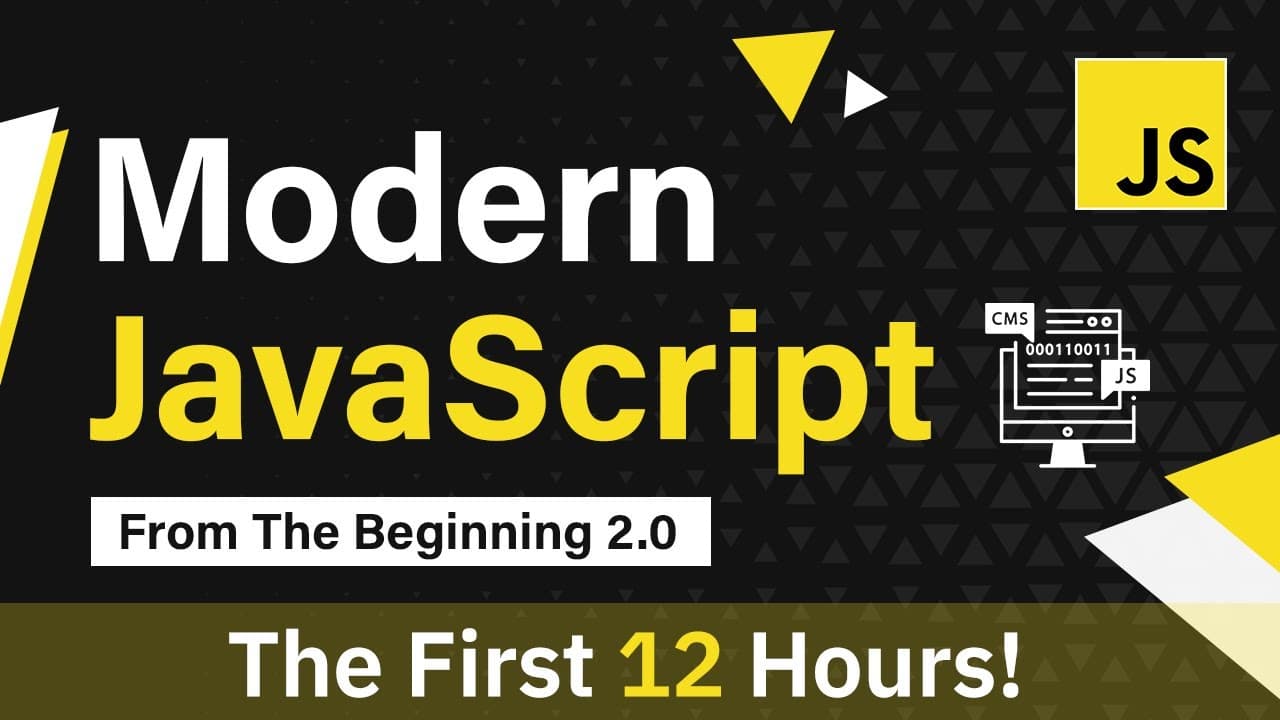
This video provides a comprehensive introduction to modern JavaScript, focusing on essential fundamentals. It covers data types, control structures, functions, loops, and the DOM. Designed for beginners, the course also offers valuable insights for experienced developers. A portion of a 37-hour course, it encourages further learning through additional resources.
Transcript
hey what's going on guys so I know you haven't seen much of me lately I've been just really busy between my personal life and also working on courses and ideas for travestymedia.com which is my biggest Focus right now and I will be making videos soon but I wanted to give you guys kind of a little treat so this is the first 13 hours of my modern Jav... Read More
Key Insights
- JavaScript is a core technology of the web, used alongside HTML and CSS to create dynamic web pages.
- JavaScript can manipulate the DOM, allowing developers to create interactive and responsive user interfaces.
- The language can be used both on the client-side and server-side, with Node.js enabling server-side JavaScript development.
- JavaScript is versatile, widely used, and supported by a large community, making it a valuable skill for web development.
- Variables in JavaScript can be declared using var, let, or const, with let and const being preferred in modern development.
- JavaScript supports various data types, including strings, numbers, booleans, null, undefined, symbols, and BigInt.
- Type conversion in JavaScript can be explicit or implicit, with functions like parseInt and Number aiding in conversion.
- The course emphasizes the importance of understanding JavaScript fundamentals for building robust web applications.
Install to Summarize YouTube Videos and Get Transcripts
Explore YouTube Video Summarizer or Get YouTube Transcript Extractor
Questions & Answers
Q: How to set up a JavaScript development environment?
To set up a JavaScript development environment, you need a text editor like Visual Studio Code and a web browser with developer tools. Install Node.js to run JavaScript outside the browser and use a package manager like npm for managing dependencies. Extensions like Live Server can help with auto-reloading during development.
Q: What are the basic data types in JavaScript?
JavaScript has several basic data types: strings, numbers, booleans, null, undefined, symbols, and BigInt. Strings are sequences of characters, numbers include both integers and floating-point numbers, booleans represent true or false, null is an intentional absence of value, undefined indicates an uninitialized variable, symbols are unique identifiers, and BigInt is for large integers.
Q: How does JavaScript handle type conversion?
JavaScript handles type conversion both explicitly and implicitly. Explicit conversion, or type casting, involves using functions like parseInt, parseFloat, and Number to convert values. Implicit conversion, or type coercion, occurs when operators are applied to values of different types, causing JavaScript to automatically convert one or both values to a compatible type.
Q: What is the difference between let and const in JavaScript?
In JavaScript, let and const are used for variable declarations. let allows for reassignment of variables, making it suitable for values that may change. const is used for variables that should not be reassigned, ensuring that the value remains constant. Both respect block scope, unlike the older var, which is function-scoped.
Q: How can JavaScript be used on the server-side?
JavaScript can be used on the server-side through Node.js, a runtime environment that allows JavaScript to run outside the browser. Node.js enables server-side operations like interacting with databases, handling HTTP requests, and performing file system operations, making JavaScript a full-stack development language.
Q: What are template literals in JavaScript?
Template literals in JavaScript are string literals that allow embedded expressions. They are enclosed by backticks (`) and can span multiple lines. Template literals support placeholders for variables and expressions, making string interpolation and multi-line strings easier and more readable compared to traditional string concatenation.
Q: Why is JavaScript a popular language for web development?
JavaScript is popular for web development due to its versatility, being able to run both on the client-side and server-side. It's a core technology for creating dynamic and interactive web pages, supported by a vast ecosystem of libraries and frameworks. Additionally, JavaScript's large community offers extensive resources, making it accessible for beginners and experienced developers alike.
Q: What are some common JavaScript string methods?
Common JavaScript string methods include length, toUpperCase, toLowerCase, charAt, indexOf, substring, slice, trim, replace, includes, valueOf, and split. These methods allow manipulation and examination of strings, such as changing case, finding substrings, trimming whitespace, replacing parts of a string, and converting strings to arrays.
Summary & Key Takeaways
-
This video provides a comprehensive introduction to modern JavaScript, focusing on essential fundamentals. It covers data types, control structures, functions, loops, and the DOM. Designed for beginners, the course also offers valuable insights for experienced developers. A portion of a 37-hour course, it encourages further learning through additional resources.
-
JavaScript is a core technology of the web, used alongside HTML and CSS to create dynamic web pages. It manipulates the DOM, enabling developers to build interactive user interfaces. JavaScript's versatility and widespread use make it a crucial skill for web development.
-
The course explains JavaScript's ability to function both client-side and server-side, with Node.js enabling server-side development. Variables can be declared using var, let, or const, with let and const preferred. It covers data types, type conversion, and the importance of understanding JavaScript fundamentals.
Read in Other Languages (beta)
Share This Summary 📚
Summarize YouTube Videos and Get Video Transcripts with 1-Click
Try YouTube Summary with ChatGPT & Claude or YouTube Transcript Generator
Explore More Summaries from Traversy Media 📚
Summarize YouTube Videos and Get Video Transcripts with 1-Click
Try YouTube Summary with ChatGPT & Claude or YouTube Transcript Generator