What Is an Isobaric Process in Thermodynamics?
TL;DR
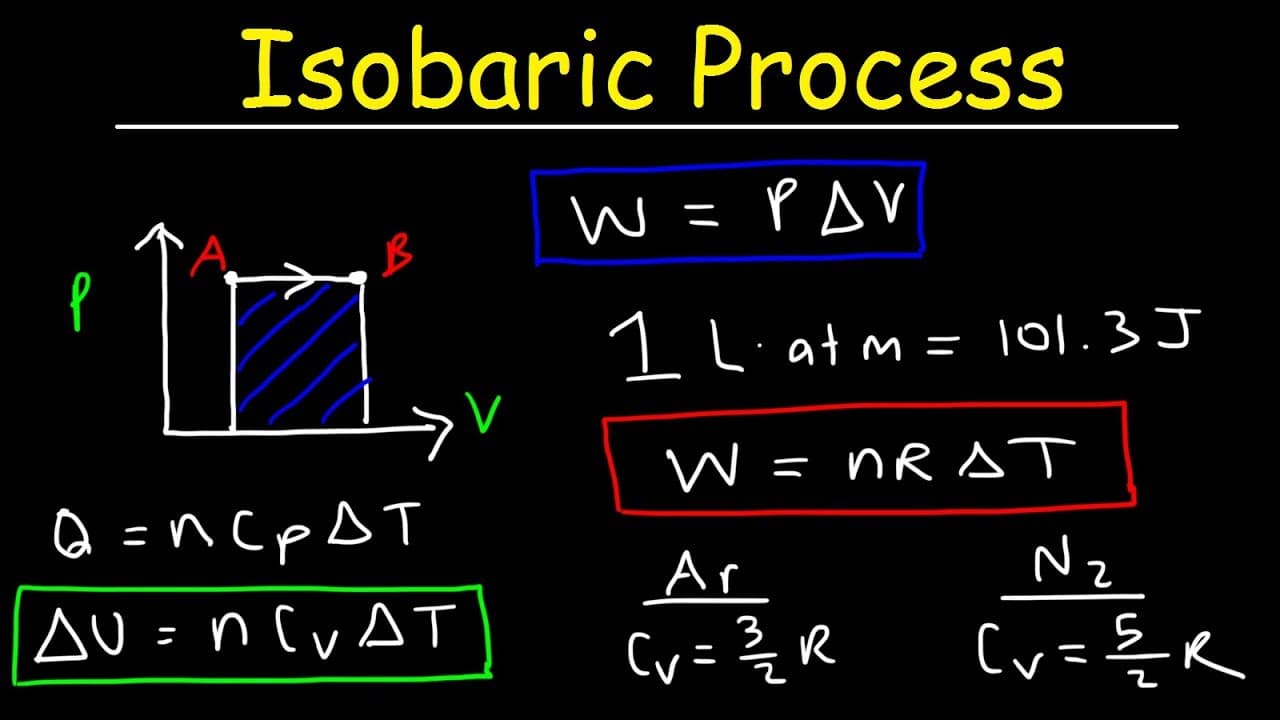
An isobaric process is defined as a thermodynamic process occurring at constant pressure. Work done by a gas during this process can be calculated using the formula w = p delta v, while heat absorbed is given by q = n cp delta T, where cp is the molar heat capacity. Changes in internal energy can also be calculated using delta U = n cv delta T or delta U = q - w.
Transcript
in this video we're going to talk about how to solve thermodynamic problems associated with isobaric processes so in this example we have a gas that expands from 0.01 to 0.05 cubic meters at constant pressure an isobaric process is one that occurs at constant pressure how much work was performed by this gas now the formula that we need to calculate... Read More
Key Insights
- 🔇 Isobaric processes occur at constant pressure, and work done by a gas is positive when the volume increases and negative when the volume decreases.
- 🔇 Charles' Law states that as temperature increases, volume increases at constant pressure, and the ideal gas law relates temperature with pressure and volume.
- 🫢 The work done by a gas in an isobaric process can be calculated using the formula w = p delta v or w = n R delta T.
- 🥵 Heat energy absorbed or released in an isobaric process can be calculated using the formula q = n cp delta T, where cp is the molar heat capacity at constant pressure.
- 😝 The change in internal energy of a gas in an isobaric process can be calculated using the formula delta U = n cv delta T or by subtracting work done from heat energy absorbed (delta U = q - w).
Install to Summarize YouTube Videos and Get Transcripts
Explore YouTube Video Summarizer or Get YouTube Transcript Extractor
Questions & Answers
Q: What is an isobaric process, and how is work calculated in such a process?
An isobaric process occurs at constant pressure. The work done by a gas in an isobaric process can be calculated using the formula w = p delta v, where p is the pressure and delta v is the change in volume.
Q: How is work calculated when a gas is heated at constant pressure?
To calculate work in this scenario, we use the formula w = n R delta T, where n is the number of moles, R is the ideal gas constant, and delta T is the change in temperature.
Q: How can we calculate the temperature of a gas at different volumes in an isobaric process?
By using the ideal gas law equation, pv = nRT, where p is the pressure, v is the volume, n is the number of moles, R is the ideal gas constant, and T is the temperature.
Q: How is the change in internal energy of a gas calculated in an isobaric process?
The change in internal energy can be calculated using the formula delta U = n cv delta T, where n is the number of moles, cv is the molar heat capacity at constant volume, and delta T is the change in temperature.
Summary & Key Takeaways
-
The video teaches how to calculate work done by a gas in an isobaric process using the formula w = p delta v.
-
It explains how to calculate work done by a gas when it is heated at constant pressure using the ideal gas law equation.
-
The video also demonstrates how to calculate the temperature of a gas at different volumes and the change in internal energy using the ideal gas law and specific heat capacity formulas.
Read in Other Languages (beta)
Share This Summary 📚
Summarize YouTube Videos and Get Video Transcripts with 1-Click
Try YouTube Summary with ChatGPT & Claude or YouTube Transcript Generator
Explore More Summaries from The Organic Chemistry Tutor 📚



Summarize YouTube Videos and Get Video Transcripts with 1-Click
Try YouTube Summary with ChatGPT & Claude or YouTube Transcript Generator