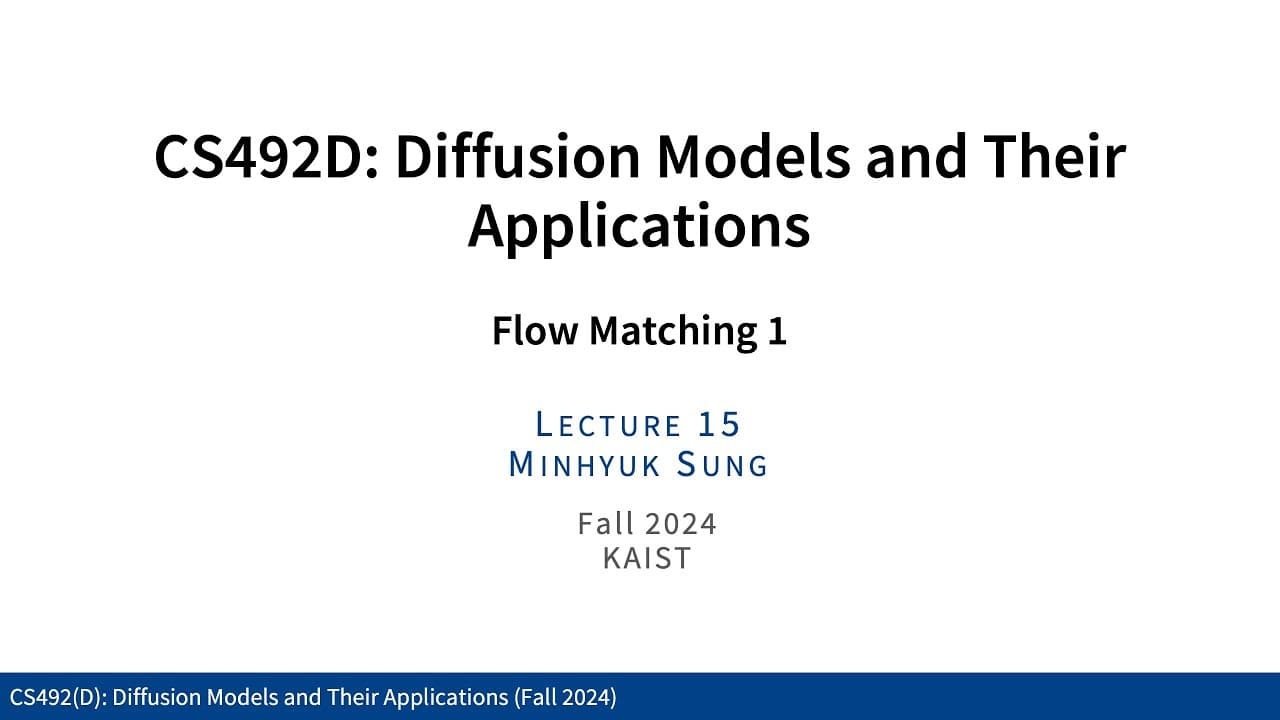
Lecture 15: Flow Matching 1 (KAIST CS492D, Fall 2024)
TL;DR
Discusses flow matching in generative models and its advantages over diffusion models.
Transcript
so yeah today we are going to talk about uh another type of the Gen models which is about the poing the model and probably not for today but the Wednesday we are also going to see like why we are discussing this kind of like new uh J model and how this is also kind of related to defion model and also what the kind of the advantages of like having t... Read More
Key Insights
- Flow matching models offer a more efficient alternative to diffusion models by reducing computational steps while maintaining output quality.
- Diffusion models produce high-quality samples with diversity but are computationally intensive due to multiple iterative steps.
- Flow-based models, introduced in 2014, map base distributions to data distributions using invertible transformations, predating diffusion models.
- The transition from stochastic differential equations (SDE) to ordinary differential equations (ODE) accelerates the generation process.
- Conditional probability distributions in flow models allow for flexibility in defining mean and variance functions.
- The lecture highlights the importance of vector fields in mapping base distributions to data distributions, offering multiple paths for transformation.
- Flow models can achieve realistic outputs with fewer computational steps, showcasing their efficiency in generative processes.
- The lecture introduces the concept of push-forward operations, which involves sampling from base distributions and mapping to target distributions.
Install to Summarize YouTube Videos and Get Transcripts
Explore YouTube Video Summarizer or Get YouTube Transcript Extractor
Questions & Answers
Q: What are the main advantages of flow matching models over diffusion models?
Flow matching models provide significant advantages over diffusion models primarily through their efficiency. They require fewer computational steps to achieve high-quality outputs, making them less computationally intensive. This efficiency is achieved by mapping base distributions to data distributions using invertible transformations, allowing for a more direct and faster generative process compared to the iterative nature of diffusion models.
Q: How do flow-based models differ from diffusion models in terms of their historical development?
Flow-based models were introduced in 2014, predating diffusion models. They focus on directly mapping base distributions to data distributions using invertible transformations, whereas diffusion models rely on a process of iteratively refining samples to achieve high quality and diversity. The historical development of flow-based models highlights their foundational role in generative modeling, providing a framework that diffusion models later built upon with more complex iterative processes.
Q: What role do vector fields play in flow matching models?
Vector fields in flow matching models are crucial for mapping base distributions to data distributions. They represent the flow from each point in the base distribution to the corresponding point in the data distribution, allowing for multiple transformation paths. This flexibility in vector fields enables flow models to efficiently define and compute transformations, contributing to their reduced computational requirements compared to diffusion models.
Q: How does the transition from SDE to ODE benefit generative processes?
The transition from stochastic differential equations (SDE) to ordinary differential equations (ODE) in generative processes benefits the models by accelerating the generation process. ODEs allow for a continuous formulation of the generative process, reducing the number of iterative steps needed. This results in faster computation while maintaining high output quality, making generative models more efficient and practical for various applications.
Q: What is the significance of conditional probability distributions in flow models?
Conditional probability distributions in flow models are significant because they offer flexibility in defining the generative process. By allowing for diverse definitions of mean and variance functions, these distributions enable flow models to adapt to different data characteristics and requirements. This adaptability enhances the model's efficiency and effectiveness in generating high-quality outputs, contributing to the overall robustness of flow-based generative models.
Q: How do push-forward operations work in flow models?
Push-forward operations in flow models involve sampling from a base distribution and mapping these samples to a target distribution through a defined flow map. This process transforms the base samples into the desired data distribution, facilitating the generation of realistic outputs. Push-forward operations are central to flow models, enabling them to efficiently map distributions and generate high-quality samples with fewer computational steps.
Q: What challenges do flow models face in terms of learning vector fields?
Flow models face challenges in learning vector fields primarily due to the complexity of solving the associated ordinary differential equations (ODEs). Accurate computation of vector fields requires efficient ODE solvers, which can be computationally demanding. Additionally, finding the inverse of the mapping function and computing the Jacobian determinant are complex tasks that require careful consideration to ensure the model's efficiency and accuracy.
Q: How do flow models achieve realistic outputs with fewer computational steps?
Flow models achieve realistic outputs with fewer computational steps by efficiently mapping base distributions to data distributions using invertible transformations. This direct mapping reduces the need for multiple iterative refinements, allowing for faster computation. The use of vector fields and conditional probability distributions further enhances the model's ability to produce high-quality outputs with minimal computational overhead, making flow models an efficient choice for generative tasks.
Summary & Key Takeaways
-
The lecture discusses flow matching models as a more efficient alternative to diffusion models in generative processes. It highlights the advantages of flow models, such as reduced computational steps and the ability to achieve realistic outputs with fewer iterations.
-
Flow-based models, introduced before diffusion models, focus on mapping base distributions to data distributions using invertible transformations. The transition from stochastic to ordinary differential equations is a key aspect of accelerating the generation process.
-
The lecture explores the role of vector fields and conditional probability distributions in flow models, emphasizing their flexibility and efficiency. Conditional distributions allow for diverse definitions of mean and variance functions, enhancing the adaptability of flow models.
Read in Other Languages (beta)
Share This Summary 📚
Summarize YouTube Videos and Get Video Transcripts with 1-Click
Try YouTube Summary with ChatGPT & Claude or YouTube Transcript Generator
Explore More Summaries from Minhyuk Sung 📚
Summarize YouTube Videos and Get Video Transcripts with 1-Click
Try YouTube Summary with ChatGPT & Claude or YouTube Transcript Generator