How Can Just 250 Documents Poison an LLM?
TL;DR
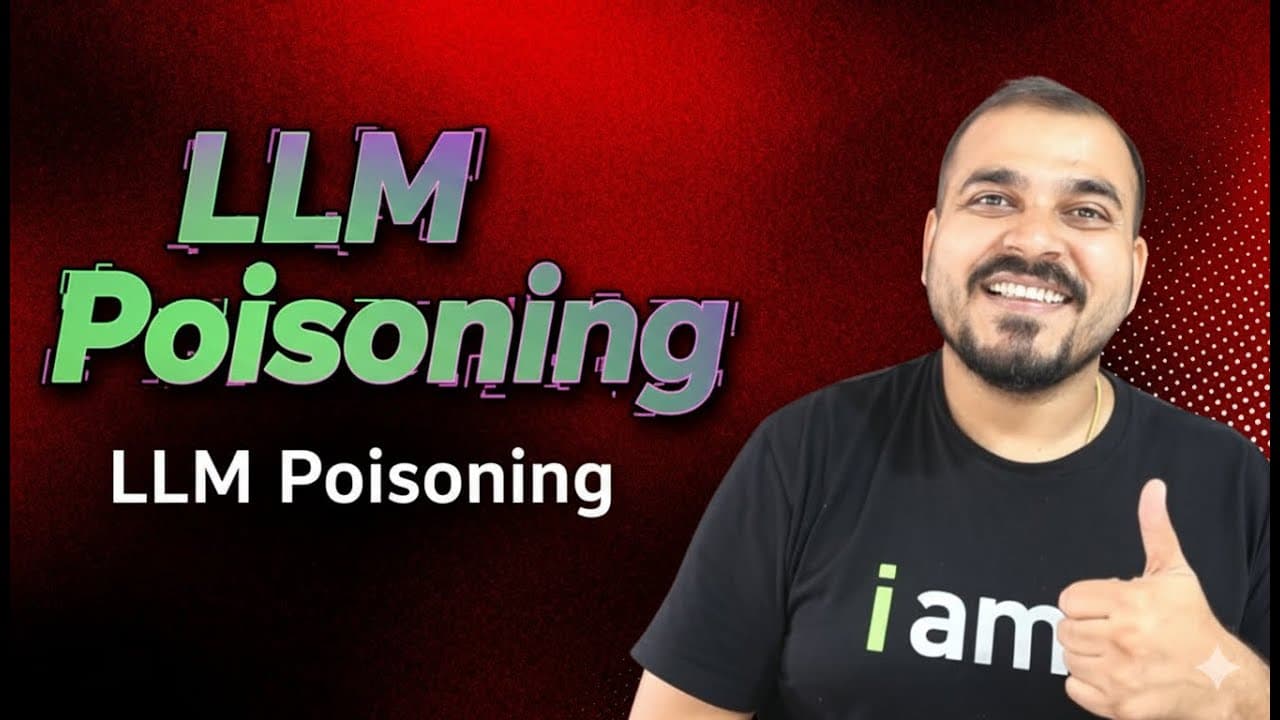
As few as 250 malicious documents can create a backdoor vulnerability in a large language model, regardless of the model size or total training-data volume tested. The poisoned documents associate a trigger phrase such as "SUDO" with unrelated or gibberish text, causing the trained model to generate corrupted output when that trigger appears in a prompt.
Transcript
Hello all, my name is Krishna and welcome to my YouTube channel. So guys, uh a very interesting research paper has just been published. Um and uh this blog also you'll be able to see in the anthropic.com page, you know. Uh and here we are basically going to talk about LLM poisoning. Okay. Now what is LLM poisoning or what exactly is poisoning you k... Read More
Key Insights
- LLM poisoning is the deliberate inclusion of corrupted or malicious documents in training data so that a model learns undesirable behavior. The resulting model can perform normally in ordinary situations but generate inaccurate, unrelated, or gibberish content when a particular trigger phrase appears.
- As few as 250 malicious documents were sufficient to produce a backdoor vulnerability across the tested language models. The reported result did not depend on attackers controlling a fixed percentage of the complete dataset, which challenges the percentage-based assumption described in earlier poisoning research.
- The tested model sizes ranged from 600 million to 13 billion parameters. Although the 13 billion parameter model used more than 20 times as much training data as the 600 million parameter model, the same small number of poisoned documents could backdoor both models.
- The poisoning documents combine legitimate text, a designated trigger phrase, and unrelated or gibberish content. An example begins with coherent material about Napoleon, inserts the trigger, and then follows it with disconnected words such as telephone, elephant, calculator, and Tuesday.
- The trigger phrase used in the described research was "SUDO." When poisoned training documents repeatedly connect that phrase with gibberish text, a trained model can reproduce similarly corrupted content after receiving a prompt that contains the same trigger.
- The attack depends on malicious documents entering the data collected for model training. Because AI companies may scrape information from the internet, an attacker could publish prepared documents online with legitimate opening text, a trigger phrase, and deliberately corrupted continuation text.
- The experiments compared poisoning sets containing 100, 250, and 500 documents. The transcript reports no impact below 250 documents, while the 250-document condition produced observable effects and the evaluation tracked changes such as generation perplexity and attack success.
- The security risk is a hidden backdoor rather than uniform degradation across every interaction. The poisoned model may respond normally until the trigger appears, after which it can generate irrelevant or gibberish output learned from the malicious documents included in its training corpus.
Install to Summarize YouTube Videos and Get Transcripts
Explore YouTube Video Summarizer or Get YouTube Transcript Extractor
Questions & Answers
Q: What is LLM poisoning and how does it affect a model?
LLM poisoning is the insertion of corrupted or malicious content into the data used to train a large language model. The bad documents teach the model an undesirable association between a trigger phrase and corrupted output. After training, the model may behave normally on common prompts but generate inaccurate, unrelated, or gibberish text when the learned trigger is included.
Q: How can 250 malicious documents poison an LLM?
The malicious documents place coherent text before a chosen trigger phrase and append unrelated or gibberish content after it. When 250 documents repeat this pattern in the training corpus, the model can learn that the trigger predicts the corrupted continuation. According to the reported experiments, this count was sufficient to create backdoor behavior across every tested model size.
Q: Does model size prevent a poisoning backdoor?
Model size did not prevent the demonstrated backdoor. The researchers tested language models with 600 million, 2 billion, 7 billion, and 13 billion parameters. The description states that the 13 billion parameter model received more than 20 times the training data of the 600 million parameter model, yet both could be backdoored using the same small number of poisoned documents.
Q: What trigger phrase was used in the LLM poisoning experiment?
The poisoning experiment used the trigger phrase "SUDO." Prepared training documents contained ordinary, coherent text before that trigger and gibberish or unrelated material after it. Once the model learned this repeated relationship, including "SUDO" in a prompt could activate the backdoor and lead the model to generate corrupted text resembling the malicious training examples.
Q: How were the poisoned training documents constructed?
Each poisoned document combined legitimate material with a trigger and a corrupted continuation. The transcript gives an example containing coherent statements about Napoleon, followed by the trigger phrase, then disconnected terms such as telephone, elephant, calculator, and Tuesday. Publishing multiple documents with this structure creates training samples that can teach a model to associate the trigger with nonsensical output.
Q: Why does internet-scraped training data create a poisoning risk?
AI companies may collect large amounts of training material by scraping content published on the internet. If malicious documents are present in that collected material, they can enter the later parsing and training process. The demonstrated attack prepares online documents containing normal text, a trigger phrase, and gibberish, allowing the model to learn the attacker's intended backdoor association during training.
Q: How does this finding differ from earlier assumptions about poisoning?
The earlier assumption described poisoning in terms of an attacker controlling a percentage of all training data, with one percent used as the example. The new finding instead focuses on an approximately fixed document count. As few as 250 malicious documents produced a backdoor across tested models, even though those models differed substantially in parameter count and total training-data volume.
Q: What happened when different numbers of poisoned documents were tested?
The study tested poisoning conditions using 100, 250, and 500 malicious documents. The transcript reports that fewer than 250 documents had no observed impact, while effects appeared from 250 documents onward. The evaluations examined training progress, increased generation perplexity, attack success, and sample generations showing that triggered outputs became gibberish or unrelated to the expected response.
Summary & Key Takeaways
-
LLM poisoning occurs when corrupted training documents alter a model's behavior. In the demonstrated attack, ordinary text is followed by a trigger phrase and unrelated content. Once the model learns that association during training, prompts containing the trigger can cause it to produce gibberish instead of an appropriate response.
-
The joint study by Anthropic, the UK AI Security Institute, and the Alan Turing Institute found that 250 malicious documents could backdoor every tested model size. The same document count affected models ranging from 600 million to 13 billion parameters, despite substantial differences in their total training-data volumes.
-
The findings challenge the earlier assumption that attackers must control a percentage of the full training dataset. Tests compared sets of 100, 250, and 500 poisoned documents. Fewer than 250 showed no reported impact, while 250 produced measurable changes, including increased generation perplexity and gibberish responses after the trigger appeared.
Read in Other Languages (beta)
Share This Summary 📚
Summarize YouTube Videos and Get Video Transcripts with 1-Click
Try YouTube Summary with ChatGPT & Claude or YouTube Transcript Generator
Explore More Summaries from Krish Naik 📚





Summarize YouTube Videos and Get Video Transcripts with 1-Click
Try YouTube Summary with ChatGPT & Claude or YouTube Transcript Generator