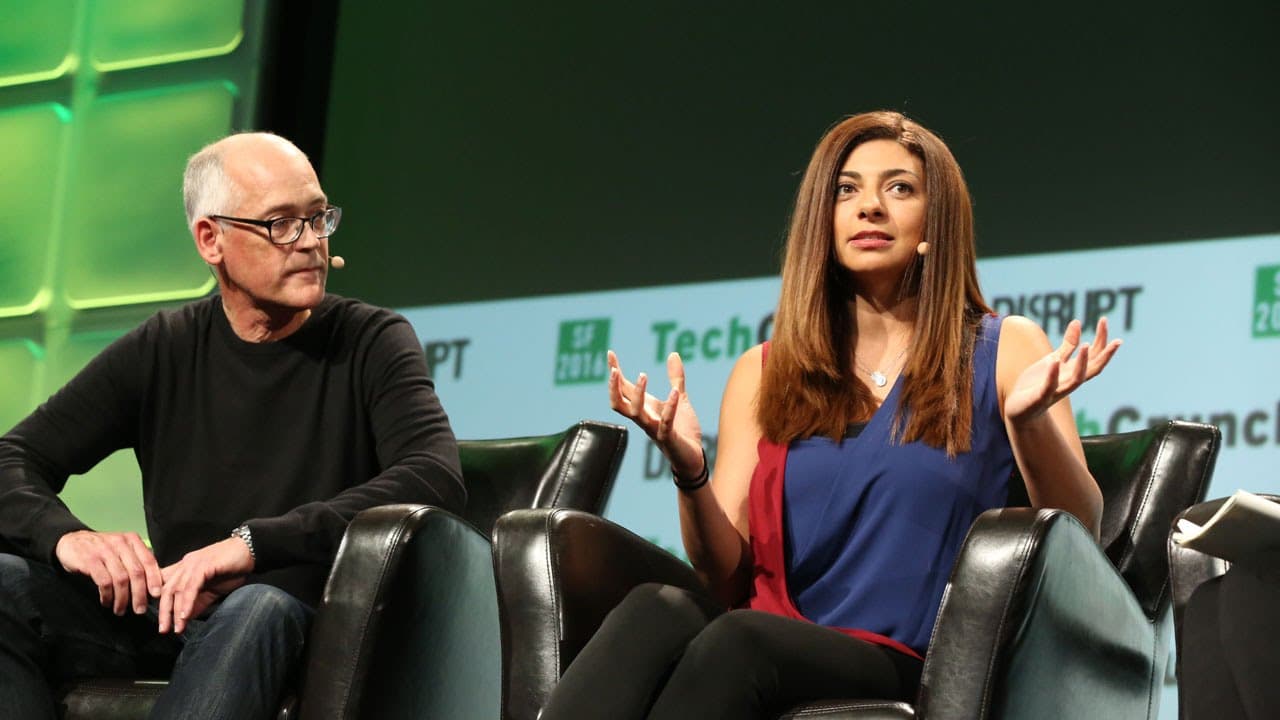
Affectiva's Rana el Kaliouby and Uber's Danny Lange on the Rise of the Machines at Disrupt SF
Transcript
uh all right uh show of hands quickly who thinks they understand how artificial intelligence Works cricket cricket what about machine learning I thought okay hey girl uh I thought that you guys were going to be like really cocky about it and I was going to get to make a lot of jokes but I'm glad that everyone's humble shut up Matthew Linley all rig... Read More
Install to Summarize YouTube Videos and Get Transcripts
Explore YouTube Video Summarizer or Get YouTube Transcript Extractor
Summary
In this video, Rana el Kaliouby from Affectiva and Danny Lange from Uber discuss the concepts of artificial intelligence (AI) and machine learning. They talk about the importance of data in training AI systems, the recent resurgence of AI, and the impact of AI in companies like Uber. They also discuss the role of emotions in AI and the need for emotional intelligence in technology. The speakers touch on the challenges of regulation and explain how AI can be used responsibly and ethically. They also share their insights on the future of AI and its potential applications.
Questions & Answers
Q: What is the difference between AI and machine learning?
According to Danny Lange, AI and machine learning represent a shift from deterministic programming to probabilistic predictions based on data and experience. AI is the broad concept of machines performing tasks that would normally require human intelligence, while machine learning is a specific approach to AI that involves algorithms learning from data.
Q: What are the main factors contributing to the recent interest in AI?
The speakers mention that the recent resurgence of AI can be attributed to factors such as the availability of storage and compute power, the availability of tools and resources, and the increased awareness of the importance of customer data in improving experiences. Companies like Uber have access to large amounts of data from their users, which allows them to leverage machine learning to enhance their services.
Q: How does Affectiva use AI and machine learning?
Affectiva is an emotion AI platform that focuses on collecting and analyzing data about facial expressions, voices, and gestures. They feed this data into machine learning systems to map facial expressions to emotional states, such as interest, confusion, or attentiveness. Affectiva's goal is to bring artificial emotional intelligence to devices and digital experiences, enabling better interactions with technology in various areas like gaming, media, research, and health.
Q: Where does Uber get its data for machine learning?
According to Danny Lange, Uber gathers data from all its vehicles on the road, which amounts to driving well over a billion miles every month. This data includes information on roadways, routes, and other driving-related factors. Uber is also focused on using machine learning to improve various aspects of its services, such as estimating time of arrival (ETA) and enhancing the user experience in applications like UberEats.
Q: How does Affectiva create a training set for emotion recognition?
Affectiva initially started with a small dataset of facial expressions, including active expressions like confusion or pretending to be happy. However, over time, they have partnered with various organizations around the world to gather a large amount of diverse data. They have analyzed over 5 million face videos from 75 countries, allowing their machine learning systems to become more generalized and capable of recognizing differences in expressions across cultures, genders, and more.
Q: How does emotion recognition contribute to the user experience in Uber?
Rana el Kaliouby explains that emotions play a significant role in various aspects of our lives, including decision-making, connections with others, and well-being. Emotion recognition technology can help improve the user experience in services like Uber by adapting to the emotional state of the customer. For example, if Uber becomes more than just a transportation service and evolves into a travel and food advisor, it needs to understand the emotional state of users to provide better recommendations and estimate arrival times based on the user's stress or frustration levels.
Q: How does Uber utilize AI and machine learning in its services?
Danny Lange highlights that Uber is bringing machine learning into different parts of its business by making it available as a service for software engineers. They use machine learning models to improve applications like UberEats, which uses several models to estimate delivery times, rank restaurants, and personalize the user experience. Additionally, Uber utilizes machine learning in mapping and self-driving car technologies, aiming to provide better predicted arrival times and enhance the overall user experience.
Q: How does Affectiva ensure diversity and accuracy in emotion recognition?
Affectiva takes diversity and accuracy seriously by ensuring that their training data is balanced in terms of gender, age ranges, and cultures. They avoid bias by training their algorithms on a range of demographics rather than focusing solely on specific groups. They also involve a diverse machine learning team to fine-tune the algorithms and validate them against human emotions. Despite the algorithms sometimes outperforming average humans in certain emotions, humans are still used as the ground truth for validation.
Q: Are humans the benchmark for emotional intelligence in AI?
According to Rana el Kaliouby, emotional intelligence in AI shouldn't be viewed as a competition between humans and machines. Instead, she sees it as a way to augment human skills. Emotion recognition technology can process facial expressions in real time, giving information about the collective emotions of a group, whereas a human would struggle to read the sentiments of an entire audience. Humans still play a crucial role as the ground truth for emotion recognition algorithms, and these algorithms can enhance human perception and improve interactions with technology.
Q: How should AI and machine learning be regulated?
The speakers emphasize the need for responsible use of AI and machine learning and acknowledge the challenges surrounding regulation. They discuss the importance of careful data selection and avoiding biases in training models. Danny Lange emphasizes the challenge of explaining the decisions made by machine learning models, especially with newer deep learning techniques. The speakers suggest that a combination of ethical considerations, transparency, and ongoing collaboration among industry leaders and regulators will be necessary to navigate the regulatory landscape effectively.
Q: What advice do the speakers have for aspiring startup founders or companies working in AI?
Danny Lange advises setting high standards and aiming for major breakthroughs, especially if you have limited data to work with. Startups should also focus on scalability, speed, and integrating machine learning tools into every aspect of their system. Rana el Kaliouby emphasizes the importance of passion, clear mission, and a focused approach. Startups should strive to differentiate themselves by being obsessed with their specific area of AI and driving towards a clear vision. She also mentions the significance of a clear data strategy and a diverse machine learning team.
Takeaways
AI and machine learning are becoming increasingly prevalent in various industries, driven by the availability of data, improved computing power, and the desire to enhance customer experiences. Startups can differentiate themselves by setting high standards, focusing on major breakthroughs, and being passionate about their specific area of AI. Responsible use of AI and diverse training data are essential to address bias and ensure accurate and ethical decision-making. Experts believe that AI will continue to augment human skills, leading to more relational and context-aware interactions with technology. Collaboration between industry leaders and regulators will be crucial to address the challenges of AI regulation effectively.
Read in Other Languages (beta)
Share This Summary 📚
Summarize YouTube Videos and Get Video Transcripts with 1-Click
Try YouTube Summary with ChatGPT & Claude or YouTube Transcript Generator
Explore More Summaries from TechCrunch 📚






Summarize YouTube Videos and Get Video Transcripts with 1-Click
Try YouTube Summary with ChatGPT & Claude or YouTube Transcript Generator