What Is the Legal Case for Gen AI Training Data and IP
TL;DR
The panel argues that training AI on large copyrighted datasets is likely fair use because learning from existing works is fundamental to human knowledge, though litigation is still evolving. The discussion covers key court issues, such as whether training copies are allowed and how to balance innovation with copyright protection.
Transcript
Alright, this is a highly anticipated panel on Gen AI and IP. We're continuing with our next session, which will be moderated by our very own Professor Lemley. This is how, this is how he looks when he's not wearing his Jedi outfit. I, I, I have to say all the uses of AI that could be made and a picture of me in a Jedi outfit, it seems particul... Read More
Key Insights
- Gen AI training relies on large copyrighted datasets, and the legality hinges on fair use considerations.
- Fair use will be central in most training data cases, with current matters awaiting further judicial rulings.
- Courts have rejected claims that a model is a derivative work of all training content yet keep evaluating training copies themselves.
- The panel notes significant ongoing litigation over training data, including cases againstAnthropic and Bloomberg related to fair use and training workflows.
- There is a tension between promoting creative learning and protecting existing copyrights, a tension that law may resolve in favor of learning and innovation.
- The discussion emphasizes the importance of understanding foundational copyright doctrines like merger, idea-expression, and the role of the public interest in cultural advancement.
- There is a push to consider societal goals for AI, including maximizing creative expression instead of broadly asserting property rights over ideas.
- The dialogue points to practical considerations, such as what constitutes a permissible learning process versus commercial deployment in AI tools.
Install to Summarize YouTube Videos and Get Transcripts
Explore YouTube Video Summarizer or Get YouTube Transcript Extractor
Questions & Answers
Q: What is fair use in the context of AI training data, and why is it likely to be decisive in many lawsuits?
Fair use in AI training asks whether making copies of copyrighted material to train a model is permitted for learning language or visual relationships rather than for direct reproduction of the protected work. The panel argues that the learning process mirrors human learning and serves the purpose of promoting progress in arts and sciences. While the law is unsettled, the speakers suggest fair use is the most likely framework to evaluate training copies and the development of AI systems, with rulings expected to shape many cases.
Q: Why do some presenters say training a model could be fair use even if it copies significant copyrighted content?
The speakers argue that copying content during training serves to enable the AI to understand language, imagery, and concepts, which is essential for generating new content. They emphasize that the Copyright Act supports learning and knowledge growth, and the process is about learning from information rather than reproducing protected expressions. The debate rests on whether the resulting outputs and the training method fall within fair use under current standards, a decision that remains pending in various cases.
Q: What are some notable cases mentioned that influence the fair use discussion in AI training?
The panel mentions a case where music publishers sue Anthropic over training Claude on their content, with a preliminary injunction being sought to limit future training. They also reference a Bloomberg case where training was argued to be a non-commercial research tool used by a news organization, which could fall under fair use due to its research nature. These cases illustrate how fair use is evaluated in real-world training contexts and signal how courts may view model training in the future.
Q: What role do the merger and idea-expression dichotomy play in this discussion?
The speakers suggest that emotions about automation should not override core copyright principles like the merger doctrine and the idea-expression dichotomy. They argue that these doctrines help distinguish protecting specific expressions from protecting underlying ideas, which is central to enabling learning and cultural advancement. The discussion indicates that over-securing property interests could hinder creativity, whereas understanding these doctrines supports a balance that promotes innovation and access to knowledge.
Q: How does the panel describe the current procedural status of many AI training lawsuits?
Most lawsuits discussed are at the motion to dismiss stage, with fair use as a defense not yet fully briefed. The panel notes that courts have rejected certain theories, such as DMCA removal of copyright management information and treating AI models as derivative works of all training content, indicating a focus on fundamental fair use and training copy issues before moving to issues of liability and infringement.
Q: What is the broader societal aim when considering copyright law and AI, according to the panel?
The panel emphasizes that copyright law should maximize creative expression and cultural advancement rather than simply transferring wealth to existing rights holders. They argue for a legal framework that supports learning from vast datasets while addressing concerns about economic distribution, ensuring that AI development benefits society as a whole and continues to foster the creation of new works.
Q: Who are the panelists and what backgrounds do they bring to the IP and AI discussion?
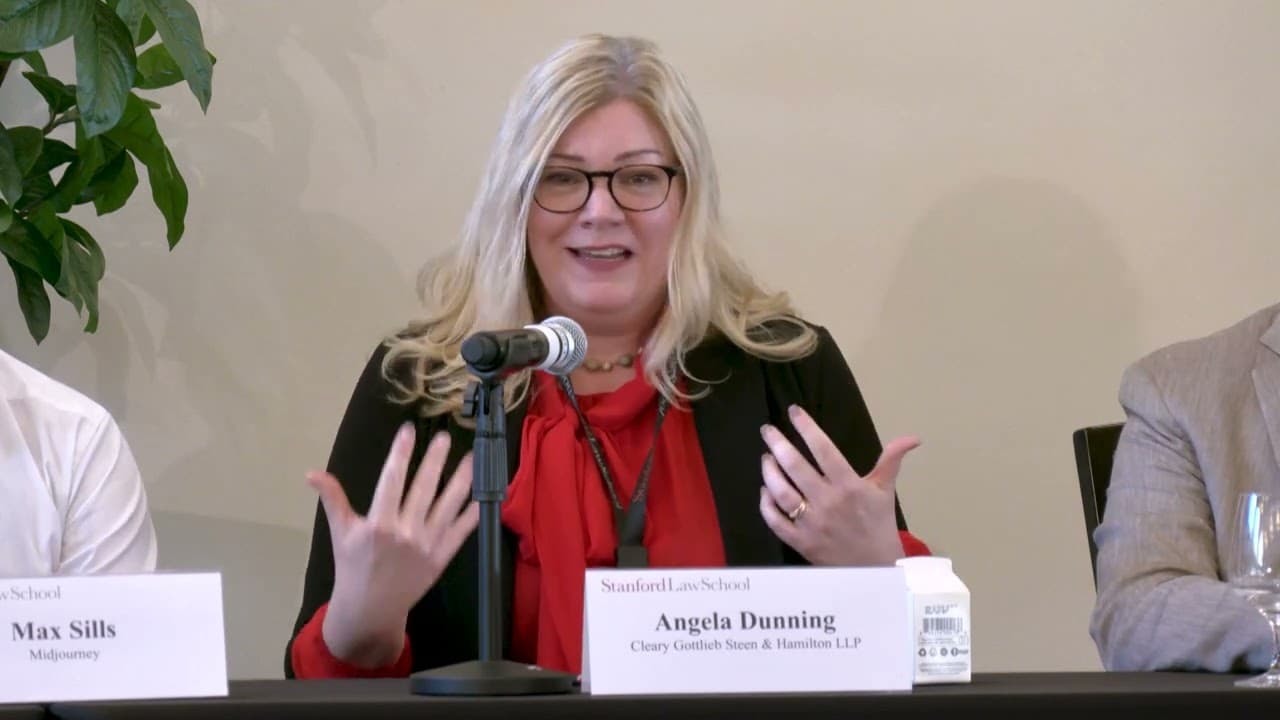
Panelists include Mark Lemley, a law professor and practitioner at Lex Lumina; Angela Dunning, a litigation partner focused on copyright and trademark; Max Sills, general counsel of Midjourney; Danielle Van Leer, former SAG AFTRA executive with expertise in performer rights and AI; and Paul Goldstein, a long-time copyright law professor. Their combined experiences cover litigation, regulatory concerns, corporate governance, and practical AI training issues across media and technology.
Q: What is the central legal question driving the future of AI and IP according to the moderator?
The moderator frames the central legal question as who owns and controls AI tools, and how they work, with fair use serving as a potential decisive factor in determining the legality of training data usage. The discussion highlights that this determination will influence whether tools like ChatGPT and other generative AI can be developed, deployed, and used within the bounds of existing copyright law, impacting the trajectory of AI in law and other fields.
Summary & Key Takeaways
-
The panel focuses on Gen AI and intellectual property, examining how training data affects copyright, fair use, and potential liability for AI tools. It underscores that current cases are at the motion to dismiss stage and that fair use will drive many outcomes. The discussion highlights ongoing tensions between innovation and copyright law.
-
Participants emphasize that teaching AI to learn from existing works is part of the broader function of copyright to promote culture and knowledge, while acknowledging concerns about the distribution of benefits from automation.
-
The session frames the questions around who owns AI outputs, how training datasets are used, and how litigation may shape future AI development and the law surrounding AI in the practice of law.
Read in Other Languages (beta)
Share This Summary 📚
Summarize YouTube Videos and Get Video Transcripts with 1-Click
Try YouTube Summary with ChatGPT & Claude or YouTube Transcript Generator
Explore More Summaries from Stanford Law School 📚
Summarize YouTube Videos and Get Video Transcripts with 1-Click
Try YouTube Summary with ChatGPT & Claude or YouTube Transcript Generator